

Before objects can be printed by a 3D printer, they must first be modelled using CAD (Computer-Aided Design) software. This fundamental phase allows for a certain level of creativity and product customisation, but also lets the user digitally analyse an object before it is prototyped. This process, however, involves a great deal of steps to set up precise parameters and requires the user to have a high level of technical ability.
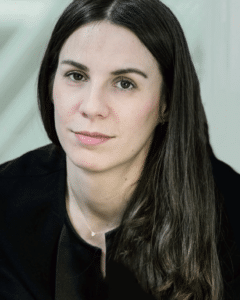
Albane Imbert is head of science technology platform, the Making Lab, at the Francis Crick Biomedical Research Institute in London. It provides technical expertise to the research laboratories at the Crick and other partner institutions. With her team, Albane Imbert designs new tools for researchers in order to answer complex research questions and speed up biomedical discoveries.
Can you provide a brief explanation of your work?
Albane Imbert. Our expertise ranges from microfabrication (at the cellular scale) as a way to regulate biological systems, to other fields like electronics and mechanics. We also use optics to measure biological activity and design devices to assist in biomedical imagery. In my lab, we use 3D printing technology on a daily basis to quickly manufacture functional prototypes. This collaborative work between researchers and our team is part of a worldwide trend which aims to adapt rapid prototyping technologies to research, and more specifically to the field of biology.
Are there major differences between modelling software programs used for additive manufacturing in industry, research, or domestic settings?
A wide range of 3D modelling software is available on the market. Each area (industry, design, architecture, animation, research…) has specific needs which require precise, and more or less complex, functionalities. The choice depends both on the application and the experience level of the user.
In addition to additive manufacturing, 3D modelling has become widely accessible. Today, many excellent software solutions exist for people who wish to better understand this process that are free and easy to use. But beware, even though using a 3D printer is relatively simple, it nevertheless requires a certain amount of time to master – it is not easy to get the hang of!
Except in particular cases, such as industry, 3D modelling and programmes running the manufacturing process are two very distinct steps, which rely on two different software programs. First, the modelling software. Second, the software that breaks it up into the segments. The latter, in particular, depends on the 3D printer used and sets the parameters for the printing process.
3D modelling must take into account the manufacturing method and the material used to make the object. For example, you will design objects differently that are made out of metal or plastic. Not only is the material different, but the chosen manufacturing technology comes with its own challenges, too. And in research it all depends on the needs of the laboratory!
In our field, we mainly focus on printing photosensitive resin on a small scale. It requires great precision, using materials which are biocompatible or resistant to chemical treatments. We also study the incoming and outgoing flow of liquids in parts and optimise our printable models so as to respect all these conditions.
For you, what is the future of modelling software? Will they become increasingly simple to use (especially for the general public) or are there still too many technical limitations?
The 3D printing sector has a bright future ahead of it, and the accompanying software as well. Faced with ever more specific demands, it will continue to specialise. In other words, they will grow more complex in terms of power and available options, while becoming easier to use. Today, interfaces are already much more practical than they were 10 years ago.
Technical limitations are due to machines. But here, again, private users benefit from a growing openness of additive manufacturing technologies, whose cost have considerably lowered these past few years. We now find high-quality 3D printers that cost as little as 500€. They are reliable, easy to use and can even compete with professional machines.
What risks does 3D printing represent in terms of counterfeiting or pirating?
Counterfeiting is a real issue that needs thorough reflection because 3D printing has the potential to disrupt the balance between industrial production and end users. But does that necessarily make it a bad thing? No, I don’t think so.
Last March, at the beginning of the Covid-19 pandemic, the Italian start-up company Isonnova made a name for itself with the general public by copying then distributing ventilator valves to hospitals because the company making them could not keep up with production. Their actions saved lives yet exposed them to possible lawsuits. Can we talk about counterfeiting in such a case? I think, on the contrary, that this tool improves a more equal balance between production lines and consumers. It gives end-users greater power over their environment by allowing them to produce what they need by themselves.
You can easily find the 3D model of an object that has already been created by another user using an open-access database on the Internet. Some companies have understood this and are playing along. They offer 3D models of their spare parts, making them available to repair ageing devices, and thus help in the fight against planned obsolescence.