Immersive 3D experience at the CNAM: witness construction of the Statue of Liberty




- To mark the 140th anniversary of the Statue of Liberty’s inauguration, the exhibition “Lady Liberty” will be held in September 2026 at the Musée des Arts et Métiers in Paris.
- Through an immersive experience, visitors will be able to observe the stages of the statue’s construction.
- To achieve this, the exhibition combines various 3D modelling techniques, notably photogrammetry and laser scanning.
- However, a new approach significantly improves the visual rendering of 3D scenes: 3D Gaussian Splatting.
- Today, companies in the audiovisual and video game sectors are rushing to test and develop their solutions based on this innovative technology.
140 years ago, the Statue of Liberty was unveiled in New York. To mark this anniversary, the “Lady Liberté” exhibition will open in September 2026 at the Musée des Arts et Métiers in Paris. Visitors will be taken behind the scenes of the construction of this colossal structure, designed and built in France. Combining physical sets and three-dimensional animations, the exhibition offers an immersive experience akin to virtual reality, but without the need for a headset. It thus illustrates the technological advances in the 3D modelling sector, which has been significantly revitalised, in particular by the rise of 3D Gaussian Splatting, a family of methods enabling highly realistic renderings.
3D reconstruction in the service of cultural outreach
Donated by the French people to mark the centenary of US independence (though delivered a full 10 years late!) and designed by the sculptor Auguste Bartholdi in collaboration with the engineer Gustave Eiffel in Paris, the Statue of Liberty is a feat of engineering. Comprising a copper shell resting on an internal metal framework, it stands approximately 46 metres tall. How was such a colossal monument, yet one with such precise physical proportions, created?
Visitors to the “Lady Liberté” exhibition will be invited to wander through a series of successive rooms in which they will observe the stages of the statue’s construction, from the drafting of the plans to the preparation of the ship setting sail for New York laden with the various parts of the structure. Throughout the exhibition, visitors will recognise certain iconic objects, such as the hand holding the torch, recreated in 3D.
And the exhibition takes the immersive experience even further: “In one of the rooms, the real setting of Bartholdi’s workshop blends with a projected backdrop: the sculptor appears and addresses visitors from a mezzanine via a 3D projection using a system combining two screens,” explains Hubert Naudeix, founder of Aristeas, the company responsible for the exhibition’s 3D reconstructions and animations. To create this scene, an actor was filmed in costume, then Auguste Bartholdi’s face, recreated from photographs, was integrated into the video using artificial intelligence techniques.
“It’s like a virtual reality experience, except you don’t have a headset; you’re partly in real settings. The video, lighting and sound must be perfectly synchronised,” he continues. Further on, visitors will find themselves “as if inside the statue: they will see all the metal plates being put in place, assembled…” adds Hubert Naudeix.
Traditional techniques are effective but have their limitations
The “Lady Liberté” exhibition thus combines various 3D modelling techniques. For example, two main techniques were used to reconstruct objects in 3D: photogrammetry and laser scanning. Photogrammetry utilises a series of photographs taken from different angles. Distinctive points are identified across the images, enabling the position of the cameras to be estimated and a point cloud to be reconstructed, and subsequently a textured mesh.
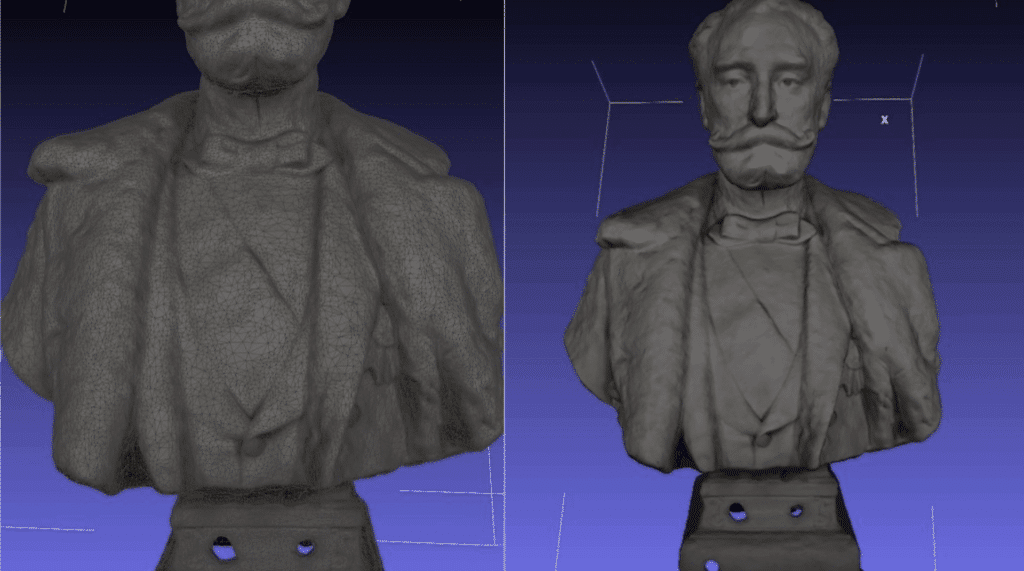
The underlying geometric principle is that of triangulation. Laser scanning, on the other hand, relies on the use of LiDAR (Light Detection and Ranging), which measures the distance between the sensor and visible surfaces by analysing the return of a laser signal. It thus produces a point cloud representing the visible surfaces of the object or scene.
Today, these techniques can be combined with artificial intelligence tools that optimise and accelerate the 3D reconstruction process. Nevertheless, photogrammetry and laser scanning have certain limitations. For example, “photogrammetry reconstructs geometry based on image correspondences. It can produce highly accurate models, but the result depends on the quality of the images, the texture of the surfaces and the ability to identify the same details across multiple images,” explains Marius Preda, senior lecturer at Télécom SudParis (IP Paris).
Furthermore, “translucent, shiny or highly reflective surfaces complicate the reconstruction, as their appearance varies depending on the viewing angle and lighting, and characteristic points are more difficult to identify consistently,” he continues. As for the laser technique, it is “often more geometrically precise, but data acquisition can be time-consuming and remains best suited to static objects or scenes; movement during capture makes reconstruction much more difficult,” adds the researcher.
A revolutionary technology in the experimental phase
A new approach is now making it possible to significantly improve the visual rendering of 3D scenes: 3D Gaussian Splatting. “A real revolution is underway!” enthuses Hubert Naudeix, who is eager to start using this solution, which is currently in the experimental phase. Combining cutting-edge computer graphics methods with machine learning techniques, the 3D Gaussian Splatting method achieves “optimal visual quality with a high level of detail,” explains the founder of Aristeas.
A level of visual realism that surpasses the usual standards of mainstream 3D. How? By using a different representation of the scene. Whereas photogrammetry often produces a mesh of triangles to which a texture is applied, 3D Gaussian Splatting represents the scene as a set of small “spots” called 3D “Gaussian primitives”. Each is described in particular by its position, size, orientation, opacity and colour. It therefore does not remove all geometry: rather, it replaces the triangular mesh with a volume representation optimised for rendering.
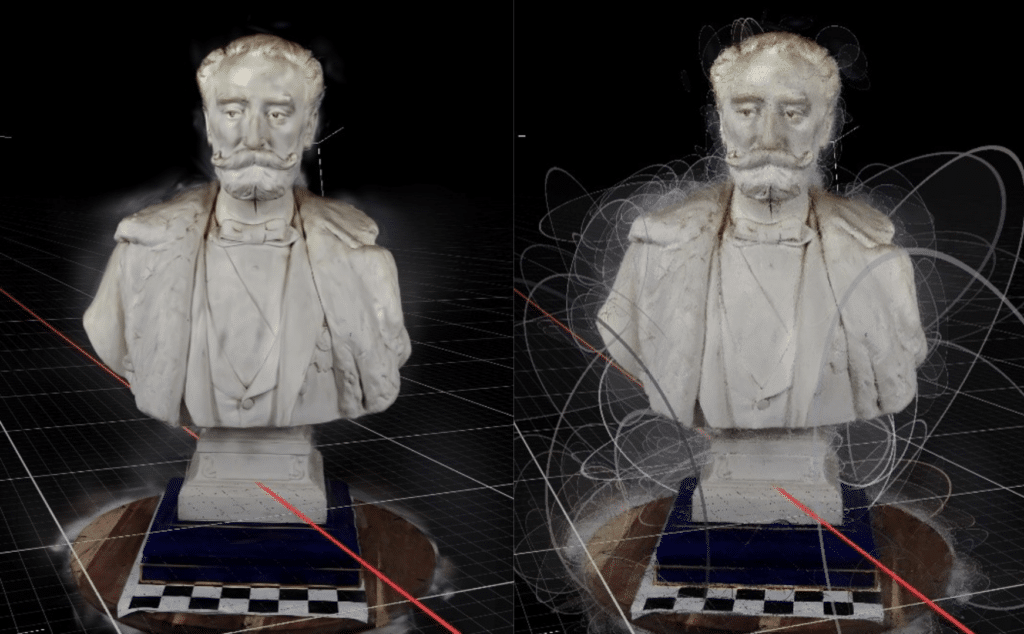
“It’s exactly the same principle as pixels in an image: you don’t see the pixels when you look at it, but if you zoom in, you see them side by side,” explains Hubert Naudeix. “The heritage object is thus visually reconstructed, and in a way that is very faithful to reality, particularly in terms of colour properties and textures,” adds Marius Preda. Whilst the principles of “splatting” and “Gaussian primitives” have long existed in computer graphics, 3D Gaussian Splatting is enjoying a resurgence of interest thanks to the work of Inria’s GraphDeco research team1, which, in 2023, proposed a method enabling real-time rendering.
Today, companies in the audiovisual and video game sectors are rushing to test and develop their own solutions based on this innovative technology. And with a view to democratising access to advanced 3D technologies, at Télécom SudParis2, Marius Preda and his team are experimenting with these approaches as part of the “Museum Metaverse” platform, to improve the visual quality of 3D heritage models and make these technologies more accessible to partner museums.
Through the “ICON” project, launched this year as a continuation of the “Museum Metaverse” project and scheduled to run for three years, the researcher aims to “accelerate the creation of content based on Gaussian Splatting, in line with scenography requirements.” This brand-new approach could address the major challenge facing museums: preserving the authenticity of the cultural experience in a virtual environment.