
Disabilities: rethinking inclusivity to avoid design-driven exclusion



- People with disabilities are three times less likely to receive a positive response to their job applications and 12% of them are unemployed, which is twice as high as the general population.
- Adapting the concept of ‘symmetry of attention’ to disabilities could make the response to needs more equitable.
- In industry, the problem is not the lack of specialised products for disabilities, but the fact that mainstream products create exclusion.
- Several limitations need to be addressed, including the under-representation of disabled workers in design services, the lack of a truly incentivising public policy, and inadequacies.
- An ‘Inclusive Designer’ label has recently been created and companies such as Apar, the Seb group, La Poste and Macif are already rethinking their products and services.
In Europe, one in six people aged between 16 and 64 have a disability or recurring health problem1, and 12% of people with disabilities are unemployed – which is twice the rate for the general population. According to testing carried out by APF France handicap and Université of Lyon 1 Claude-Bernard2, candidates with disabilities are three times less likely to receive a positive response to a job application than candidates who are presumed to be able-bodied. This demonstrates, if proof were needed, the need for disability policies in companies, the aim of which is to restore a degree of fairness to fundamentally unfair internal processes. These policies address internal processes, but what about external processes, those between the company and its customers?
The concept of ‘symmetry of attention’ postulates that a happy employee naturally provides better customer service3. This concept, which originated in the hotel industry, particularly within the Accor group, and is widely used in modern management, is based on the principle that taking care of employees improves customer satisfaction. Applied to disability, this principle should logically mean that if we take care of our employees with disabilities – with dedicated policies, workplace adaptations and trained advisors – we can expect, by symmetry, that the needs of customers with disabilities will also be taken into account.
However, the reality is different. While most large companies have a disability policy aimed at including disabled workers, far fewer have given serious thought to offering products and services tailored to their disabled customers4.
Exclusion through design
This asymmetry is strikingly evident in essential areas of everyday life. In industry, the problem is not the lack of specialised products for people with disabilities, but the fact that consumer products unintentionally create exclusion: packaging that is difficult to open, illegible information on containers, products that are unnecessarily complex, and touch screens without sensory feedback5. In the digital world, according to a 2024 study by Craftzing6 of 260,000 websites, 94% of European websites are inaccessible: insufficient contrast, images without text equivalents, even though some of the necessary adjustments are extremely simple to implement.
The situation is similar in the service sector. Services that are welcoming and adaptable to all types of profiles, without creating stigma, remain the exception. Every week, people with disabilities take to social media to share their anger about how they are treated on public transport, in shops, tourist attractions and government offices. Simple examples suffice to illustrate the problem: buses with broken ramps, insufficient in number for wheelchairs to board during rush hour; ticket machines without voice menus for the visually impaired; and public places without access ramps.
This exclusion is not anecdotal, as it affects 12 million people in France and 87 million in the European Union, not counting senior citizens (18 million people over the age of 60 in France), people with temporary disabilities, and situations of forced use that affect us all.
Where does this asymmetry in attention come from?
The fact that we take care of employees with disabilities while neglecting customers with disabilities reveals several flaws in the way disability is taken into account. First of all, disabled workers are under-represented in design departments7. But how can we design for everyone when teams do not reflect the diversity of users?
Secondly, there is a lack of public policy that provides genuine incentives. While the law imposes employment quotas and imposes financial penalties for non-compliance, there is nothing comparable for the accessibility of products and services, despite theoretical legal obligations on accessibility8. The inadequacy of coercive public policies is compounded by a misguided view of disability as a niche market. Companies ignore the economic potential of universal design, which benefits everyone: parents with pushchairs, delivery drivers carrying heavy loads, people who are tired or stressed.
Finally, the lack of user-centred approaches and feedback mechanisms exacerbates the problem. For example, the least connected users — and often those most in need — remain unheard in the design process. User testing, when it exists, paradoxically excludes those who would benefit most from adapted products.
Questioning this symmetry in organisations
However, several pioneering companies are showing another way forward: Aptar is revolutionising packaging with universal solutions, the Seb group is rethinking household appliances for all, and La Poste and Macif are adapting their services. The ‘Inclusive Designer’ label recently awarded to them by APF France handicap’s TechLab highlights their commitment and shows that another way is possible.
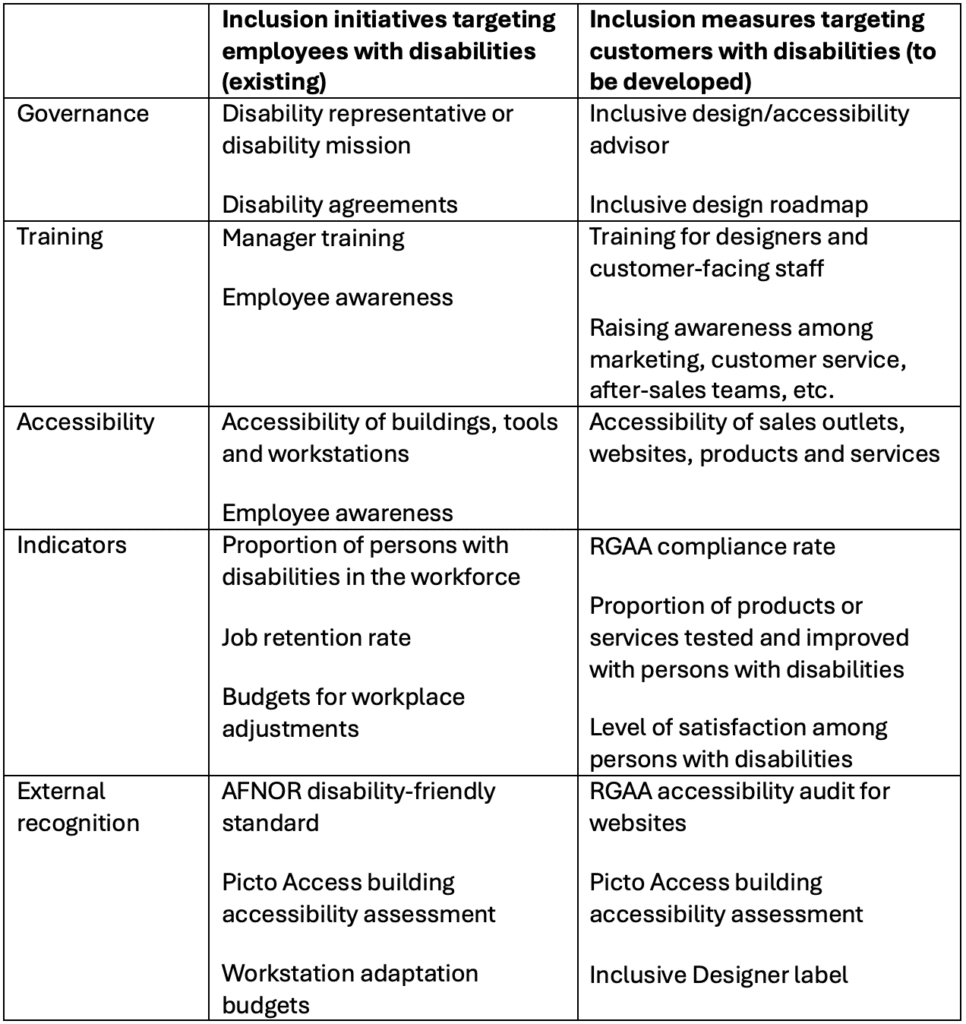
True symmetry of attention requires integrating the issue of accessibility of their products and services into companies’ disability policies. This requires concrete action:
- Training design teams in inclusive design,
- Creating accessibility indicators that are monitored as closely as employment rates,
- Involving users with disabilities in product testing,
- Standardising universal design approaches.
Beyond ethics, this is a major economic opportunity. Universal design, by expanding the use of products to everyone, multiplies the addressable markets. This has already been proven in the tourism sector, but it is also true in all areas that target the average consumer.