Geothermal heat: the great forgotten renewable energy


- Geothermal energy uses the heat in the subsoil: it is captured and used in the form of electricity or heat.
- It is particularly interesting for urban areas and will be an asset in the face of climate change.
- However, a very small proportion of heat consumption is supplied by geothermal energy in France: in 2021, it will amount to 1% of final consumption.
- This is because it is little known to the public and local authorities, and there are relatively few drilling companies in France.
- Thanks to the many projects that are being set up, Europe should see a 270% increase in geothermal energy consumption between 2019 and 2024.
What if France were to rely partly on geothermal energy to achieve carbon neutrality? Last February, the government presented an action plan to accelerate its deployment. The objective: “to produce enough heat in 15 to 20 years to save 100 TWh/year of gas, i.e. more than Russian gas imports before 2022.” The multi-annual energy programme aims to increase geothermal heat production facilities by a factor of 2 or more between 2016 and 2028.
Geothermal energy relies on the heat in the subsoil1: it is captured and used in the form of electricity or heat. Let’s take a look at heat production, the government’s objective.
Geothermal energy to produce heat
At a depth of more than 200 metres, low-energy deep geothermal energy – such as the Dogger aquifer in the Île-de-France region – consists of pumping and then reinjecting water from aquifers, underground reservoirs. It is heated by the natural decay of radioactive elements in the subsoil. High-energy deep geothermal energy, as in Soultz-sous-Forêts in Alsace, exploits the water naturally contained in fractured rocks. These sites are located in active volcanic zones or in collapse trenches (particular geological structures).
At a depth of less than 200 metres, surface geothermal energy exploits the inertia of the ground, which is almost unaffected by variations in atmospheric temperature: it remains constant at around 10–15°C in mainland France. The use of a geothermal heat pump (PACg) is necessary: it exploits the temperature difference between the surface and the subsoil. Heat is recovered by pumping (and then re-injecting) groundwater or by circulating a heat transfer fluid through a pipe in the hot ground.
Geothermal energy in France
In France, the heat produced by deep geothermal energy is mainly used to supply urban heating networks (currently 59) and is used in industrial processes (2 TWh in total) or to heat greenhouses. “With an ambitious deployment plan, it would be possible to produce around ten TWh of additional heat within 20 years,” adds Mikaël Philippe, head of BRGM’s Geothermal and Energy Storage unit. It is particularly interesting for supplying large conurbations: it requires the installation of a heating network and a power station nearby, with a surface area of around 2 000 m2. “There are many untapped aquifers with very interesting resources,” says Mikaël Philippe. “We are starting new exploration and research programmes to better assess their potential.” These basins are located to the west of Paris, in south-eastern France and in the Aquitaine basin. The limit? “Exploitation of the resource is only possible if it is appropriate to the need: the aquifer must be located near a highly populated area,” replies Mikaël Philippe.
Another potential to be developed is surface geothermal energy. It accounts for most of the geothermal heat produced in France today (4.8 TWh). “We estimate the potential to be reached within 20 years at 100 TWh, which is 10 times more than with deep geothermal energy,” says Mikaël Philippe. The major advantage? It is available over almost the entire French territory, unlike deep geothermal energy. “Surface geothermal energy is particularly interesting in areas with scattered, moderately dense housing,” adds Mikaël Philippe. “Its reversibility to produce cold, thanks to PACg, is a real asset in the context of climate change.”
What are the limits of geothermal energy?
However, a very small proportion of heat consumption is supplied by geothermal energy in France: in 2021, it will amount to 1% of final consumption2. Why? “It is little known by the general public, and local authorities,” describes Mikaël Philippe. “There are also very few drilling companies in the country. With the help of several organisations, we are working to remove these obstacles.” The investment costs are also high, even if the State supports its deployment through various schemes (Fonds Chaleur, MaPrimeRenov’, Coup de pouce chauffage). For a single-family home, Ademe estimates3 that the cost (excluding subsidies) of a PACg is €2,731 per year (including installation), compared with €2,236 for a gas boiler or €4,429 for electric heating. However, the calculation is different if the increase in the price of electricity, gas and wood is taken into account: geothermal energy becomes the solution with the lowest operating cost. For collective and tertiary buildings, surface geothermal energy is currently the most expensive solution.
In 2021, geothermal energy accounted for 1% of final heat consumption.
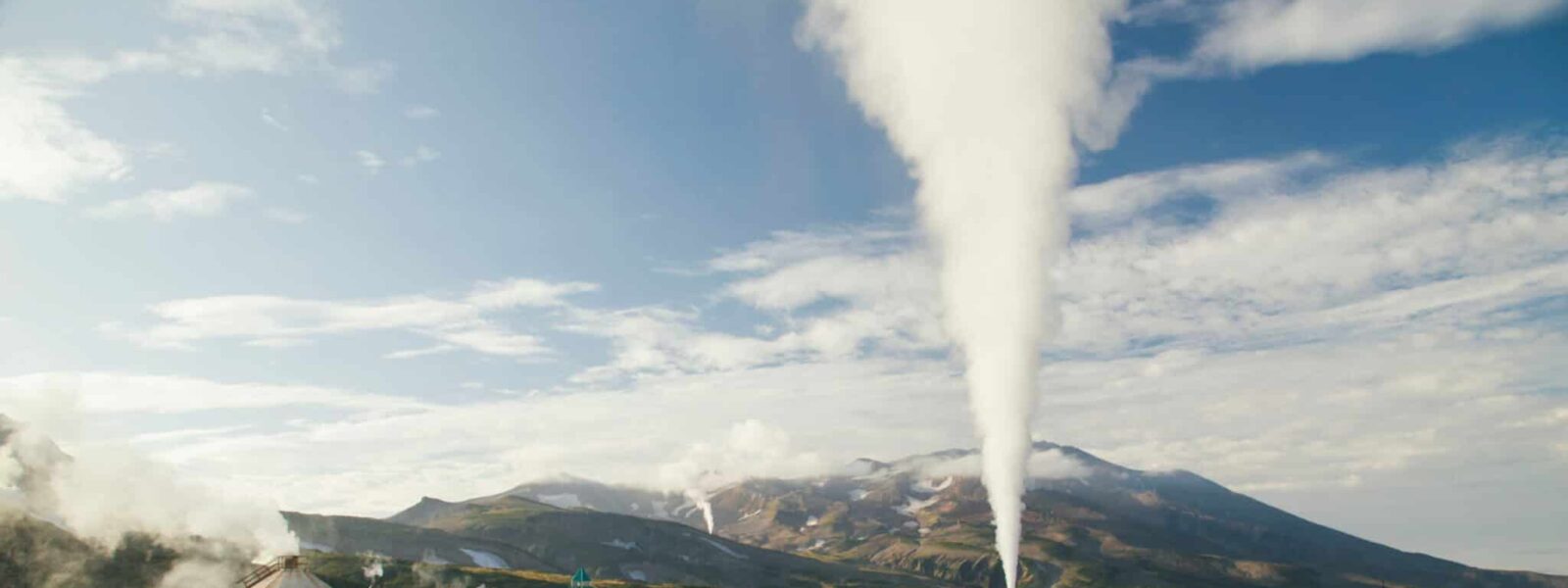
What about internationally? Everyone has in mind the images of power stations surrounded by steam in Iceland. By feeding a turbine, geothermal heat (above 110°C) is used here to produce heat and electricity in cogeneration. In 2013, 29% of Iceland’s electricity was produced using this technique and 45% of buildings were heated4. But Iceland is a model: worldwide in 2022, only 0.37% of the heat consumed is of geothermal origin5. French heat production amounts to 6.7 TWh, compared to 82.1 TWh on a European scale6 and 26,000 TWh on a global scale7. For electricity, the United States has the largest production capacity (2.5 TWh), followed by Indonesia and the Philippines8. In France, electricity production is essentially limited to the Bouillante plant in Guadeloupe (112 GWh/year) and the Soultz-sous-Forêts plant in Alsace (12 GWh/year).
“In France, we are seeing an acceleration in heat production projects, particularly for tertiary buildings and heating networks,” says Mikaël Philippe. According to the International Energy Agency, China and Turkey are responsible for most of the growth in geothermal heat production in recent years. In its projections, the agency estimates that Chinese growth should continue, but also notes that Europe is one of the most active markets: the continent should record a 270% increase in geothermal energy consumption between 2019 and 2024.
EARTHQUAKES RELATED TO DEEP GEOTHERMAL ENERGY
Deep geothermal exploitation is often accompanied by earthquakes. “This is a well-known phenomenon, and operators are obliged to monitor this seismicity,” reports Jérôme Vergne, a physicist at the School and Observatory of Earth Sciences in Strasbourg. The earthquakes measured are very often below magnitude 1.5 and are not felt by the population. “In some specific cases, a few earthquakes of a higher magnitude occur: for example, between 2019 and 2021, three earthquakes of magnitude 3 to 3.9 were recorded during the preparation phase of the Vendenheim very deep site, in the north of the Strasbourg Eurometropolis,” says Jérôme Vergne.
Most of the seismic activity is generated during the hydraulic stimulation phases: a mixture of water and additives is injected under pressure to improve the circulation of geothermal fluids in the reservoirs. “These reservoirs are naturally permeable due to pre-existing cracks and faults, natural fractures along which earthquakes can occur,” explains Jérôme Vergne. Injecting water modifies the pressures on these fractures and can generate seismic ruptures. These are called induced earthquakes. Sometimes larger earthquakes are recorded, such as the Pohang earthquake (South Korea) in 2017 with a magnitude of 5.4 (the largest associated with a geothermal project). “In this case, geothermal energy did not induce an unprecedented earthquake, but rather a triggered earthquake,” comments Jérôme Vergne. Geothermal exploitation accelerated the occurrence of an earthquake that would have taken place naturally later, it was the last straw. A prevention system – called “traffic lights” – is put in place for each high-energy deep geothermal project. In Illkirch-Graffenstaden and Vendenheim, it provides for the switch to reinforced vigilance as soon as an earthquake of magnitude 1.5 is recorded, and a gradual stop for any earthquake reaching magnitude 2.