Photovoltaics: what future can we expect for Europe?


- The global photovoltaic industry is currently concentrated in China. But the unprecedented growth of the market is opening up opportunities for European players, who are benefiting from three trends.
- After a long period of incremental progress, where the difference was only in price, technological accelerations are being achieved in Europe.
- In areas such as automotive, agriculture and construction, various niches could open the way to new market segments for highly differentiated products, far from the commodity logic that currently dominates.
- Finally, European regulations are evolving, with more focus on the life cycle assessment (less carbon-intensive production, recyclability), which is likely to change the situation.
In photovoltaics, what differences are there between offers other than on price?
It is true that, in terms of technology, the solar panel industry is currently characterised by a certain homogeneity. Most players use polycrystalline or quasi-monocrystalline silicon technology, implemented in different architectures.
This does not mean that there is no innovation, but rather that innovation has so far followed an incremental logic. The improvements are nonetheless significant over time, both in terms of performance and cost. Concerning the performance of devices: the first panel proper, developed in 1954 by Bell Labs (forty years after the first tests of silicon photovoltaic cells), had an efficiency of 6%. A few years ago, it was 13 or 14%, and today a good proportion of the solar panels on the market have an efficiency of around 20%.
The cost of solar panels has fallen by 80% in ten years for good, and bad, reasons.
As for the cost of panels, it has fallen by 80% in ten years, for good and bad reasons: the good reasons are technological progress and the scaling up of the energy transition. The bad reasons are massive subsidies, particularly in Germany, which instead of helping European industry to take off have led to industrial overcapacity and a price war in which only a few Chinese manufacturers have been able to survive; they now exert an overwhelming domination over the market. Today, price is the main criterion, well ahead of performance, both for installers of photovoltaic parks and for private individuals.
Does this mean that the game is up for the European industry?
No, for at least three reasons. The first is that the market is booming, and there is room for new players. We do not yet have the final figures for 2022, but in 2021, according to the International Energy Agency, world photovoltaic energy production increased by 179 TWh (i.e. + 22%), a record, to exceed 1000 TWh. This growth is driven by the Chinese market, followed by the US and the EU. According to the United Nations Net Zero scenario, an annual solar PV production level of about 7400 TWh will have to be reached in 2030. Starting from the current 1000 TWh, this implies an average production growth of about 25% per year during the period 2022–2030.
In this huge market, production in China will remain dominant, and we must look closely at what is happening in the US. But the growth of the European market will also be very important, which opens up prospects for European players to get back into the race because – this is the second reason – we are entering a phase of maturity of several technological innovations which, without being disruptive in the strict sense of the word, constitute decisive accelerations, with truly new technologies.
The most promising are the ‘tandem’ cells that combine silicon and perovskite. This makes it possible to better exploit the solar spectrum, adding ultraviolet light to visible light and infrared light (well captured by silicon). Such technology shifts the theoretical barrier that previously placed the maximum efficiency at just over 29%. It is now around 40%. In the laboratory, we are already going very far: last September, Dutch researchers succeeded for the first time in crossing the 30% efficiency threshold. Industrialisation is in sight: the IPVF, which brings together the strengths of many players (including EDF, TotalEnergies, the CNRS and the Ecole Polytechnique), is going to install the first production line in Alsace using this silicon-perovskite tandem technology with its industrial partner, Voltec Solar. Europe is therefore at the forefront of this breakthrough technology, both in research and development.
A third reason is that while the commoditisation of solar panels will continue, with standardised products, we are now also witnessing the development of a market with much more varied applications, driven by a logic of differentiation. I will give you three examples. The first is agrivoltaics, with semi-transparent panels that make it possible to optimise the association between crops and panels on shades. Here we are dealing with fine adjustments, as close as possible to the market, needs and weather conditions: commercially and industrially, there is room for differentiated products, supported by players capable of providing a service.
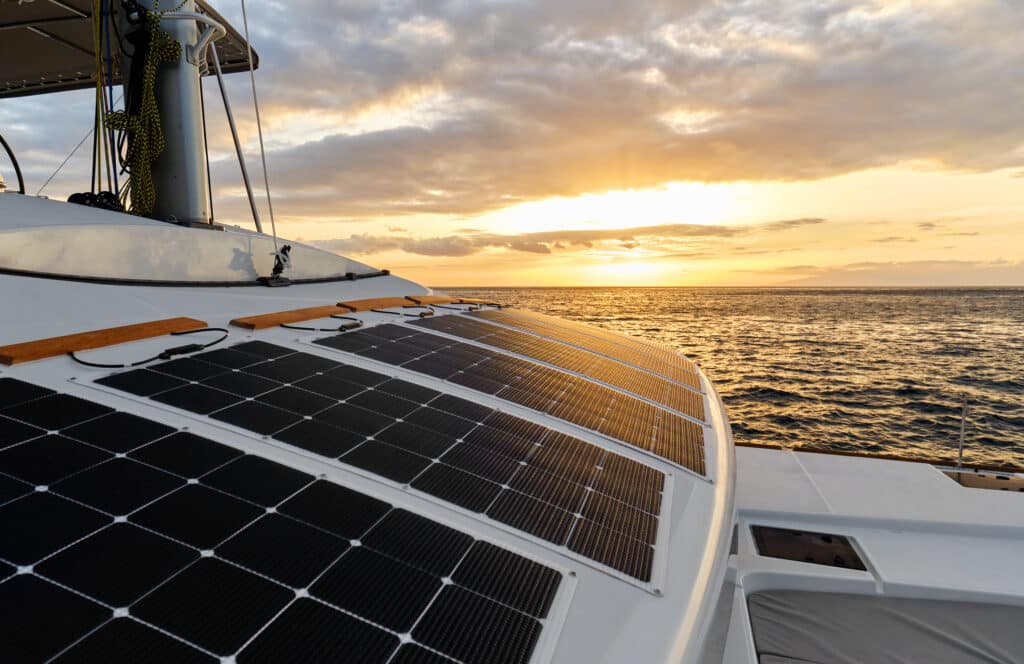
The second example is solar energy on vehicles. Today, this is a niche, with a few examples in the pleasure boat industry (the challenge: turning off the engine without turning off the air conditioning and the fridge). But the rise of electric cars is creating a massive need for solutions to cool the vehicle when it is stationary or, conversely, to keep the battery warm so as not to lose performance in winter. Solar energy is a good candidate: manufacturers and equipment suppliers have projects in the pipeline.
Encouraged by well thought-out regulations, industrial players will extend the value chain to the last part of the life cycle: recycling.
Third example: solar panels are good for buildings, but they are not very elegant. A market for solar tiles is emerging, which again will develop according to more local needs (not all tiles are the same, there are regional differences) and on the basis of aesthetic quality, from niches that will grow. Here again, there is room for agile and local players. Recently, we have seen the development of photovoltaic tiles with a design very close to that of traditional tiles.
Apart from these niche markets, which are set to expand, can we imagine game changers that would change the situation for the European industry?
Yes, particularly in the logic of the European Green Deal, which combines industrial policy and ecological requirements. In terms of photovoltaic panels, European standards and regulations have so far paid little attention to the life cycle issue. However, this will become increasingly important. Two points in particular could make a difference: the first is the amount of energy consumed (and CO2 emitted) to manufacture a panel. At present, the “energy return” of panels is not very good: a photovoltaic module has to run for about two to three years to compensate for the energy needed to manufacture it. Moreover, those manufactured in China have a carbon footprint that is not very traceable, and probably not very good. A regulation emphasising this dimension would change the situation.
In the same spirit, another aspect of the life cycle is likely to become more important: recyclability. This could encourage a form of circular economy, as soon as, encouraged by well thought-out regulations, industrial players extend the value chain to this last part of the life cycle. Here again, it is at the regional level – that of the EU – that this integration between industry and services will be most relevant.