
Wired for change? Road transport electrification across the Global South




- Road transport alone accounts for 12% of global greenhouse gas emissions.
- In Africa, it is two- and three-wheeled vehicles that are most suited to electrification.
- In South-East Asia and Africa, electric car charging is based on the “battery-as-a-service” model: the user owns the vehicle, but not the battery.
- Electrification is driven by two distinct trends: shared mobility platforms (such as Grab) and international donors (such as the World Bank).
- In Kenya, the electrification of minibuses, viewed negatively by drivers, has increased women’s access to jobs in public transport.
Transport is a sector that emits particularly high levels of greenhouse gases (GHGs): road transport alone accounts for 12% of global emissions1. CO2 emissions from developed economies (mostly located in the Northern Hemisphere) have been plateauing for the past decade. In contrast, those from emerging economies, although lower, are constantly rising.
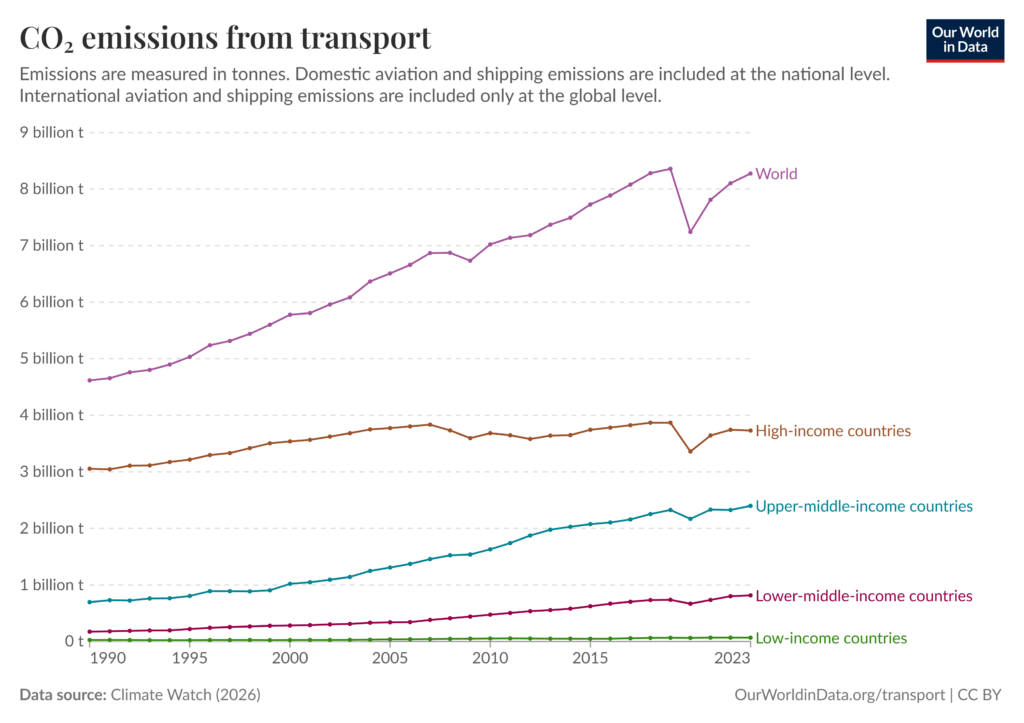
Sales of electric vehicles continue to grow worldwide, accounting for over 20% of car sales in 2024. However, this growth is now largely driven by China and other emerging markets in Asia and Latin America3. Is this the start of transport electrification in the Global South?
Yao Tsoekeo Amedokpo. Our work focuses on Africa and Asia. In Africa, vehicle electrification is indeed a relatively recent phenomenon: the first significant initiatives date back to 2008, before seeing rapid growth a decade later, in 2019. The Covid-19 crisis slowed the momentum, before a new surge. Electrification affects all types of vehicles, from bicycles to buses, but two-wheelers and three-wheelers are by far the most affected [editor’s note: for example, 46% of three-wheelers sold in Asia in 2022 were electric4.
As for usage, there is a clear predominance of electric vehicles in commercial transport, unlike in Northern countries. Electric cars account for less than 1% of car sales in Africa. Conversely, in China, the adoption rate of electric cars is very high, with nearly 50% of sales in 2024.
This trend towards the electrification of two- and three-wheeled vehicles is very different from that in Northern countries. What explains this?
Manon Eskenazi. In Asia and Africa, two- and three-wheeled vehicles are the most widely used motorised vehicles. It therefore makes sense that electrification should focus primarily on these. The other major difference concerns charging management. In France, for example, the roll-out of charging infrastructure has been a major obstacle to the development of electric cars. In South-East Asia and Africa, the model is based on “battery-as-a-service”: the user owns the vehicle, but not the battery. All they need to do is visit a station to swap the battery, which is much quicker than waiting for a full charge.
YA. By making batteries available on a subscription basis, operators have managed to reduce costs: the price of an electric motorbike is now comparable to that of its combustion-engine equivalent. This business model has encouraged the roll-out of electric two-wheelers.
And what about commercial transport, are the same factors driving the electrification of vehicles?
ME. Electrification is being driven by two different trends. On the one hand, ride-hailing platforms (such as Grab) have become a real driving force behind the electrification of two-wheelers by favouring drivers using electric vehicles. On the other hand, when it comes to public transport, projects are funded by international donors (such as the World Bank). Their decision-making power is therefore significant: they are increasingly making their funding conditional on the electrification of fleets. As a result, several electric public transport services have been developed in recent years: the Bus Rapid Transit system in Dakar, the Liên Ninh electric buses in Hanoi, and the upcoming Bus Rapid Transit system in Abidjan.
Do governments not have a role to play in the transport transition?
YA. We have begun mapping public policies across the African continent. Several African governments are starting to incorporate measures to support the transition to electric mobility: putting it on the agenda with roadmaps; national electromobility strategies; or even isolated measures, for example, in finance laws.
Analysis of these measures reveals a scattered and incomplete set of measures, primarily focused on tax incentives: exemptions from import duties, VAT or excise duties aimed at reducing the cost of electric vehicles. These measures appear to point to two distinct policy trajectories. On the one hand, fleet policies are characterised by support for imports and the gradual electrification of vehicle fleets (Togo, Benin). On the other hand, industrial policies aim to localise part of the added value of the transition (South Africa, Nigeria, Kenya).
ME. In South-East Asia, there is also a drive to strengthen independence by moving away from fossil fuels. These countries are particularly affected by current conflicts, and electrification represents a major geopolitical issue for them. Some states, such as the Philippines and Indonesia, are already implementing sovereignty measures relating to mobility.
YA. This is also the case in Africa, where some countries are adopting an increasingly systemic approach. In certain countries that generate hydroelectricity or are heavily dependent on oil imports, policies are being implemented to develop renewable energy and electric mobility: Nigeria, Ghana, Rwanda, etc.
Ultimately, the carbon footprint of transport is relatively low in the Global South. Is the sector’s transition really a major issue?
YA. Yes, and for several reasons. We have already mentioned the importance of energy sovereignty for these countries. But we can add to that a crucial health issue. African cities face significant levels of air pollution due to ageing fleets of combustion-engine vehicles. Electrification is therefore a key lever for improving public health.
Finally, the climate benefits are real. The electrification of transport forces countries to produce more electricity, pushing them towards policies to develop renewable energy. Added to this is the growing carbon footprint of transport in the Global South, driven by the recent emergence of the middle class. This is a pivotal moment, and it is important to act now.
Can electrification be an opportunity for sustainable development in the Global South?
YA. Yes, absolutely. With the global rise of electrification, African countries are looking to capitalise on the added value of the transition. This involves reorganising the vehicle value chain, from manufacturing right through to maintenance. Finally, on a small scale, electrification can halve operating costs for motorbike taxi drivers. This is a real opportunity for citizens.
Editor’s note: A recent World Bank report analyses the economic benefits of electrifying transport in developing countries. Through targeted investments, improved financing models and strategies to relocate industries, the report notes that electric transport can create jobs, strengthen the economy and support sustainable, inclusive growth5.
ME. Some local stakeholders have also seized upon the electrification of public transport to increase the number of women in the sector through training in electric vehicles. In Kenya, for example, whilst public transport is perceived as a very male-dominated profession, the electrification of minibuses is viewed negatively by drivers. This has enabled women to access these jobs.