Remote monitoring: how to better care for patients at home



- Monitoring of cancer patients at home during treatment is necessary and remote monitoring can be used to help improve this approach.
- CAPRI, a remote patient monitoring application, allows patients to be accompanied at a distance by providing answers to any questions they may have.
- The tool allows the patient to get in direct contact with nursing staff who can provide necessary information easily.
- Several benefits emerge such as constant monitoring of the patient, which makes it possible to assess necessary dosages of treatments.
A person suffering from cancer must often begin a difficult and lengthy course of treatment. This period, which can only be stressful for the individual, is necessary for the care of the patient, but leads to many inconveniences. In addition to the risks of unjustified hospitalisation, the effects of toxicities linked to treatments and the way the disease develops are major issues for quality of care.
In oncology, the doses prescribed are sometimes high and the patient does not always cope with the side effects. Monitoring of patients during treatment, far from the hospital at home, is therefore necessary. Today, a new field is emerging that can counteract these drawbacks: remote monitoring. It can be applied to many diseases, offering the possibility of remote medical monitoring via digital communication.
Remote monitoring is a promising field that is attracting a lot of investment from start-ups, but very few studies are available on the benefits of this type of monitoring. With my team, we therefore carried out a randomised controlled trial 1, on a sample of 559 cancer patients – of all cancer types – to test the effectiveness of remote monitoring for a chronic disease, along with a longitudinal study.
CAPRI, a tracking application
Treating cancer requires regular visits to the hospital. The patient is therefore often in an environment that is specialised to their needs. Oral treatment limits these visits, but once back home, there is a kind of disconnection that takes place due to a lack of information. This can lead to a feeling of abandonment for the patient so, in order to provide the most appropriate response, we conducted a preliminary survey to find out what elements were missing in this long-distance relationship.
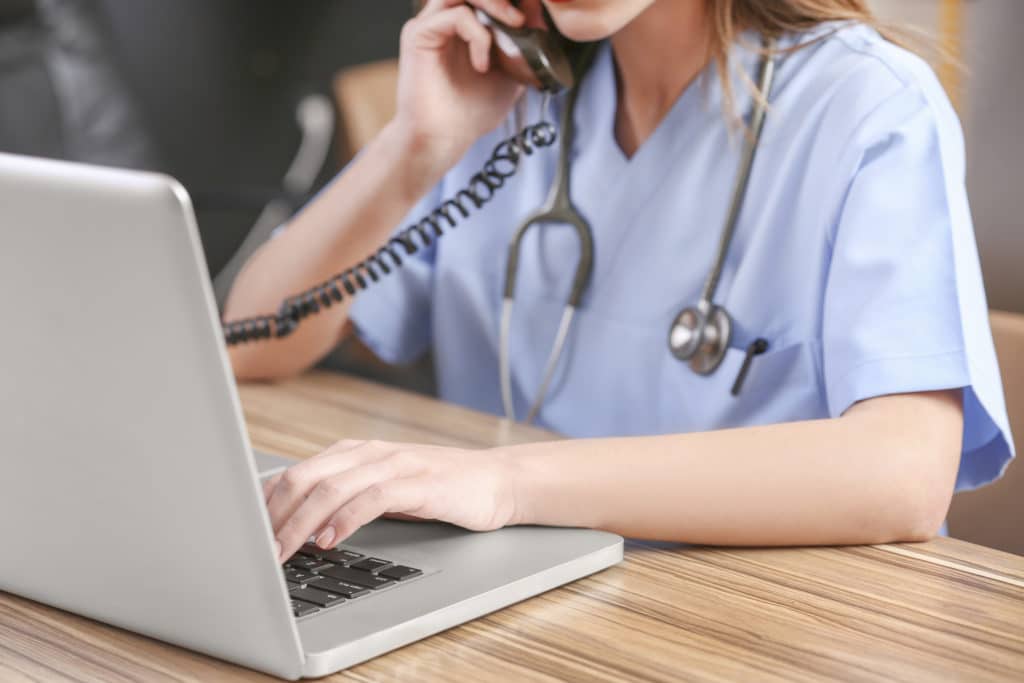
CAPRI, a remote patient monitoring app, was developed from this survey. It is simple to use and allows patients to get in touch directly with the medical staff to answer their questions and manage treatment. In our study, where the communication system was mixed, CAPRI allows bilateral or symmetrical communication – two coordination nurses are in charge of the digital interactions, further completed with telephone calls where necessary.
To evaluate and respond to requests in an efficient manner, the nurse is accompanied by 80 decision trees. Digital technology is therefore only the tip of the iceberg; the way the information is processed by the nurses is essential for good follow-up care. This is in contrast to many existing applications, which evaluate but do not guide the patient in his or her journey. During the study, 77% of patient requests were directly processed by the nurses without going through the referring oncologist. This is, of course, due to a large number of questions that do not require in-depth knowledge of the disease. For example, “can I go swimming with the treatment?”. But has the direct effect of relieving the already overly heavy workload of the referring oncologist and validates the relevance of the decision tree available to nurses.
A more than beneficial treatment
To ensure the effectiveness of this type of follow-up, we established a randomised controlled sample of 559 patients analysed including the patient in the CAPRI group or the control group (usual care).
Several benefits of this type of remote monitoring device are apparent. Constant monitoring of the patient limits the difference between the dose necessary to treat the patient and the dose initially prescribed (this is called the relative dose intensity). Moreover, this type of monitoring system helps to prevent the toxicity effects associated with the treatments. This is a fundamental benefit, because toxicity, when it becomes severe, is often irreversible for the patient. Secondly, there is a reduction in hospital visits. With remote monitoring, patients are, on average, hospitalized 1.5 days less than in the control arm. In addition, they visit the emergency room less often. Lastly, patients expressed more positive experiences.
These benefits obviously come from the follow-up care, but behind it, there is the significant amount of work that the coordinating nurses provide. This leads to the question: how many patients per year can be followed by a nurse? According to our study, it would be about 125 to 150 patients over the year. For this, they work full-time, sometimes under extreme conditions. They play an exceptional role in remote monitoring, and it is their investment in this follow-up that makes a real difference.
Finally, our results lead us to say that this type of monitoring works. We believe that it is the whole design that worked: the organisation adopted by the nurses and the omnipresence of digital technology. This type of system design is the result of shared clinical and management science expertise. With these solutions already in place, the design could be reproduced for other types of follow-up care.