Three possible ways of turning back the clocks of ageing


- Scientists now understand better than ever the fundamental biology of what causes us to grow old and, most excitingly, how we can slow down or even reverse these biological changes.
- The study of telomerase a major aspect of the ageing research around ageing. An idea is to extend telomeres to revert cells to a more youthful form.
- Another theory is to remove “senescent” cells (responsible for ageing) so that we may live longer and younger.
- Finally, a solution could be cellular reprogramming, which consists of taking any cell from our body and converting it into a “pluripotent cell” to replace damaged ones.
Many of us think of the ageing process as a fact of life. As humans, our risk of death rises by 10% each year thanks to the ever-ticking biological clock of the ageing process. Older people are more likely to suffer from diseases like cancer and dementia, more likely to be frail, lose their sight, hearing or memory, and much more besides.
However, this process may not be so depressingly inevitable as we usually imagine. Scientists now understand better than ever the fundamental biology of what causes us to grow old1 and, most excitingly, how we can slow down or even reverse these biological changes.
Here are three ideas to watch which could one day soon be turning back your biological clock.
1. Telomerase: revitalising our DNA
One of the best known areas of ageing research is studying ‘telomeres’: protective caps which ensure the integrity of the ends of our DNA. However, many cells in our bodies are constantly dividing: tissues like our skin, our blood and the lining of our guts need to be constantly replaced due to wear and tear, and freshly divided new cells replace the old-timers. And unfortunately, cellular division comes at a cost to our telomeres: they get shorter every time a cell divides.
The longer you live, the more times your cells will have divided, and the shorter your telomeres will be on average. And measuring telomere length isn’t just a roundabout way of determining how old you are—telomeres seem to have a causal role in ageing too. Shorter telomeres make age-related diseases more likely, and slightly morbid studies of identical twins have found that the one with shorter telomeres is likely to die sooner.2
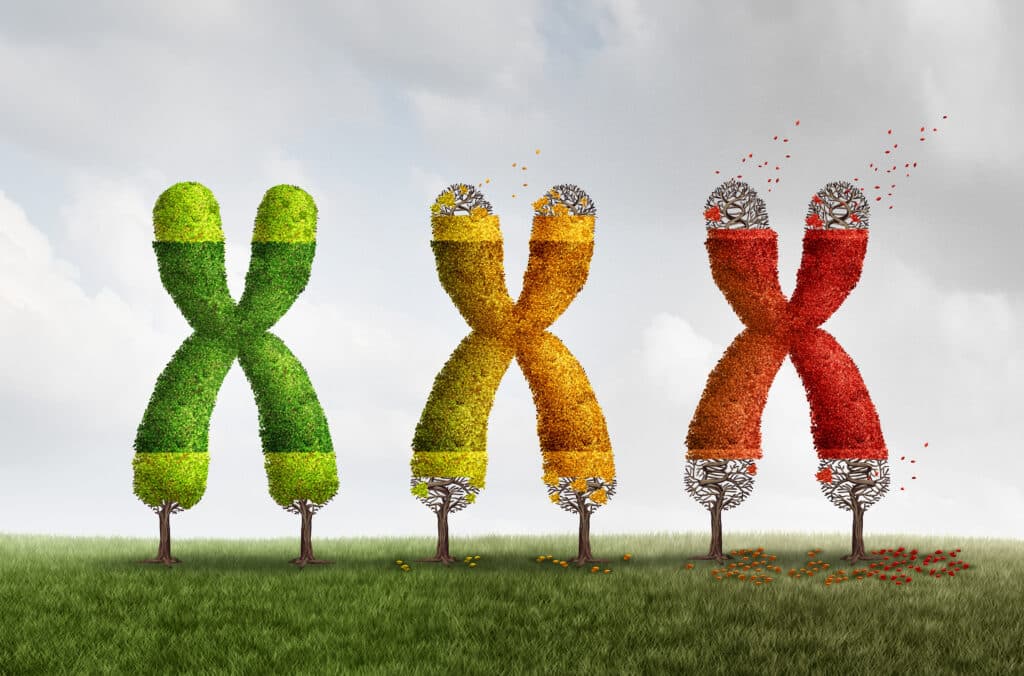
Scientists in the 1990s were thus very excited by telomerase: an enzyme which can extend telomeres and, perhaps, make cells more youthful at the same time. Unfortunately, its tenure as the immortality enzyme didn’t last long: experiments in mice showed that telomerase did indeed give their cells the potential to divide far more times—at the cost of massively increasing the risk of the deadly disease for whom excessive cell division is its modus operandi: cancer3.
Luckily, not all researchers abandoned telomerase as a potential therapy. In the last ten or fifteen years, scientists have shown that it can extend the lives of mice if coupled with measures to reduce the risk of cancer, or if used intermittently rather than activated continuously as it was in early experiments.
The next step will be to try some of these ideas in humans4.
2. Senolytic treatments: killing aged cells
As we grow grey and wrinkled on the outside, so too the cells that make up our insides grow old. As we age, some of our cells become ‘senescent’ — the scientific word for aged — and, in doing so, they can accelerate the ageing of the rest of our body too. We now understand that senescent cells aren’t just benign bystanders in the ageing process, the cellular equivalent of candles on a birthday cake, but emit a toxic cocktail of molecules which can increase the risk of heart disease, cancer, cognitive decline, and much more besides.
The good news is, it might not have to be this way. Scientists have come up with a number of different ways to kill these cells, while leaving the rest of the cells in the body intact. The idea furthest along in development is ‘senolytic’ drugs, the first of which were discovered in 20155, and several of which are already in human clinical trials.
A 2018 study6 showed the wide-ranging effects of giving senolytics to old mice: the animals lived longer, which is a good start, but they also lived younger, with less chance of disease, less frailty (measured by performance on tiny mouse-sized gym equipment, from treadmills, to tightropes, to wires to hang from), improved cognition, and even better fur! This suggests that senescent cells aren’t just responsible for a single aspect of ageing, but have effects on many or even all of its facets—meaning that removing them could have widespread preventative medicines for many different diseases.
There are currently over two dozen companies aiming to commercialise senolytic treatments7, from drugs, to chemicals called peptides, to encouraging our immune systems to clear up these aberrant cells. This diversity means we’ve got a lot of options in case some approaches don’t work out—and means that senolytics are a strong contender for our first true anti-ageing treatment.
3. Cellular reprogramming: turning back the biological clock
Its name makes it sound like science fiction — and, once you hear what it actually entails, it only sounds moreso — but cellular reprogramming is probably the hottest idea in ageing biology right now, with enormous potential to improve our health. The question is, do we know enough to get it from science fact in the lab, to workable medical technology in the real world?
The technique was first discovered in the mid-2000s8, when Japanese scientist Shinya Yamanaka was trying to work out what enables cells in the embryo to grow up into any kind of cell in the body, from heart, to skin, to brain. He found that a combination of just four genes, now known as the ‘Yamanaka factors’, was enough to revert any cell in the body to this ‘pluripotent’ state, meaning that they could turn into any type of adult cell. I could take a skin cell from your arm, use these genes to turn it into a pluripotent stem cell, and then ‘differentiate’ that stem cell into any kind of cell I liked.
Yamanaka received the Nobel Prize in 2012 for this discovery, and it was around this time that we realised quite how extensively this process of inducing pluripotency turns back the clock in cells. Not only does it wind back the developmental clock, reverting the cell to a pluripotent state, but it also seems to reduce the biological age of the cells, making them younger and healthier in a number of different ways.
Turning all our cells into stem cells would be a terrible idea — I’m quite fond of my brain cells being brain cells, thanks very much — but the good news is, if you activate the Yamanaka factors intermittently rather than continuously, a cell can shed a few years of biological age without turning into a different kind of cell9. Doing exactly this has been shown to improve the health of mice with a disease that causes them to age prematurely, and regenerate tissues in adult mice that would normally only heal properly before birth, not in an adult mouse.
The promise of this approach made headlines when billionaires including Amazon founder Jeff Bezos created a $3bn startup called Altos Labs10 and recruited a number of the top scientists working on reprogramming, including Yamanaka, to work on turning this idea from great news for mice, to great news for people. The question is whether we can move this from a phenomenon observed in genetically modified mice in the lab to us unmodified humans walking around in the wild—and $3bn may just be enough to find out.
Contributors
Andrew Steele
After a PhD in physics from the University of Oxford, Andrew Steele decided that ageing was the single most important scientific challenge of our time, and switched fields to computational biology. After five years using machine learning to investigate DNA and NHS medical records, he is now a full-time writer, author of Ageless: The new science of getting older without getting old, presenter and campaigner.