Geothermal lithium: a resource for the future?




- Lithium is an essential resource for the ecological transition, but today no European country exploits it industrially.
- Paradoxically, the continent is home to a natural lithium reserve (nearly 5 million tonnes) that it does not exploit.
- In France, a type of reserve never yet exploited in the world as an industrial level exists – lithium from geothermal waters.
- It is a strategic resource with many benefits: ready to use, renewable with lower environmental impact.
- To extract lithium from these deep waters, several technologies are being developed and tested in France and Europe.
- However, while the technologies are progressing, no industrial exploitation exists today.
Essential to the energy transition, lithium is such a precious resource that it has been dubbed “white gold”. In 2022, it was mostly extracted by three countries: Australia (47% of global production), Chile (26%) and China (17%)1. Two-thirds of the lithium produced worldwide is then processed in China. Lithium is a metal considered critical by the European Union: the clean energy sector – in particular lithium-ion batteries in electric vehicles – is very dependent on this raw material, although it is mainly imported.
To date, no European country exploits lithium industrially. Resources are estimated at about 5 million tonnes, or 6.9% of the world’s resources2. Also, France has a reserve never exploited industrially before in the world – lithium naturally present in geothermal waters.
Where does the lithium from our batteries come from?
Worldwide, two modes of lithium production are used. In Australia, for example, lithium is recovered by mining in lithium-rich rocks, spodumene pegmatites. It is found elsewhere in the world in granites or clays. Lithium can also be recovered from brines – salt water – naturally rich in dissolved lithium. This is particularly the case in Chile, where salt lakes called salars are exploited. The production resembles that of salt: water is transferred to salt marshes until evaporation. Physicochemical processes are then used to produce lithium carbonate from these concentrated brines.
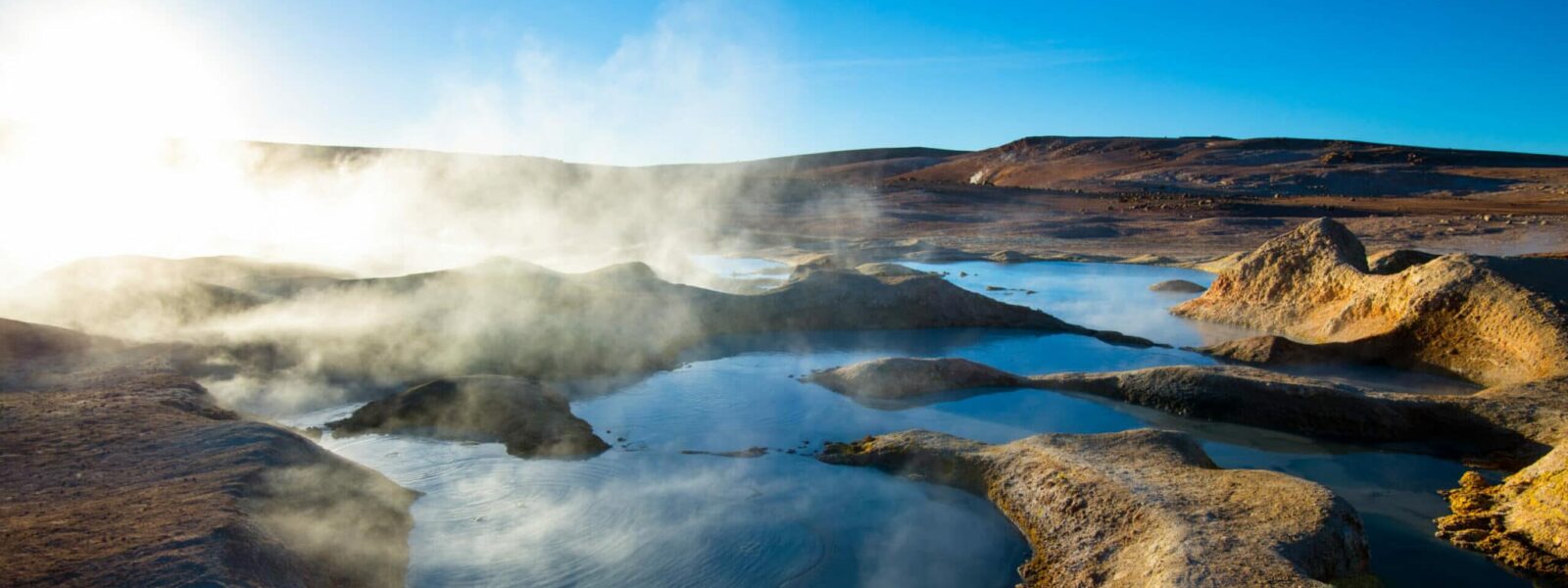
In a geothermal power plant, naturally hot groundwater is pumped, energy is recovered – to provide heat or electricity – and water is finally re-injected. A high amount of lithium has been detected in some geothermal reserves. In eastern France, the Soultz-sous-Forêts power plant exploits saltwater containing 200 mg of lithium in each litre of water3. “Geothermal lithium is in an active system, where geothermal waters circulate and recharge with lithium,” said Ghislain Trullenque. “The difference with conventional mining is fundamental: it relies on old geothermal systems that are now far from the heat source, and are therefore fossil reservoirs that cannot be recharged.”
To recover lithium from deep warm water, several innovative technologies currently exist. In France, the mining group Eramet and IPF Energies nouvelles have developed a technology for direct lithium extraction since the 2010s. It has since been optimised for geothermal lithium recovery as part of the EuGeli research project. “A lamellar material made of aluminum hydroxide allows to adsorb [fix on the surface] lithium chloride”, explains Arnaud Baudot. Thanks to the prototype, the first kilograms of European lithium from geothermal water were produced4. Since the end of 2023, an extraction pilot has been installed at the Rittershoffen geothermal power plant to test the efficiency of the process in real conditions.
“Lithium from these processes has the quality required for the manufacture of batteries”, stresses Arnaud Baudot. In Germany, Vulcan Energy is testing a similar technology. Another existing process is ion exchange technology, which acts as a filter within which lithium-rich water circulates. The French company Geolith is testing this process on a semi-industrial scale in Cornwall, UK. “A few other initiatives exist in Europe but also in the United States,” adds Baudot. “France is very advanced in the field thanks to an ecosystem of innovative companies very active in the field of lithium mining and refining.”
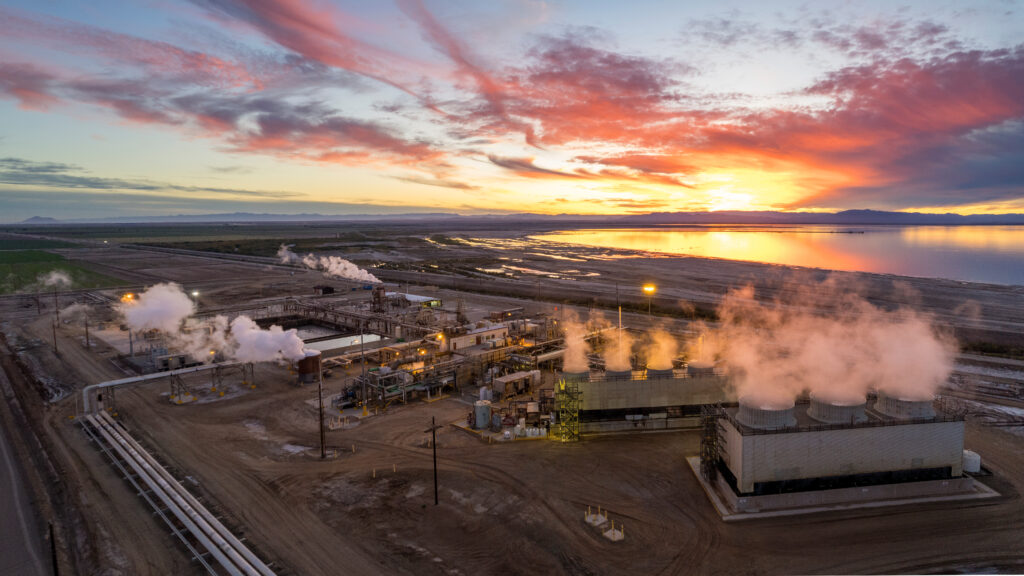
However, even though technologies progress, no industrial exploitation exists today. “Geothermal lithium has many advantages,” says Yannick Peysson. “One of them is being ready to use.” No need to send the raw material to China for refining, as is the case today for lithium extracted from brines or rocks. Another benefit is less environmental impact. “It is enough to add a set of modules on the existing geothermal power plants,” points out Ghislain Trullenque. “And even if a new power plant is to be installed, the surface impact is considerably less than conventional operations, where millions of cubic meters of rock are excavated, and large evaporation ponds created. All the pumped water – unfit for consumption – is injected back to its original level to allow it to recharge to lithium.” Renewable geothermal energy is also being considered as the main energy source for lithium surface treatments. Arnaud Baudot adds: “The exploitation of lithium in evaporation ponds consumes 250–450 m35 of water per tonne of lithium produced. This figure is 150 m3 for rocks and falls to a few dozen m3 for geothermal sources.”
A strategic resource with many advantages
With the needs increasing considerably, geothermal lithium has become a strategic resource. Lithium consumption in the energy sector tripled between 2017 and 2022, mainly due to the explosion in electric vehicle sales. The International Energy Agency (IEA) estimates that demand will increase 3.5‑fold by 2030 and 9.5‑fold by 2050 if states meet their announced climate commitments. Do we have enough geothermal lithium resources? Eramet aims to produce enough lithium to produce 250,000 electric vehicle batteries per year. “There is no complete global inventory, and a minimum lithium concentration must be considered for the operation to be profitable,” says Yannick Peysson. “Today, this minimum concentration is considered to be about 100 mg per litre of water.” A partial assessment of 48 regions around the world suggests that geothermal lithium resources are of the same order of magnitude as salt flats and rocks6.
“The big question of the moment – which several research consortia are working on – is whether the exploited waters can recharge sufficiently quickly in lithium,” points out Yannick Peysson. As lithium is exploited, the underground water tank will become depleted in lithium. This imbalance will cause an alteration of the rock in which these geothermal waters circulate, which could then be enriched again with lithium. “The operation of these active systems offers the unprecedented potential of a lithium-recharging tank,” concludes Ghislain Trullenque. “ It is essential to better characterize these recharge processes in order to establish sustainable and sustainable exploitation of these reservoirs.”