


Making it to the podium can be a matter of mere hundredths of a second. To maximise the chances of winning medals, a great number of factors must be optimised. Rémi Carmigniani and his team’s research focuses on so-called “rowing” water sports: swimming, rowing, canoeing, and kayaking. In these disciplines, athletes use an oar to move at the water/air interface – in swimming, this oar corresponds to the hand and forearm.
Speed-cadence relationship
To vary their average speed, swimmers rely mainly on the speed of execution of a periodic movement with their arms, called cadence. The higher the cadence, the higher the average speed. To study this relationship in swimming, a test is carried out in a pool: a progressive 10 × 25 m with a start every three minutes. The cadence and speed are measured at each run. In swimming, speed evolves as does the cadence at high speeds1.
The aim is to improve understanding2 of the evolution of speed as a function of cadence and to relate it to the power delivered to the arms to move forward. For the time being, macroscopic measurements (average speed, average cadence, and total force in the so-called tethered stroke) have been made, but these will be followed by measurements of the dynamic forces at the level of the hands using strain gauges and of the kinetics of the movement with inertial measurements. A general model to explain the different regimes observed will then be proposed. This project is supported by the EDF Foundation.
During the so-called active phases, the swimmer’s body is subjected to additional resistance forces that generally increase the resistance in the water3. For example, during a wave, due to the deformation of the body, the swimmer must fight – in addition to the passive resistance of the undeformed body – against an additional force that is also quadratic with speed and depends on the shape of the wave. In swimming, in contrast to other “rowing” sports, the swimmer is both the shell and the oar.
A classification and quantification of the different forms of active resistance for rowing sports is underway.
Integral monitoring of swimmers
This project started in 2018 in the framework of the ANR NePTUNE (ANR-19-STHP-0004). The particularities of swimming are the absence of equipment (no boat hull or oar, just the athlete’s body) and the presence of the water/air interface making the use of equipment complex. This equipment can include inertial units (small waterproof boxes the size of a €2 coin containing gyroscopes and accelerometers that are attached directly to the swimmer) and force sensors. They can interfere with the swimmer’s stroke and even affect the way they feel…
One of the main subjects is the study of the swimmer’s start and the optimisation of his trajectory.
To support these instruments, the INSEP pool has been equipped with twenty cameras (which film at a frequency of 50 Hz). Ten are placed on the surface every five metres and ten underwater. The data captured by these cameras is used by machine learning programmes to monitor the swimmers. The force measurements are used to explain the observations by physics and to find parameters to characterise the position of the swimmer as well as his speed and acceleration.
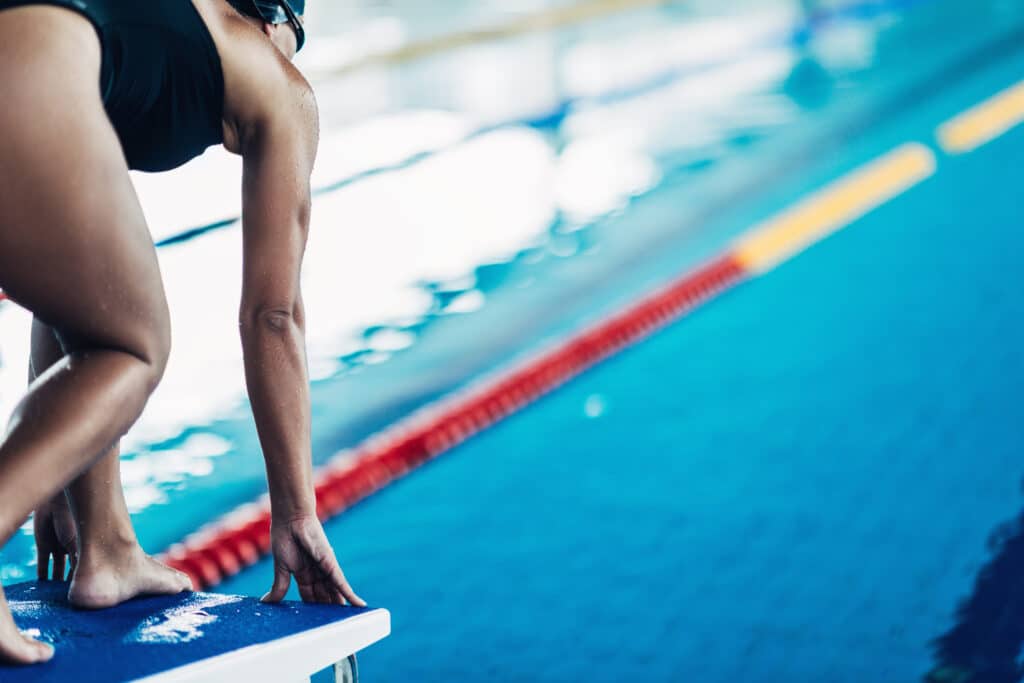
One of the main topics is the study of the swimmer’s start, and the optimisation of its trajectory. The start can be quite complicated to optimise: the swimmer starts out of the water on the pad, then breaks through the surface at a high speed relative to the swimming speed, sinks underwater by about one metre before resurfacing, and all this over a characteristic time of five seconds and a horizontal distance of 15 metres.
For the first part, try to understand the best take-off angle the swimmer should have when leaving the pad. The aerial trajectory that follows until the swimmer enters the water is less interesting from a physics point of view, as it can be described by the classical equations of free fall (air friction is negligible). What is important in this phase is the orientation that the swimmer will manage to give to his body to enter the water by turning around his centre of mass.
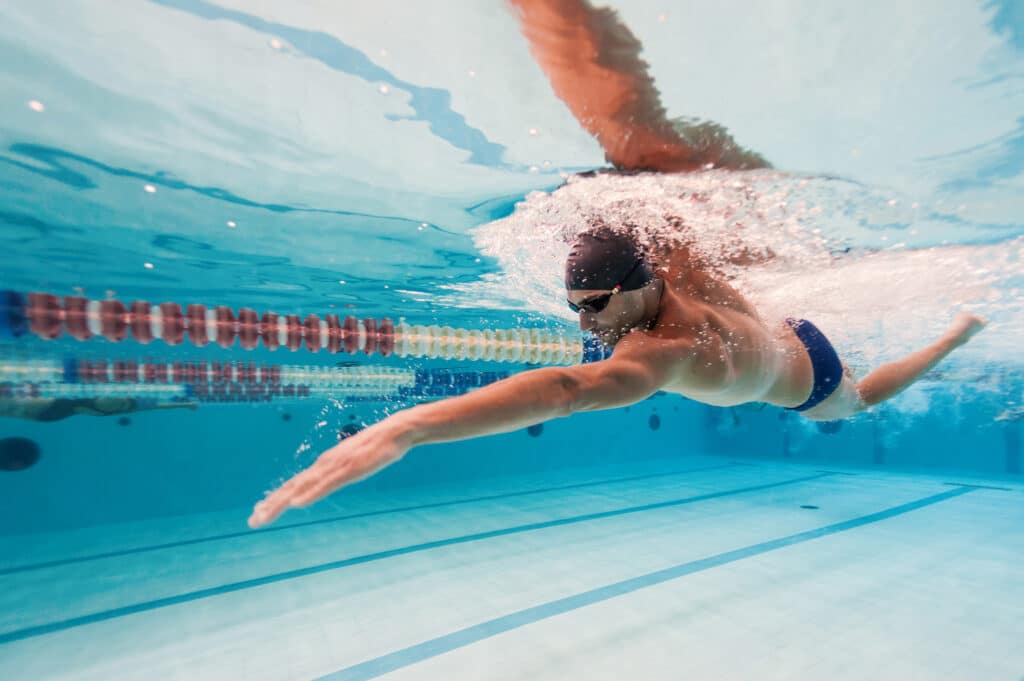
Remember: by propelling himself, the swimmer generates additional resistance! The speeds in this phase are high (nearly 4 m/s). You should not trigger undulations too early at the risk of penalising yourself with greater resistance and finally braking harder while trying to accelerate. But be careful, waiting too long can also be problematic as you risk sinking further and having to cover a greater distance to return to the surface.
In general, in the front crawl, swimmers trigger undulations when they reach the lowest point at the apex of their trajectory. This gives them zero vertical velocity. The situation is different in the backstroke: they start in the descent phase, as they start with much lower speeds.
How does the swimmer manage his trajectory?
The final objective of this project, the thesis work of Charlie Prétot, who is a member of Rémi Carmigniani’s team, is to help swimmers optimise their trajectory over the first 15 metres (the length over which swimmers are allowed to be under water in competition) at the start and at the turns. Should you go out a bit before the 15 metres? Maxime Grousset, runner-up in the 100 m freestyle at the last World Championships, who has been monitored for about a year as part of this project, has shown that his best start occurs when he comes out of the water between 11 and 12 m. This project aims to help him improve his turn trajectory as well. Since the start of the project, more than 300 starts and turns have been analysed on about 20 swimmers.
Since the beginning of the project, more than 300 starts and turns have been analysed on about 20 swimmers.
For the video observations, the swimmer is tracked using several markers on the skeleton: head, hands, shoulders, sternum, elbows, wrists, knees and ankles. A neural network was developed to automatically track starts, turns and swimming for the first 15 metres.
Swimming in the Seine river
In view of the open water swimming events that will take place in the Seine in 2024, several projects are focusing on this discipline. An analysis of the interaction of swimmers in an 80 m long canal in Chatou is underway. The aim of this project is to understand using scale models how, depending on the position of the swimmers, the wakes they create influence other swimmers nearby. As in cycling, in this type of race, swimmers can take advantage of the competitors’ suction to save themselves or even disturb another swimmer. This work is being carried out by Baptiste Bolon, a research engineer in Rémi Carmigniani’s team.
Another project also aims to provide information to the swimmers of the French open water team on the expected race conditions: flow speed in the Seine and water temperature. For speed, this is the first time an Olympic race has been held in a river since the reintroduction of open water races in Beijing in 2008. For the temperature, it influences the equipment (neoprene or fabric wetsuit) and on the period of training two weeks before the race. This work is being carried out with Marion Cocusse, a student at École des Ponts and is supported by the EDF Foundation.
SCIENCES2024
This work is carried out within the framework of the national project SCIENCES2024 which is a collective project in basic sciences (mechanics, physics, mathematics) dedicated to solving problems identified with sportsmen and women to support them in their quest for medals at the Paris 2024 Olympic and Paralympic Games. It is co-supervised by two Grandes Ecoles, École Polytechnique (IP Paris) and École des Ponts, and conducted with the French Rowing (FFA) and Swimming (FFN) Federations. These projects are linked to two Priority Research Projects (PPR) for very high level sports: ANR-19-THPCA2024 and NePTUNE (ANR-19-STHP-0004).