


Aurélien Houard is coordinating an EU-funded consortium that includes three Swiss institutions – the University of Geneva, the University of Applied Sciences and Arts, and the École Polytechnique Fédérale de Lausanne (EPFL) – as well as TRUMPF Scientific Lasers in Germany, André Mysyrowicz Consultants and ArianeGroup. The team has developed a laser filamentation technology capable of deflecting the path of a lightning strike, work that could lead to better lightning protection for critical infrastructure such as airports.
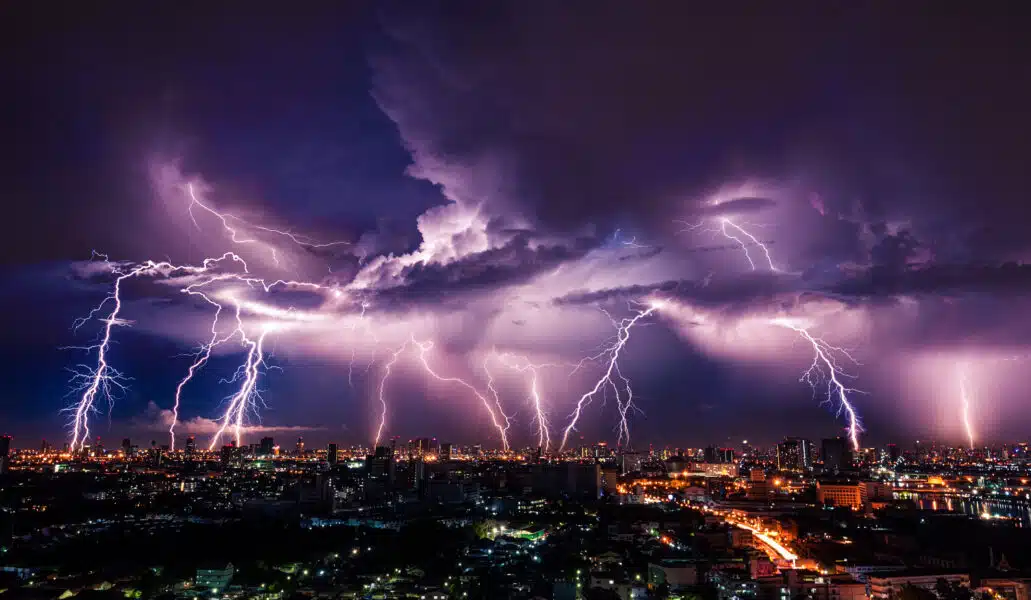
Lightning is a major natural hazard and is estimated to cause between 6,000 and 24,000 deaths per year worldwide. Lightning also causes power outages, forest fires and damage to electronic equipment costing billions of euros each year.
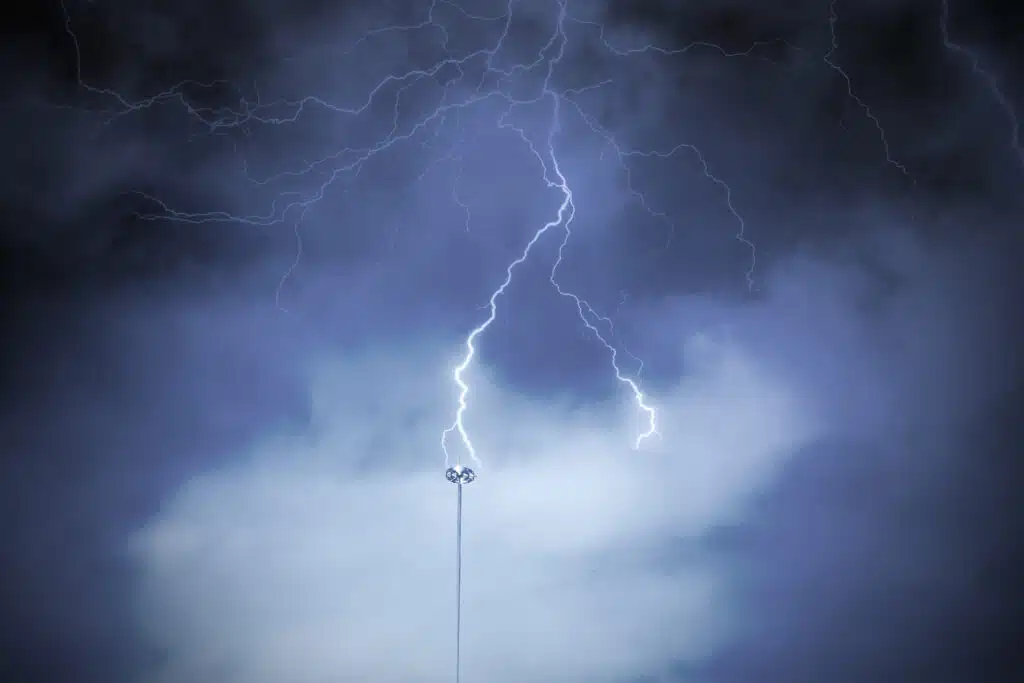
A lightning bolt forms when the turbulent air of a thundercloud violently disrupts the ice crystals and water droplets it contains, tearing electrons from their atoms to create a plasma (an ionised gas). This process creates areas of opposite electrical charge that can connect discharging electricity as they do so.
Today, the most common method of lightning protection is still provided by a 300-year-old concept invented by Benjamin Franklin: the lightning rod. This conductive metal antenna provides a preferential point of impact for lightning discharges and guides the generated current safely to the ground. However, this type of lightning conductor offers only limited coverage – over a radius roughly equivalent to its height. Furthermore, these structures only protect against the direct effect of lightning and, by attracting lightning strikes, they can even increase indirect effects such as electromagnetic interference and power surges on electronic equipment.
A “mobile” lightning rod on the Säntis mountain
Scientists have been thinking about using intense laser beams as alternative types of “mobile” lightning conductors as early as the 1970s, when the first long-pulse lasers able to guide megavolt discharges a few metres in the laboratory were developed. But it was the development of intense femtosecond pulse lasers, enabling the generation of long plasma filaments, that revolutionised the field in the 1990s. The idea: these laser beams are fired towards a cloud. Very intense filaments of light are then formed in the beams and ionise the nitrogen and oxygen molecules in the air, thereby creating free electrons. Since the long filaments of ionised air are more conductive than the surrounding areas, these channels create a path along which the electrical discharges of the lightning flash can travel.
Aurélien Houard and colleagues successfully tested their idea in the summer of 2021 in the Swiss Alps – on the Säntis mountain in North-Eastern Switzerland, to be exact. The 2,500-metre-high mountain is a hot spot for lightning, with more than 100 strikes recorded each year on the 124-metre-high communications tower at its summit. The researchers set up their laser near the communications tower, which took four years of development and laboratory testing and emits picosecond laser pulses with an energy of more than 500 mJ at a rate of 1000 pulses/second.
Thanks to the laser, the protection radius was increased from 120 m to 180 m around the tower.
During their experiments, which lasted three months, the tower was struck by at least 16 lightning strikes, four of which occurred when the laser was switched on. The researchers were able to divert these four lightning strikes using the laser. They were also able to record the trajectory of one of the strikes using two high-speed cameras. The recordings revealed that the lightning tracer initially followed the laser path for about 60 m before reaching the tower, which means that the protective radius increased from 120 m to 180 m around the tower.
The immediate applications of this technology would be to protect critical infrastructure such as airports, launch pads, nuclear power plants, skyscrapers and forests from lightning. The laser lightning conductor would be switched on when needed during thunderstorms and when a thundercloud was detected
“The LLR laser lightning rod project was initiated by my team and that of my Swiss counterpart, Jean-Pierre Wolf at the University of Geneva,” says Aurélien Houard. “We have been working on the subject of laser filamentation and laser lightning conductors for more than 20 years. It was the success of our laboratory experiments and the fact that we had access to a new laser technology capable of producing ultrashort, intense laser pulses with a rate of 1,000 laser shots per second that encouraged us to launch the project.”
A highly collaborative project
The technology itself was developed by TRUMPF Scientific Lasers, based in Munich. “We turned to them and asked them to make the most powerful laser that was possible with their technology, and we ordered a 1‑Joule-laser. We then formed a consortium with Swiss lightning experts at the EPFL, with Prof. André Mysyrowicz, who had initiated the project 20 years ago and intervened here in a consultant capacity, and ArianeGroup.” The latter is directly interested in this type of system for the protection of airports and of course the Ariane rocket.
In addition to the fact that the laser is more powerful than any the team had access to before, the site they chose for their experiments was also crucial. “The Säntis mountain is one of the most lightning-struck sites in Europe. Also, lightning always strikes in the same place there, so it’s ideal for the type of experiment in which we wanted to maximise our chances of the laser interacting with the lightning. Lightning experiments are very complicated, it can take months or even years for a lightning bolt to strike a particular spot,” explains Aurélien Houard.
The laser itself is expensive, so the consortium applied for funding from the European Commission. “This was a long process because the funds we applied for are for collaborative research (requiring at least three countries and three partners) and for so-called ‘breakthrough research’ that can benefit society.”
“To apply, we had to demonstrate that the laser could control electric discharges in the laboratory over several metres, which we did successfully,” explains Aurélien Houard. “However, we were not sure that the technique would work over much longer distances, as is the case with natural lightning, because the values of the electric fields are completely different.”
Efforts that paid off
At the start of the project, TRUMPF’s development of the laser took two years because it turned out to be more difficult than the researchers had originally thought. They then had to test the device and make sure it was capable of producing filaments over distances of 100 metres. But when they wanted to start their experiments, the Covid epidemic arrived, and the researchers had to stop everything. “We had to postpone the whole campaign for a year, which meant finding additional funding,” recalls Aurélien Houard.
The difficulties were not only financial but also practical. It was a matter of bringing a laser that weighed five tonnes and was nine metres long to the top of a mountain. “The summit was only accessible by cable car and we had to dismantle the laser to get it there. Once up there, we had to build an infrastructure to house a telescope that would focus the laser in the atmosphere. This required multiple helicopter trips and hoping for good weather conditions – not too much wind and snow – so that we could install all our instruments. It then took us about a month to get everything working.”
Lightning experiments are very complicated. It can take months or even years for lightning to strike a particular spot!
The team also had to obtain permission from the local authorities before firing its laser into the air: a 5‑km-wide no-fly zone had to be organised each time the laser was activated. Their efforts paid off though: “We were lucky enough to observe the lightning deflected in two distinct photos at the same time – which is rare, as clouds on top of mountains often conceal lightning. We detailed these observations in Nature Photonics and our publication attracted a lot of media interest.”
However, there is still a lot of work to be done, according to the researcher. “While we have been able to show that a laser beam can deflect lightning, we cannot yet easily quantify that the protection provided by the laser is equivalent to that of a conventional Franklin-type lightning rod. To do this, we need to be sure that when the laser is turned on, the lightning will want to pass through the path traced by the beam filaments.”
“Franklin lightning rods have been around for hundreds of years and have been extensively tested and modelled, but our laser is new, and we don’t yet understand all the physics behind it,” concludes Aurélien Houard.
Isabelle Dumé
Références
- https://llr-fet.eu
- https://www.epjap.org/articles/epjap/full_html/2021/01/ap200243/ap200243.html
- https://www.nature.com/articles/s41566-022–01139‑z