


Biomimicry is becoming increasingly popular in biomedical research. It permeates both fundamental biological research and the development of medical technology. Here are a few examples.
A new turning point for restorative medicine, which is on the way to becoming regenerative, i.e. truly capable of restoring biological tissues and their functions. The aim is to reproduce living organisms and their processes, in other words to develop a biomimetic approach to medicine. This is combined with another approach, bioengineering, at the intersection between materials science and the biological sciences. Catherine Picart, head of the Biomimetics and Regenerative Medicine team in the Biosanté Unit at CEA Grenoble, is using these tools to create biomaterials to repair bone tissue, in collaboration with maxillofacial surgeons at Annecy hospital. The aim is to provide the damaged bone with an environment in which it can rebuild itself. To do this, the team designs biomaterials containing bone growth factors. They are 3D-printed and a biomimetic film, known as an “osteoinducer”, is applied to encourage bone regeneration.
New concepts
These biomaterials are polymers that resemble the extracellular matrix, the biological gel found between animal cells. This cross-linked polymer is composed of hyaluronic acid, a polymer found in the skin and capable of forming very thin films on which growth factor, the protein that controls bone growth, can be deposited. The film is deposited on the surface of a porous biomaterial produced by 3D printing. The cells adhere to it and fill the spaces, producing bone. This was demonstrated in rodent models in 20161.
This approach has also proved its worth in large animals (pigs, sheep) with bone defects in the jaw and leg23. In humans, this type of malformation currently requires several bone grafting operations. With the concept of bone regeneration, it could be as simple as grafting synthetic bone and leaving it to rebuild itself.
This technique has the advantage of producing a customised, made-to-measure restoration. The 3D mould controls the shape and porosity of the restored bone, while the surface film defines its quantity and the speed at which it grows back.
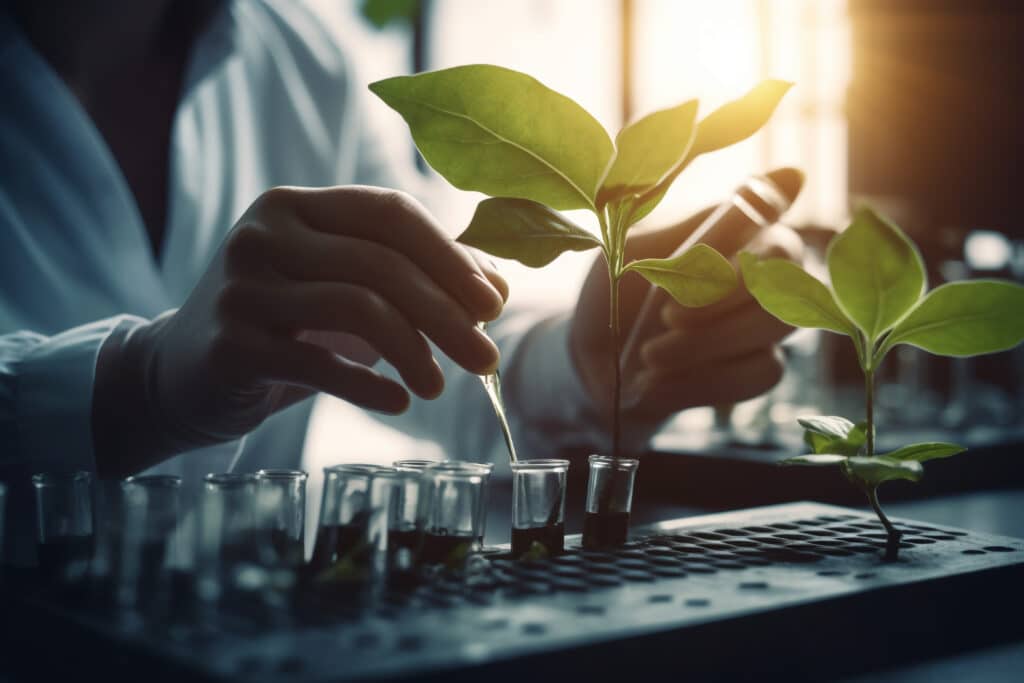
In addition to this biomimetic approach, another focus of the team is to understand how these artificial matrices, combined with growth factors, act on cells. In particular, the aim is to reproduce in vitro the control they exert over cell communication and tissue formation4.
The difficulty with this work is that the rigidity of the surfaces affects the response of the cells. The Grenoble researchers have therefore developed an approach using flexible biomimetic films that are less than two micrometres thick. The films are deposited on 96-well plates, commonly used in biomedical research. Each well can therefore constitute an experimental condition, and 96 experiments can be carried out simultaneously, each with different matrix or growth factor compositions.
This approach provides insights into the molecular mechanisms of bone tissue formation, which may be useful for the clinical approach to bone repair.
New tools
Biomimicry also makes it possible to create new medical tools, particularly for surgery. There is a whole range of medical technologies that seek to reproduce the properties of certain animal or plant species. One such example is surgical needles5 inspired by parasitic wasps, developed by the universities of Delft and Wageningen. Ultra-thin, these needles are made up of seven independent rods that ensure the elasticity and strength of the system.
Also in the field of surgery, researchers at the American University of Illinois have created a suction cup inspired by the octopus6 and designed to transfer delicate tissue during transplants. This system uses the electrothermal properties of a polymer to reproduce the delicate suction of the tentacles.
Surgical adhesives are another very promising field of biomimetic tools. French company Tissium7 appears to be one of the most advanced in this field. The Paris-based company has reproduced the properties of a marine worm, Phragmatopoma californica, which builds sand castles to house its colonies. A water-resistant cement ensures the solidity of the edifices. A property that is of great interest to the surgical community.
From fundamental research to medical technology, the concept of biomimicry is driving medical innovation. A study8 by the Indo-British strategic analysis firm Precedence Research estimates that the biomimetic medical innovation market will be worth more than 33 billion dollars in 2022 and could reach 65 billion dollars in 2032. These estimates are undoubtedly based on a broad definition of biomimetic innovation, but they point to a trend in which a great deal of research will be entering the market in the next few years.