
Carbon footprint: how to minimise the impact of everyday journeys outside major cities



- In France, road transport is the main source of greenhouse gas emissions.
- Passenger journeys, in particular, accounted for 23.5 % of national GHG emissions in 2023.
- A key lever for climate action lies in addressing medium-distance daily journeys, those between 10 and up to 100 km from home.
- 71 % of journeys are for distances of less than 10 km; of these, at least 53.7 % are made by car.
- Reducing transport’s carbon footprint requires electrification, but also more fuel-efficient driving (reducing driving speeds, eco-driving, etc.), higher occupancy rates, a shift in transport modes and a reduction in transport demand.
In France, road transport is the main source of greenhouse gas (GHG) emissions1. The primary cause is passenger journeys, which accounted for 23.5% of national GHG emissions in 20232. Between 1960 and 2023, these emissions increased 4.5‑fold due to the very sharp rise in demand and the prominence of cars and aeroplanes in these journeys.
So, given the urgent need to reduce greenhouse gas emissions, which levers should be pulled? The answer is clear: all of them. Every GHG emission avoided helps to limit global warming, but whilst they are too often overlooked by the media, daily medium-distance journeys, between 10 and 100 km, are a particularly important lever for climate action (see Figure 1). “These long daily journeys are a key factor in the transport sector,” explains Aurélien Bigo, “they account for nearly half of the GHG emissions linked to travel by the French population.”
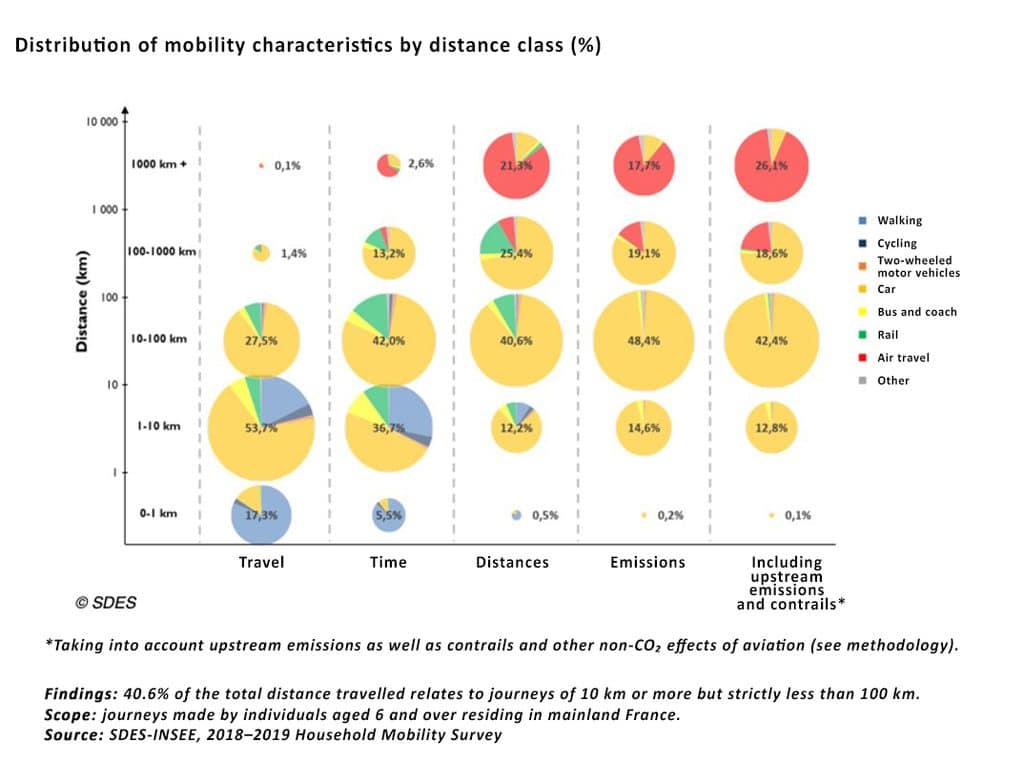
These journeys account for only a small proportion of journeys made by the French population: 27.5%. By comparison, 71% of journeys are for distances of less than 10 km. Their significant climate impact is due to their distance and, above all, the mode of transport: they are made almost exclusively by car, a mode of transport that emits high levels of GHGs, particularly when powered by internal combustion engines.
These medium-distance journeys (10 to 100 km) have another distinctive feature. According to the latest INSEE survey on personal mobility (2018–2019)4, they are predominantly undertaken by residents of rural and intermediate-sized municipalities. As a result, these residents account for three-quarters of GHG emissions linked to passenger transport, even though they represent only 61% of the population.
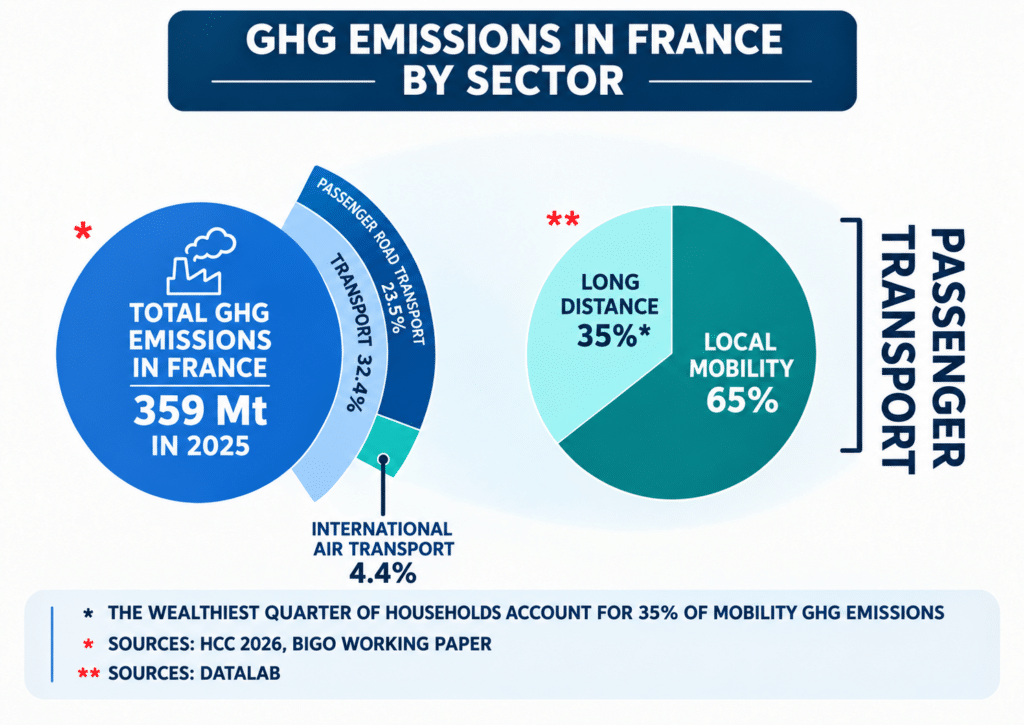
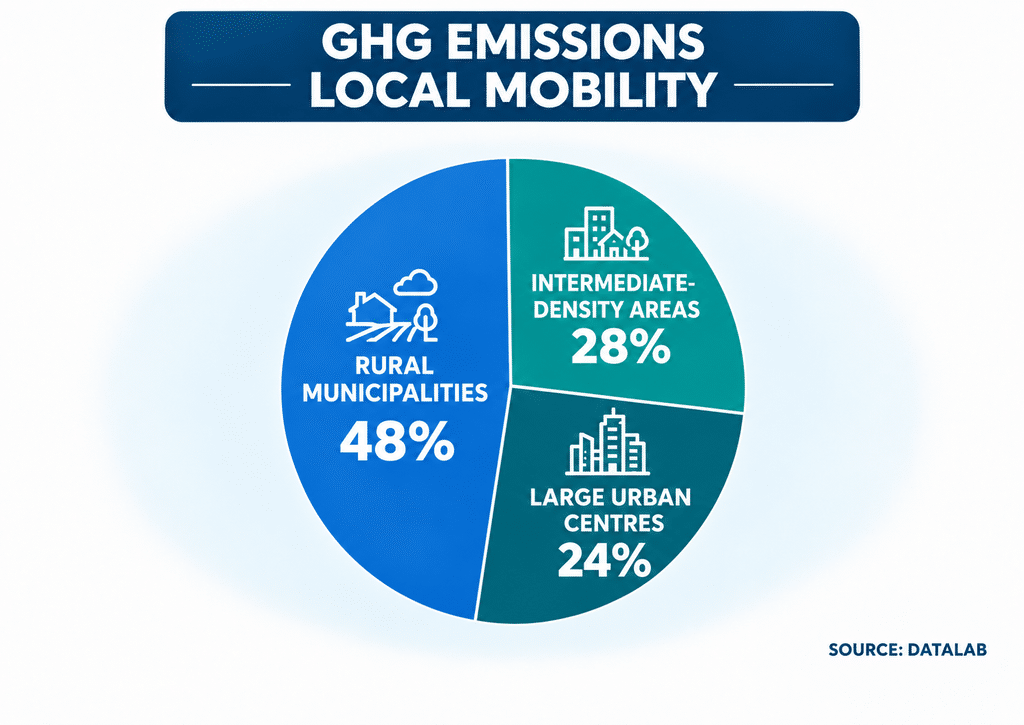
Whilst the use of cars in major urban centres has been decreasing in recent years, transport patterns in less densely populated areas do not appear to be changing. How can this discrepancy be explained? “Today, transport policies focus on the electrification of vehicles,” notes Aurélien Bigo. “However, whilst electrification is essential, it is far from being a sufficient solution, and this is evident in the disproportionate contribution of journeys made by residents of less densely populated areas to GHG emissions.” Aurélien Bigo emphasises: “Mobility must be transformed across the board to meet the challenges of the transition.” Reducing transport’s carbon footprint requires not only the electrification of vehicles, but also fuel efficiency (reducing driving speeds, eco-driving, etc.), higher occupancy rates, a shift towards public transport, and a reduction in transport demand. These levers are not being utilised sufficiently in rural areas.
When passenger volumes are sufficient, public transport offers proven economic and environmental benefits. For lower volumes, the development of car-sharing and intermediate vehicles, a category of light vehicles that fall between bicycles and cars, such as cargo bikes and electric microcars, is particularly well-suited to this mobility segment (see Figure 3).
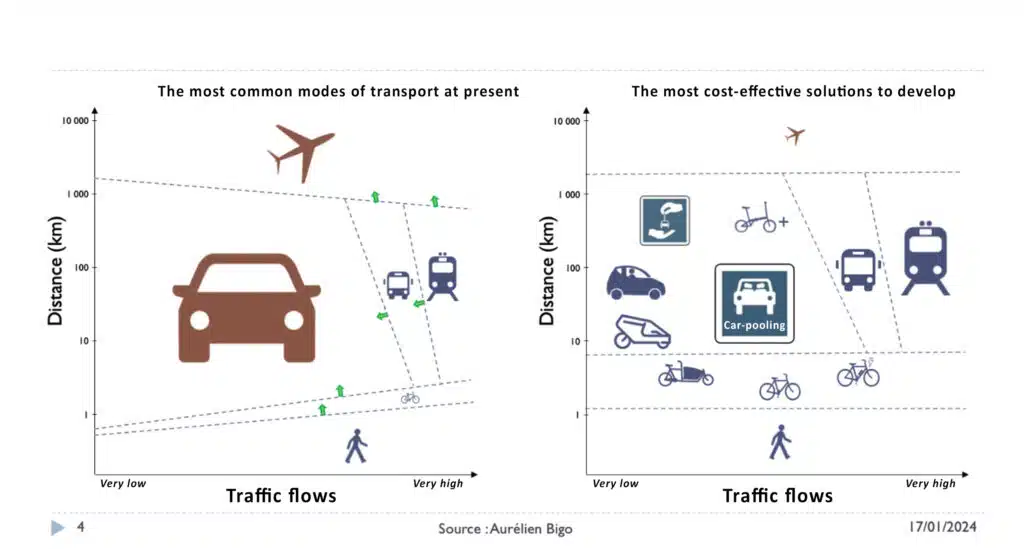
“Above all, it is a reduction in transport demand that would minimise the greatest number of environmental impacts associated with mobility,” warns Aurélien Bigo. “However, this requires far-reaching changes.” In fact, whilst residents of these sparsely populated areas account for a greater share of transport emissions than city dwellers, this is largely due to land-use planning. “The distances travelled to get to work, access services or reach shops are greater there, and the use of public transport and active modes (walking or cycling) is lower,” comments Aurélien Bigo.
Furthermore, social inequalities widen this gap even further. In an online article8, Caroline Gallez, research director at the City, Mobility and Transport Laboratory (LVMT), commented: “Faced with rising house prices, many people are forced to move from city centres to the outskirts, which results in an increase in the number of people dependent on cars. Added to this is a decline in the provision of public services across regions, which further exacerbates the phenomenon.”
Furthermore, it has been observed that moving to a medium-sized town does not reduce car use: nearly 30% of new arrivals continue to commute to work at distances of over 55 km. As a result, over recent decades, the average travel distance has increased, linked to land-use planning and lifestyles. “Mobility policies are sorely lacking in ambition when it comes to measures to reduce car use: active travel, public transport, vehicle weight, and so on,” concludes Aurélien Bigo. “Yet, as well as helping to combat global warming, these measures address public health issues such as noise, pollution, physical activity and road accidents, as well as social inequalities, which urgently need to be tackled in sparsely populated areas.”