






Aviation is counting on the use of biofuels and petrol-free synthetic fuels to reduce carbon emissions. Technically, it is possible: “biofuel standards allow the incorporation of 30–50% biokerosene into current airplane models without modifying the engine,” says Jean-Philippe Héraud, BioTfueL project manager at IFP Énergies nouvelles (the former French Petroleum Institute).
However, so-called first-generation biofuels made from food crops (grains or sugar) are not recommended for use in sustainability projects. They compete with the food industry and can have a negative environmental overall when taking into account the life cycle. However, there is a place for second-generation biofuels made from forest residues, straw and biosourced waste.
Biofuel resources
Jean-Philippe Héraud says that “because France is a very green country, the resources for these biofuels exist. A major difficulty, however, comes from the mix of where the resources are located – as opposed to oil that arrives in France in only three ports. Hence, we need to know how to collect these widespread deposits and regroup the biomass so we can better transport it, whilst adapting to seasonal variations, too.”
Hence, IFPEN has carried out research into the indirect thermochemical conversion of biomass. The biomass is gasified to obtain a synthetic gas; a mixture of carbon monoxide (CO) and hydrogen (H2). After purification, this gas is transformed into a synthetic paraffin using a process known as Fischer Tropsch. “We have demonstrated the feasibility of the BioTfueL project, now we have to turn it into an industrial reality, » explains Jean-Philippe Héraud.
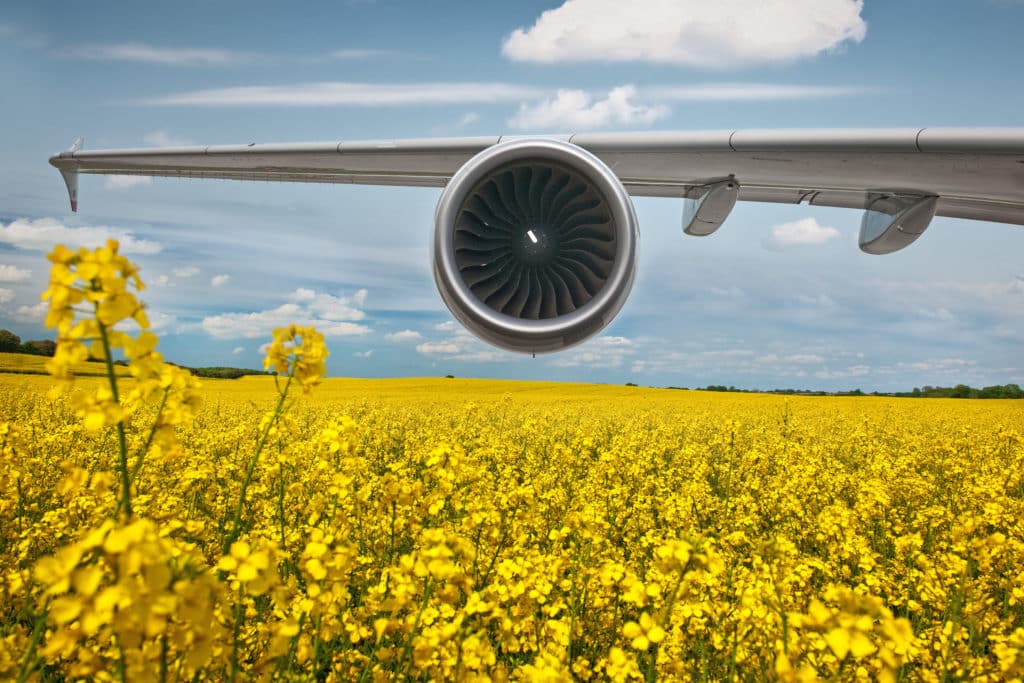
The cost of this biofuel is higher than that of kerosone made from fossil fuels, “between 1.5 and 2 times higher than equivalent fossil fuels before tax,” says Jean-Phillipe. “This extra cost varies according to the price of the raw material, the location and integration with sites undergoing conversion.” And he says that this is their challenge, “it seems difficult to make airline customers bear the burden without the risk of them turning away from air transport.”
Fuel represents about 25–30% of the price of a flight. “For a round trip from Paris to New York on an aircraft using 1% biofuel, the price of the ticket would increase by $5 per passenger,” explains Paul Mannes, director of aviation at Total. “For a flight using 10% biofuel, it’s ten times more, or about $50. So yes, the price could be a deterrent.”
It goes without saying that airlines will not raise ticket prices if they are not forced to do so. “The French government is working with the national companies concerned, such as Total, Airbus and Safran, to see how the SAF (Sustainable aviation fuel) industry could be developed, and the necessary legislation,” he says. For the moment, the projet des loi de finance includes an obligation to use 1% biofuels in 2022, 2% in 2025 and 5% by 2030, in order to keep pace with the increase in demand and the availability of SAF on the market.
Synthetic fuels
French Energy company, Engie, has launched a biomass pyrogasification project called Gaya. Wood is heated to high temperatures with very little oxygen, converting it into a mixture of gases: hydrogen, CO2, methane, carbon monoxide, which are then reorganised to form fuel. But here again, the price is high.
The other way to make fuel from non-oil-sourced sources are synthetic fuels derived from hydrogen, which itself comes from electricity. The principle: combine hydrogen with CO2 to obtain synthetic methane, the precursor of other fuels, called ekerosene. “We know how to produce this ekerosene,” says Samuel Saysset, chief technical advisor at Engie. “South Africa, in particular, developed this know-how during Apartheid when there was an embargo on petroleum products. The main concern now is the economics of the sector: ekerosene is more expensive.”
Is there electricity in the air ?
Apart from hydrogen and biofuels, “clean” energy sources are not suited to the drastic constraints of aviation. While Bertrand Piccard’s solar powered plane, Solar Impulse, did succeed in going around the world in 2015–2016, his design is unsuited to commercial aircraft. As for battery-powered electric planes, this concept currently seems limited to small aircraft travelling short distances, such as the e‑Caravan 1, a retrofitted electric version of a Cessna aircraft. Batteries are still the main limiting factor. “The energy density of a battery is 200Wh/kg, versus 12,000Wh/kg for kerosene,” Jérôme Bonini, research and technology director at Safran, states. “Instead, we are working on hybrid designs, to give a boost to a combustion engine at certain stages of flight.” But this boost would only represent a small percentage of the plane’s energy, with the vast majority being provided by jet fuel.