
Where does public debt come from and what should we do about it?



- A succession of financial crises has led to a very rapid increase in public debt – 116% of GDP in France.
- Despite the efforts of central banks, it was not possible to bring inflation down after the 2008 crisis.
- Countries have thus taken advantage of the opportunity to take on debt at very low cost.
- High energy prices are likely to continue, partly due to the war between Ukraine and Russia.
- Increasing the tax burden may be one of the only viable solutions to address public deficits.
In 1973, at the time of the first fuel crisis, the public debt ratio in OECD (Organisation for Economic Co-operation and Development) countries was 30% of GDP (36% in the US, 20% in France). Today, it represents 98% of GDP in the United States and 116% in France. The succession of different crises has led to a continuous use of public deficits and expansionary fiscal policies. These crises include the oil crises of the 1970s and early 1980s, the housing crisis of the early 1990s, the stock market crash of the early 2000s, the subprime crisis of 2008–2009, the Covid crisis of 2020 and the war in Ukraine.
So, the recent period has been a period of very rapid increases in public debt. Let’s look at what happened.
The failure to recover from inflation
After the subprime crisis, OECD countries experienced a period of very low inflation (1% on average from 2008 to 2020 in the euro area), below the targets set by central banks (2%). For institutional reasons, the latter have therefore tried to raise inflation by using highly expansionary monetary policies: introduction of zero or even negative short-term interest rates or « Quantitative Easing », i.e., purchases of government bonds by central banks, financed by money creation.
However, these monetary policies were not successful: inflation did not recover because the money created was used not to buy goods and services, but to buy financial and real estate assets. This led to a sharp rise in the prices of these assets (corporate shares and real estate), in particular bond prices: a sharp fall in long-term interest rates (10-year interest rates in the core countries of the euro zone became negative).
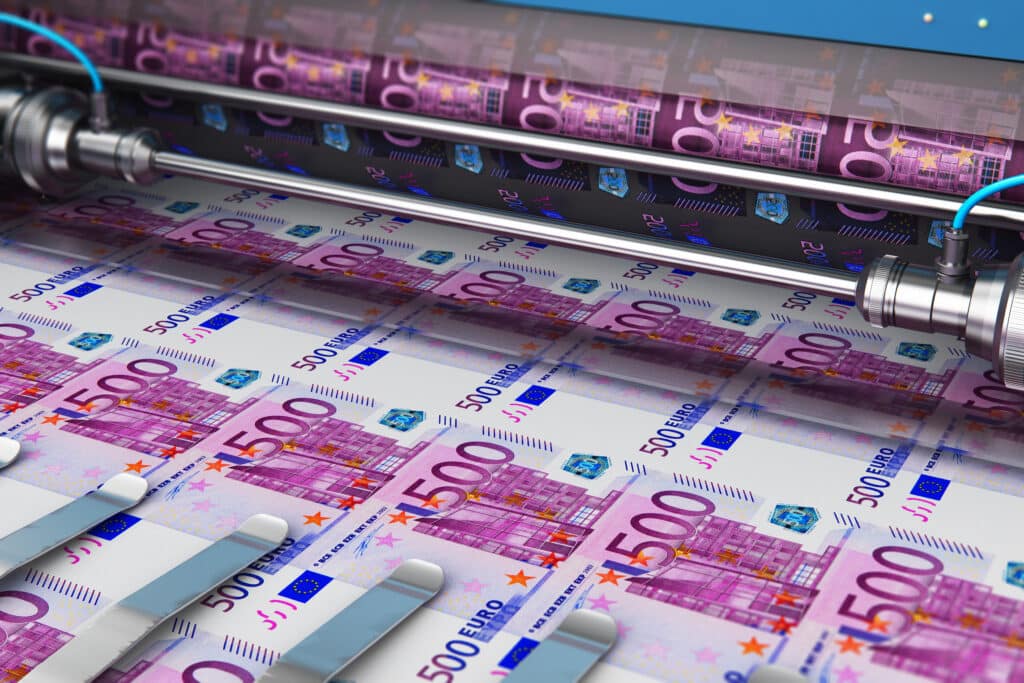
All this has resulted in the disappearance of the conditions for the sustainability of public debt. With interest rates well below growth rates, any public deficit is acceptable, any level of public debt is consistent with states’ solvency constraints. It is therefore easier to understand why public debt rates have risen sharply since 2008. States have simply taken advantage of the possibility offered to them to take on debt at a very low cost – and even at a negative cost in some cases.
Energy will remain expensive
However, today the situation has changed. The end of the Covid crisis has led to a dramatic increase in demand for goods (electronics, household equipment), which has led to bottlenecks in the supply of energy, raw materials, semiconductors, and shipping. As a result, high inflation developed and was amplified by the consequences of the war in Ukraine. Interruption of natural gas supplies from Russia to Europe and a sharp rise in energy prices (electricity, natural gas, coal), especially in Europe.
High energy prices are here to stay. Replacing Russian natural gas will take time, and beyond the energy transition, this will lead to high energy prices – especially in Europe – as we will have to bear the cost of the intermittency of renewable energy production.
We must therefore expect permanently high energy prices and further increases in inflation caused by the increased bargaining power of employees in labour markets and the relocation of strategic production. All this generates an inflationary environment, mainly in Europe, which completely transforms the issue of monetary policies.
Rising interest rates, falling GDP
The Eurozone faces the greatest challenge. Fiscal policy will be permanently expansionary as governments seek to support household purchasing power, finance the energy transition, education and health spending and improve business competitiveness in the face of rising energy prices.
It can therefore be predicted that the period of low inflation – and consequently low interest rates – is well and truly over. We will now see the return of debt sustainability constraints: the sharp rise in real interest rates will force governments to reduce public deficits, maintaining their fiscal sustainability.
The period of low inflation, and consequently low interest rates, is well and truly over.
Let’s take the example of France: in the low interest rate environment, the sustainability of the public debt was ensured with a primary public deficit (excluding interest on the public debt) of around 3% of GDP. If the real interest rate returns to positive territory – with the addition of the very low level of productivity gains – the primary public deficit will have to disappear, which means a reduction of 3 points of GDP in the deficit.
Solutions for reducing the public deficit
What are the means available to reduce the public deficit by 3 points of GDP? It is a task that seems difficult given the increased need for public spending in almost all areas: energy transition, reindustrialisation, health, education, justice, military spending… The only possible way forward is to increase the retirement age in countries where it is still early, such as France. But even if the employment rate of 60–64-year-olds in France (35%) were to reach the level of countries where it is highest (65%), we would only gain 1 point of GDP in terms of public deficit (74% in Germany, 77% in Sweden).
If lowering public spending does not seem to be relevant, what other avenues remain? In theory, it would be possible for central banks to finance public spending, which remains high because of the inflationary tax, by keeping interest rates below inflation. However, we are now witnessing a significant rise in interest rates and the disappearance of this inflationary tax.
The only way to eliminate public deficits is to increase the tax burden. This solution might be unpopular, but it is in line with the observation that the need for new public spending is very high.