Why COP28 was a critical conference for small island states



- At COP28, the discussions focused on Small Island Developing States (SIDS), which are bearing the brunt of climate change.
- These territories are particularly exposed to rising sea levels, multiple droughts and extreme weather events that affect their populations and economies.
- According to the IPCC, in the scenario of a 2.5°C rise in temperature, sea levels are expected to rise by around 58 cm by 2100, impacting nearly 430 million people.
- At the end of COP28, a monetary fund took shape, committing many countries to invest in the ecological transition and adaptation to climate change in order to mitigate its effects in developing countries.
- The conference also devoted part of the negotiations to the adoption of a “strengthened transparency framework” for the climate strategies of developed countries.
The recent 28th Conference of Parties (COP28) held in Dubai had a strong focus on Small Island Developing States. These are many small sovereign entities, predominantly located in the Caribbean and the Pacific, who are currently experiencing first-hand dramatic changes brought along by climate change. The shift in focus to these regions has been sprung by rising awareness towards the increasing frequency of extraordinary climate events that have hit many small island developing states throughout the last decade.
In 2017 alone, 22 out of the 29 Caribbean Islands were affected by Tropical Cyclone Maria, which caused considerable damage to their societies and economies. Earlier this year, two category 4 cyclones hit Vanuatu in less than 24 hours, causing irremediable damage1. The situation is made even worse by the fact that these are particularly fragile states as they are located in territories that under six metres above sea-level and more than 50% of their infrastructure concentrated in in the near proximity of the coast (less than 500 meters)2.
Over the two weeks dedicated to the event, the COP28 tackled the issues of climate adaptation and mitigation within these particularly challenging zones, also dedicating part of the negotiations to the adoption of an enhanced transparency framework for their climate strategies.
Climate Adaptation
The threat of sea level rise, together with the increasing frequency of droughts and extreme weather events such as cyclones and typhoons, cause not only a reduction in the territory available to the population, but also in the territory suitable for land cultivation. This ultimately generates both a problem of climate mobility and displacement, whereby people are forced out of their homes because of the hostility of their territory, and a problem of economic dependence on imports from developed countries. Forecasts do not appear particularly rosy. In fact, according to the 2022 IPCC report, under the scenario of a 2.5°C temperature increase, sea level is expected to increase by approximately 58 cm by 2100, causing a negative impact on approximately 430 million people.
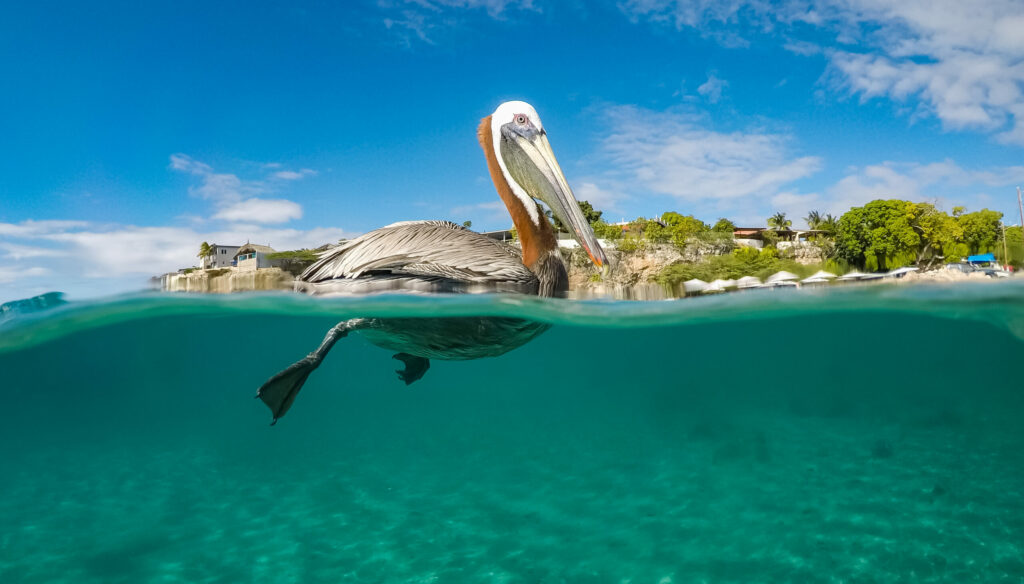
Poorer countries bear most of the loss and damage caused by climate change – which is estimated to exceed $150bn per year –, and they often do so through unsustainable debt3. As a global response to the claims for an increased accountability framework for highly emitting industrial strategies, the Loss and Damage Fund – whose name was harshly opposed by the United States at COP 284 – was agreed upon in 2022 but is now taking form. Many countries have agreed to contribute to it, namely France, Italy, and the UAE, having promised $100 million each, making the total amount pledged during the conference rise to $770 million, of which around $115 million will be employed to set the fund up at the World Bank. The remainder will be used to invest primarily in climate adaptation and mitigation in SIDS5.
This money will, however, be able to cover only 0.2% of the needs of small island developing states, which range from the investment in adaptation technologies (that need to be adopted to prevent the physical disappearance of these territories) to the need to invest in their energy transition. The latter is intended both as a tool for them to contribute to the global fossil fuel phase out and to detach themselves from international energy imports.
Climate Mitigation
COP28 has also dealt with the problem of climate mitigation in SIDS. “Renewables is the gift that keeps on giving,” mentioned Antonio Gutierres, Secretary General of the UN, at the beginning of the conference to highlight the importance of striving once again for a greener, more sustainable future away from fossil fuels. December 5th was the day dedicated to the topic of just transition, i.e. the process of accounting for the need to generate decent work and quality jobs in the gradual decarbonisation of the economy, as stated by the preamble of the Paris Agreement (2015)6. Among the many events, a conference on the sustainable energy transition of small island developing states was held, which represented a platform for many SIDS’ global leaders to share the experience of their countries.
The success stories of Barbados and Seychelles are not representative of the broader situation of SIDS.
Doctor Senator Shantal Munro Knight, Minister in the Office of the Prime Minister of Barbados, intervened to showcase the forerunner role of her country in the just transition of SIDS. Barbados is indeed striving for a net zero target by 2035, making it the first small island developing state to be able to achieve this projected objective. On the same wavelength is the state of Seychelles, where wind and solar power represent a great opportunity for a sustainable energy transition. As Flavien Joubert, Minister of Agriculture, Climate Change and Environment of Seychelles, announced, the country has produced around 22 MW of wind power in the last decade, a threshold that has enabled it to achieve its 5% renewable energy target by 2020. He also declared that the country is now targeting a 100% renewable energy portfolio by 2050, a goal whose relevance has been stated by the IPCC for global mean temperatures to be contained within a 1.5°C rise.
However, the success stories of Barbados and Seychelles are not representative of the broader situation of SIDS. Transitioning towards renewable energy sources calls for very large, almost prohibitive, investments. Vince Henderson, minister of foreign affairs, international business, trade and energy of Dominica, reported that his country is about to sign an agreement with Ormat Technologies for a project involving the development of a geothermal power plant with an initial production capacity of 10 MW, with the ultimate goal of transitioning towards green hydrogen7. He mentioned that reaching the agreement was “a tremendous struggle” and accused developed countries of having provided insufficient financial mechanisms to support SIDS in power purchase agreements and concluded his intervention at the SIDS’ energy transition panel by saying: “We need to ask ourselves why us, the SIDS, showing more commitment than the others, haven’t been able to turn commitment into real action”.
Investments need not only to be flowing in, but they must comply with the specific equity and accessibility requirements of the individual states: “It’s necessary to make sure that emergent technologies and financial instruments are fit for the purposes of the specific islands,” concluded senator Shantal Munro Knight when discussing the hardships that SIDS face in operationalising capital that flows in.
During a conference held on December 4th at the U.S. pavilion on the topic of climate finance strategies for SIDS (U.S. Department of State, 2023), Mia Mottley, the Prime Minister of Barbados, explained how the financial under provision that SIDS are facing goes hand in hand with the rising climatic uncertainty that they are witnessing, which increases the risk coefficients of any type of investment. She insisted that in the likely event of a worsening of climate conditions, the tipping point for SIDS would be to become “completely uninsurable and un-investible”. This would generate a financial insufficiency loop that would endanger the economic and energetic autonomy of these states.
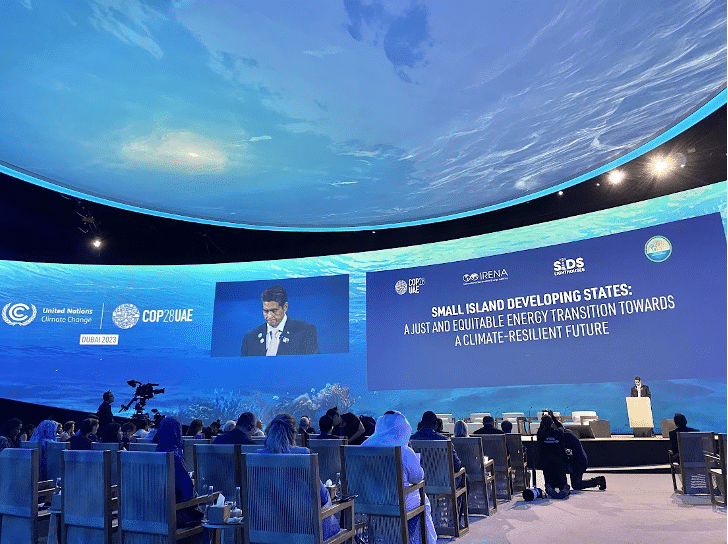
Within the goal of supporting the just transition of SIDS and de-risking climate finance, it is important to highlight the commitment of IRENA (International Renewable Energy Agency), that has launched the SIDS Lighthouse Initiative in 2014, a comprehensive action framework aimed at generating financial support from more than 80 partners. The LHI has also established the ETAF (Energy Transition Accelerating Finance Platform) a financing platform which has reached a pledge of $1bn already, still however falling short of the estimated $200bn needed to cover the climate needs of these developing countries by 20258. In the eyes of Francesco La Camera, Director General of the agency, honoured with the opening remarks to the panel discussion of December 5th, it is vital that more investors and small island states join the partnership, to create a network of mutual trust and accountability that reduces risks for investors and makes the countries a safer and more reliable investment target.
Enhanced Transparency Framework
SIDS are to be considered an example in leading towards a greener energy economy. Under article 13, the Paris Agreement oversaw the decision of adopting an Enhanced Transparency Framework for tracking and reporting national greenhouse gas emissions and have a closer look at Nationally Determined Contributions9. While the reporting tools have been produced and tested, but not yet operationalised. Indeed, they are predicted to become operational by June 2024. Many developing countries have already begun reviewing their transparency framework under the assistance of the Initiative for Climate Action Transparency (ICAT) and the Greenhouse Gas Management Institute (GHGMI).
Within its mission, the ICAT has supported many SIDS (such as Maldives, Fiji or Trinidad and Tobago) in building sectoral (or economy-wise) measurement frameworks, and tools to develop emission forecasts and projections and track climate finance. During a conference held on December 1st and hosted by the UNFCCC and ICAT, some of the experiences of SIDS were shared (ICAT, 2023). Aaliyah Tuitt, the Technical Data Officer from Antigua and Barbuda’s Department of Environment, outlined the nation’s strategy of transparency to bolster climate initiatives in transportation. This approach – heavily relying on the collection of data from mobility users – will prove pivotal in facilitating a smooth shift towards electric vehicles, whose sale is expected to reach 100% of market sales by 2030.
Similarly, Deepitika Chand from Fiji’s Climate Change Division in the Prime Minister’s office illustrated how the nation utilized transparency frameworks to assess the influence of agriculture on greenhouse gas emissions. By doing so, the national administration gained deeper insights into its emission patterns and the specific requirements of the agricultural sector, paving the way for targeted policy decisions which will be able to guarantee food security, enhance production quality, and foster resilient, gender-inclusive food systems.
COP28 revealed an operational delay displayed by most developed countries, who have failed to achieve a sufficiently green energy portfolio.
Molly White, senior director at the GHGMI, praised the panellists for the important contributions of their countries, particularly highlighting their openness to this innovative tracking strategy. She also emphasized the importance of the learning process derived from this enhanced transparency mode of operation: she mentioned the difficulty of integrating sectoral planning into economy-wide climate target setting, to be able to have a closer look at the macroeconomic performance of a country in relation to its climate strategy. When, asked how developed countries could learn the lesson of developing ones, she mentioned that this would represent the greatest challenge for the future, given that significant hurdles would be encountered in scaling up this integrated economic framework of analysis, due to the trackability issues and the broader set of economic activities that developed countries are involved in.
To sum up
By the end of the two weeks dedicated to the event, the outcomes of the first global stocktake at COP28 revealed an operational delay displayed by most developed countries, who have failed to fulfil their NDCs and achieve a sufficiently green energy portfolio to remain in line with a 1.5°C mean temperature rise goal. The pledges made to the Loss and Damage Fund by many highly emitting countries reflect the public awareness of the imbalance in emissions observed among different states. This, despite laying the foundations for a more intensive investment in both climate mitigation and adaptation in SIDS, does not delay the need of developed countries to speed up fossil phase out in an attempt to prevent small island states from disappearing.
The establishment of the enhanced transparency framework will contribute to guarantee higher clarity on the decarbonisation strategies of many of the most emitting countries, who are now more than ever required to take effective action. “Although we are not responsible, we are facing country-wise destruction”: these were the closing remarks to the December 5th conference of Konris Maynard, minister of public infrastructure in St. Kitts and Nevis, a small Caribbean insular state where electricity cannot be provided 24 hours a day. “We are looking for partnership, not sympathy,” he added.
As we now approach COP29 in Baku, significant attention will be focused on the operationalization of funds and the commitment of prominent states to support Small Island Developing States in their fight for survival. The topics of discussion will also reflect the outcome of the 4th International Conference on Small Island Developing States, which will be held in Antigua and Barbuda in May 2024, and will develop a 10-year action program for SIDS, with concrete targets required to support them in their sustainable development objectives10.