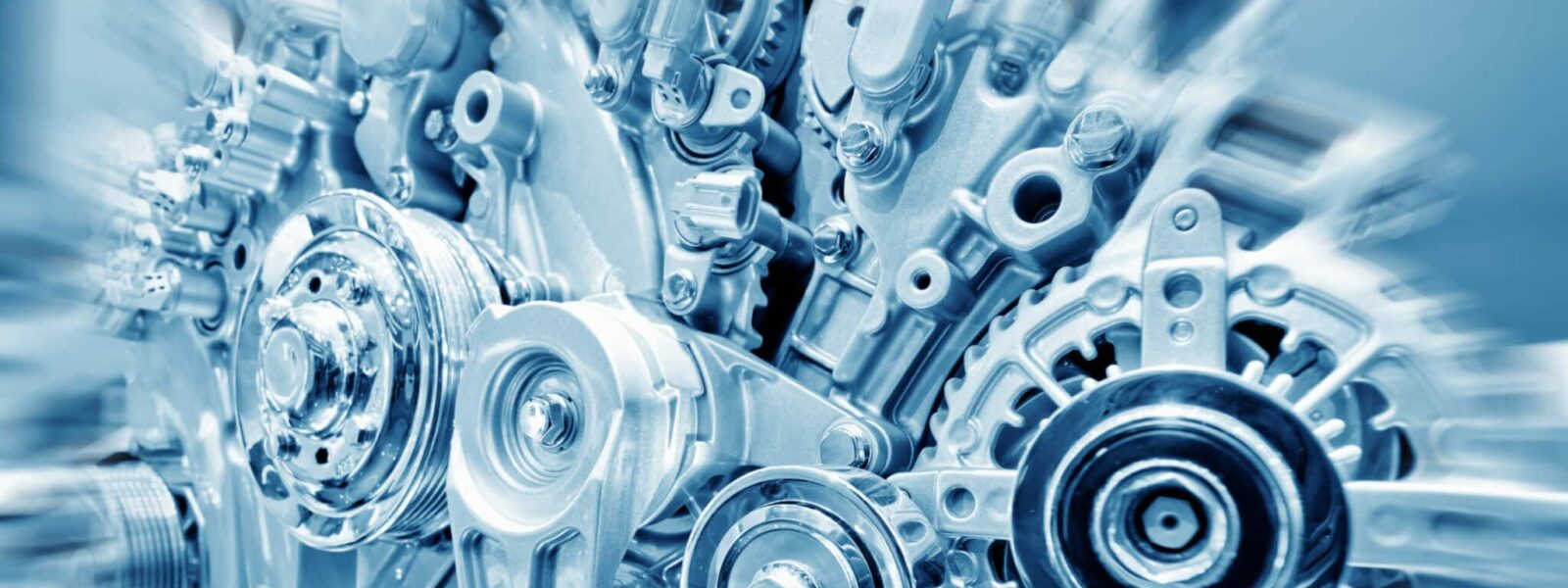
Hydrogen engines: an essential component in low-carbon transport





- Burning hydrogen or its derivatives in engines could make it possible to decarbonise trucks, boats and planes.
- This method has two main advantages: few technological adjustments and an affordable price.
- For heavy trucks, the hydrogen engine seems to be as viable a solution as fuel cells.
- It is rather the hydrogen derivatives (synthetic fuel and ammonia) that should be put forward for aviation and maritime transport.
- The future of these sectors will not be mono-technological because they are much more difficult to decarbonise than mass transportation.
The possibility of burning hydrogen, or derivatives such as ammonia, in engines is receiving renewed interest. These engines could be one of the solutions to the urgent need to decarbonize trucks, ships, and aircraft.
Engine manufacturer Cummins is testing a hydrogen-powered truck engine, Renault Trucks is developing its own with the French Petroleum Institute for New Energies (IFPEN), and Airbus has announced a hydrogen-powered aircraft for 2035, which could be driven by a modified gas turbine. All these announcements suggest that the good old combustion engine is not dead, and that by decarbonising its fuel, it even has a role to play in achieving the climate neutrality objectives for long-distance transport by 2050.
Burning hydrogen directly in combustion engines
Hydrogen, an energy-dense molecule, can be produced in a “clean” way by electrolysis of water, with energy from renewable or nuclear sources. Electric batteries, which are now the main way to reduce the carbon footprint of private cars, lack autonomy in the heavy vehicle segment: “batteries can power buses or city delivery vans that recover energy when braking and can be recharged frequently. But not a heavy vehicle, which even with 350 kW superchargers would have to spend more than an hour recharging every 300 km,” says Gaétan Monnier, director of the IFPEN Transport Results Center. As part of its 2020 “hydrogen strategy for a climate-neutral Europe”, the European Union has validated the industry’s goal of running 100,000 of the 3 million trucks in Europe on low-carbon hydrogen by 2030. “Initially, the objective was to consume this hydrogen in fuel cells, a system that produces electricity to power an electric motor. But the idea of burning hydrogen directly in thermal engines has been gaining interest for a few years among researchers and manufacturers,” says the specialist.
Its a low-cost solution for reducing the carbon footprint of transportation.
It has several advantages. First, burning hydrogen in a combustion engine only requires adjustments: “we need to integrate metals capable of withstanding higher temperatures and an injection system adapted to this highly volatile fuel, and review the control of combustion, whose characteristics are very different from those of diesel… But these are by no means technological breakthroughs,” says Luis Le Moyne, director of ESAT. Secondly, this solution would allow manufacturers to keep their production line and thus not increase their prices too much. “It’s a low-cost solution for decarbonizing transportation,” he concludes.
By comparison, fuel cells are not yet manufactured on a large scale and contain platinum, a rare metal… which considerably increases the purchase cost of the vehicle. “As their life span is currently limited, it is also necessary to plan for a replacement of the fuel cell during the vehicle’s life cycle”, adds Gaétan Monnier. However, fuel cells can offer better energy efficiency (up to 65%) than the hydrogen engine (up to 45%). Which solution will win? At the moment it’s not clear: “The hydrogen engine appears to be less expensive to invest in, but potentially slightly more fuel-intensive over the vehicle’s life cycle. Both could therefore have their economic relevance depending on the intended use of the vehicle,” summarises the researcher.
Is hydrogen too volatile for aviation?
When it comes to air travel, there is once again a debate over the use of hydrogen versus gas turbines. Airbus is currently testing both solutions to get a hydrogen-powered aircraft off the ground by 2035. However, “the challenge is not so much in propulsion as in the storage of hydrogen on board, which will have to be in its liquid state, its most compact form,” points out Cédric Phillibert, former analyst at the International Energy Agency (IEA). Even so, hydrogen takes up four times more space than kerosene and must be kept at the extremely low temperature of ‑253°C. This has one significant consequence: the liquid hydrogen tank, which is spherical or cylindrical in shape – to limit heat loss as much as possible – cannot be housed in the aircraft’s wings… which means it must be placed in the fuselage and the aircraft must be completely reinvented! Manufacturers are therefore studying the possibility of burning a more “practical” derivative of hydrogen in the current turbines: synthetic fuel.
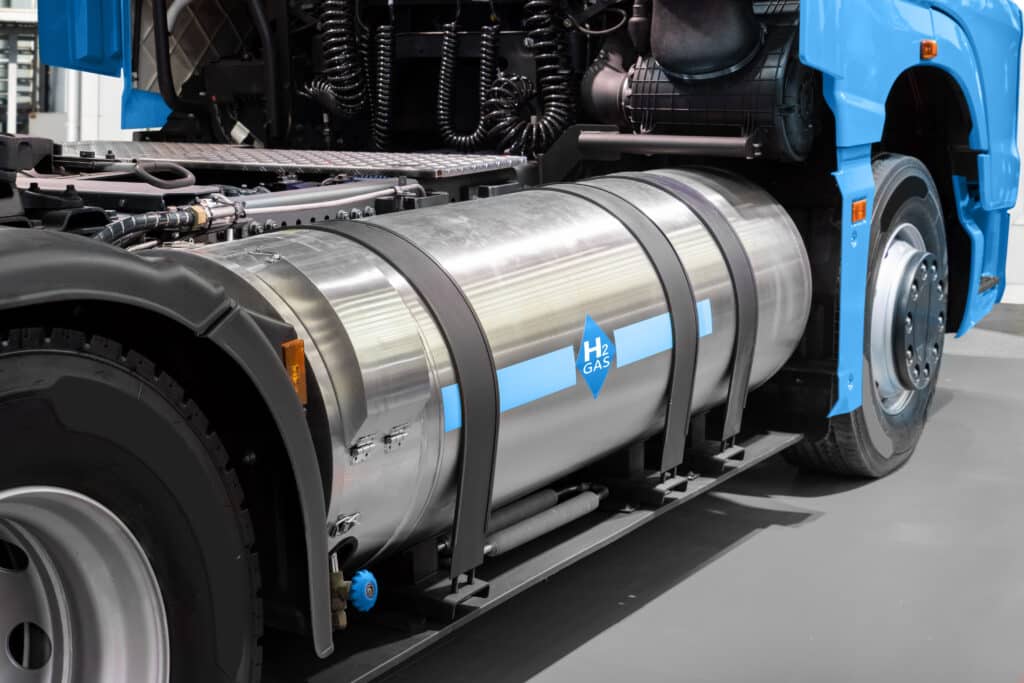
This fuel, a strict decarbonised equivalent of today’s kerosene, can be made from decarbonized hydrogen and CO2 captured from the atmosphere, using a process called Fischer-Tropsch. Even though the process is extremely fuel-inefficient, with a well-to-wheel efficiency of 15% compared to 30% for hydrogen, there is a strong argument to be made: “it does not require the reinvention of aircraft or airport infrastructure,” says the expert. Synthetic fuels are much easier to transport than the highly volatile hydrogen. “We could therefore import it from countries with strong renewable energy potential, capable of massively producing hydrogen on site,” he continues. This is exactly the plan of Porsche, which has started building an eFuel plant in Chile in 2021.
Maritime transport: ammonia takes to the sea
Similar thinking is going on in the maritime transport sector. In the field of long-distance ships, the combustion of hydrogen, which was once envisaged, now seems to have been abandoned in favour of a close cousin, ammonia. Ammonia, with the formula NH3, can be produced in a neutral way from decarbonized hydrogen and nitrogen (N2) using the Haber-Bosch process. With one advantage: “port infrastructures are already designed to handle this gas, which is liquid at ‑33.5°C and is used in the manufacture of industrial fertilizers,” explains François Kalaydjian, Director of Economics and Monitoring at IFPEN. But here again, the battle has not yet been won. Ammonia is a toxic gas that needs to be handled with care. Another derivative of decarbonised hydrogen and CO2, methanol, is therefore in the running to burn in the massive two-stroke engines of cargo ships.
All forms of technology will be needed to achieve realistic decarbonisation of transportation.
Hydrogen engines or fuel cells; synthetic fuels, ammonia, methanol… many options are on the table to decarbonize all long-distance transport. “Unlike the consumer car sector, where the electric battery will become the dominant technology, the future of this sector will not be ‘mono-technological’. Decarbonisation is more difficult, and uses are more diverse,” summarizes Gaétan Monnier. Therefore, while the future does not belong entirely to the hydrogen engine and its derivatives, « it is part of the mix of solutions that will enable us to meet the challenge.
This conclusion is contrary to that of environmental associations, such as Transport & Environment, which advocate the full electrification of road transport. The European Commission is expected to settle this debate in early 2023. It must review the definition of “zero emission vehicles”, which until now has been limited to an exhaust emission level of less than one gram of CO2 per kilometre. “If this criterion is maintained, it is unclear whether internal combustion engines using carbon-free fuels such as hydrogen or ammonia will qualify, since these engines still burn a small amount of oil. But the tiny CO2 emissions that result are difficult to quantify,” says Gaétan Monnier. “Abandoning the principle of technological neutrality would be harmful, because all forms of technology will be needed to achieve a realistic decarbonisation of transport “, concludes François Kalaydjian.