
How to evaluate commitments and progress towards “Net Zero Emissions”




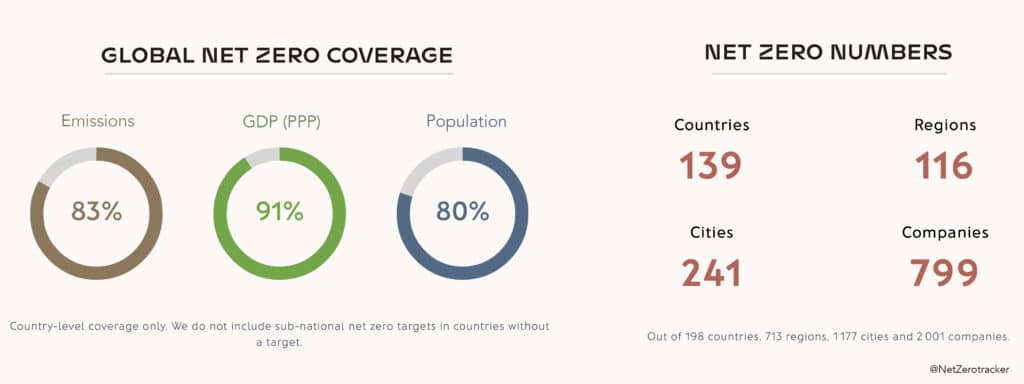
- In order to counter the climate crisis, more than 139 countries have set a NZE (Zero Net Emissions) target to be reached by the year 2050.
- The Race to Zero project is aimed at private and sub-national actors, who commit to halve global emissions by 2030.
- The OECD has developed IPAC, a climate measurement and assessment tool to help countries get an overview of their situation.
- IPAC has four tools: an indicator table; an annual tracking monitor; a scoring and guidance tool; and an interactive platform.
- While countries are making progress in their climate actions, current commitments are not meeting the targets set: IPAC aims to support and guide countries in this process.
In line with the primary target set for COP26 in Glasgow in 20211, more and more countries are committing to achieve zero net emissions (NZE2) by the middle of this century and to strengthen their nationally determined contributions (NDCs3) by 2030. Today, more than 139 countries and unions, including China, the United States and the European Union, covering about 83% of global emissions, have announced this NZE target.
Moving towards Zero Carbon
Sub-national actors and the private sector are also stepping up their own commitments to reduce emissions, including through the Race to Zero campaign.
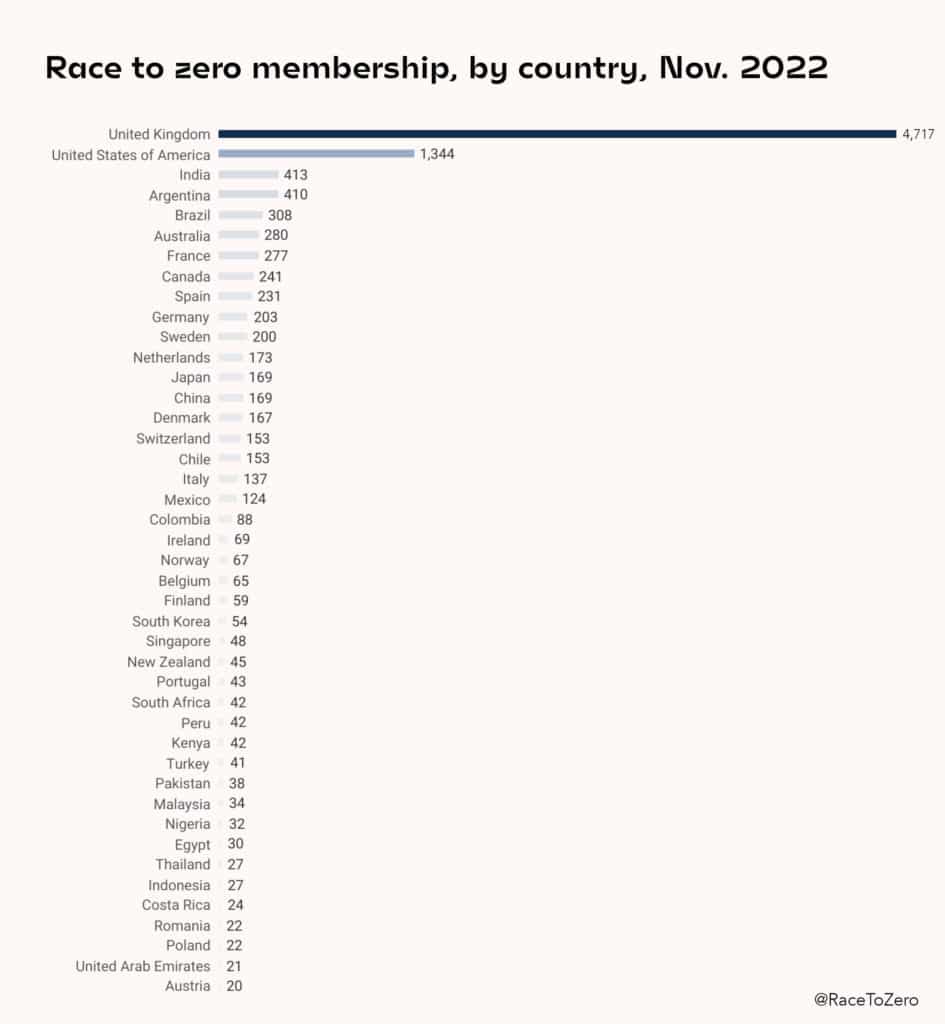
Launched at the UNSG Climate Action Summit 2019 by Chilean President Sebastián Piñera, Race to Zero mobilises actors outside national governments to join the Climate Ambition Alliance and commit to halving global emissions by 2030. As of September 2022, 11,309 non-state actors have committed to the campaign, including 8,296 companies, 593 financial institutions, 1,136 cities, 52 states and regions, 1,125 educational institutions, 64 health institutions and 29 other organisations.
But do we really have the tools to assess and measure these commitments? Not really, and it is to fill this gap that the OECD has developed an innovative tool for measuring and assessing national commitments: the International Programme for Climate Action (IPAC).
IPAC, a framework for countries to follow
Initially proposed by France and publicly supported by President Macron on the occasion of the OECD’s 60th anniversary in December 2020, IPAC was launched in May 2021 and is based on four components:
- First, a dashboard of climate-related indicators, measurable and agreed between countries for use in monitoring.
- Second, an annual climate action monitor, based on the previous dashboard, provides a summary of countries’ progress towards their own climate and sustainable development goals. This monitor provides examples of good practice and results in climate mitigation and adaptation.
- This is followed by a country rating tool based on environmental, social and geographical indicators and containing targeted policy advice to help design economically viable mitigation and adaptation actions.
- Finally, an interactive platform for dialogue and mutual learning between countries with discussion topics on innovative approaches and good practices.
The philosophy behind this approach is to avoid ineffective or counterproductive policies, which is easier said than done given the scale of the response required and the need to constantly adapt to changing national and global circumstances. IPAC fundamentally addresses the need for decision-makers to have access to comprehensive climate data and tools for meaningful monitoring, benchmarking, and policy analysis.
Using IPAC, governments are able to see where they are, where they are going and how they can improve.
The benefit of these four IPAC tools is that decision-makers can get both a granular and comprehensive overview of all relevant climate-related data: emissions and their causes, risks and impacts, and responses and actions. In addition, through its research and analysis of over 50 countries, the IPAC team is able to harness and communicate the breadth and depth of the data collected, sharing best practices and encouraging stakeholders to learn from each other. Therefore, by using the tools and information collected by IPAC, governments can see the bigger picture: where they are, where they are going and how they can improve.
At COP27 in Sharm El Sheikh, OECD Secretary-General Mathias Cormann presented the tool as part of a roundtable discussion at the French Pavilion on 7 November 2022, with Agnès Pannier-Runacher, France’s Minister for Energy Transition; Espen Barth Eide, Minister of Climate and Environment in Norway; Maximiliano Proaño Ugalde, Undersecretary of the Environment in Chile and Johan Rockström, Co-Director of the Potsdam Institute for Climate Impact Research.

What remains to be done in France?
These indicators play a key role in the second annual climate report to be published in November 2022: it highlights countries’ exposure to climate-related risks, which are increasing in frequency and intensity. To successfully mitigate and adapt to these risks, this year’s IPAC Monitor advises governments to use all policy tools and mechanisms (non-market, market, etc.) at their disposal, as well as to increase the stringency of their measures.
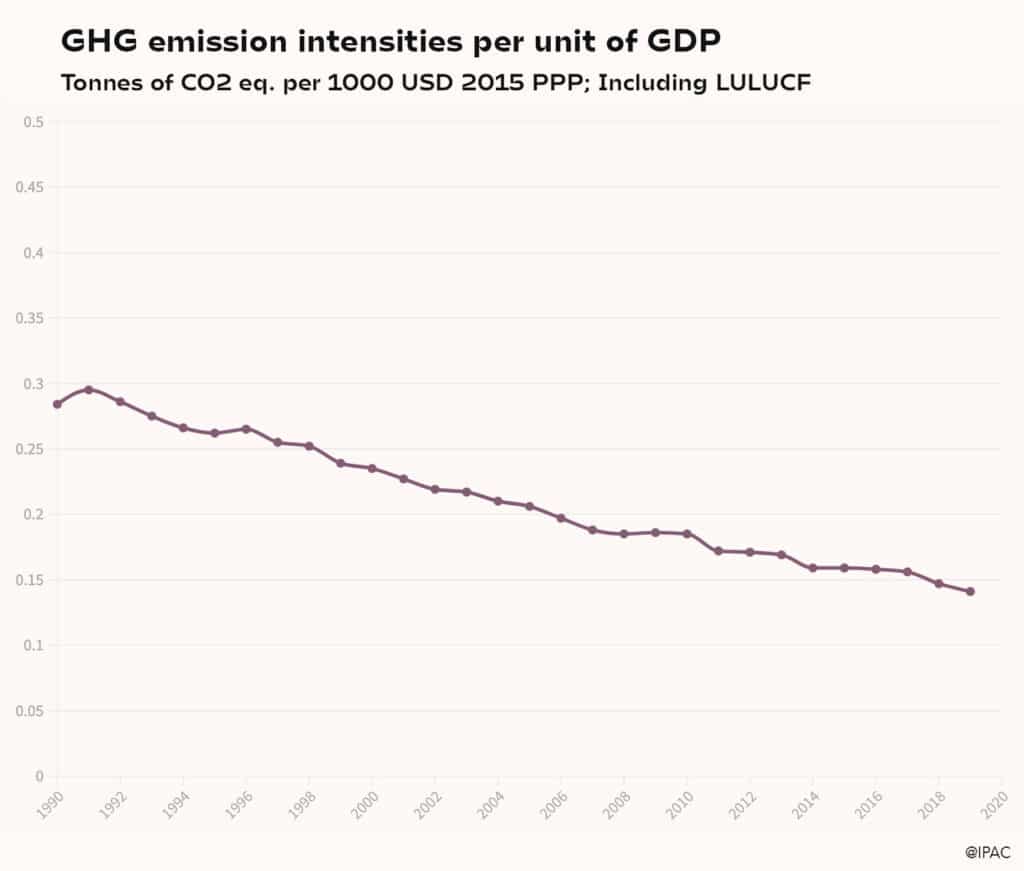
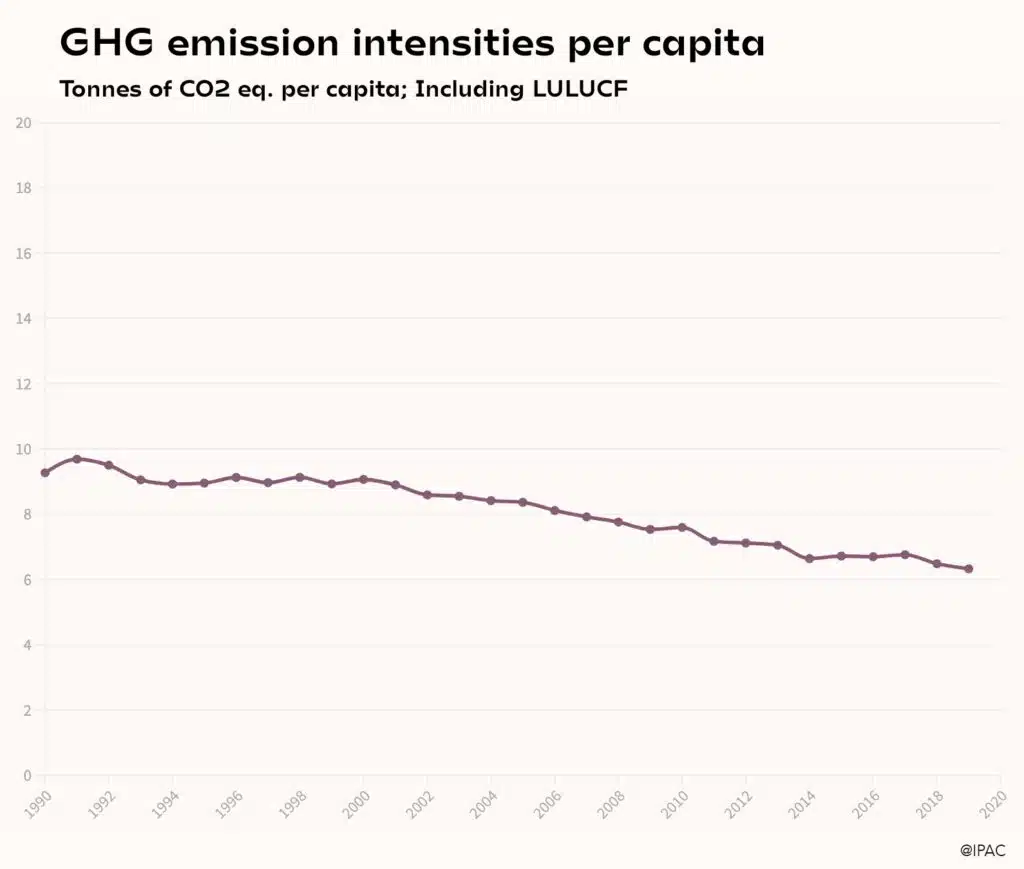
In the case of France, IPAC shows for example that GHG emission intensities per unit of GDP and per capita are decreasing. This means that, overall, France is decoupling emissions from both economic output and population growth.
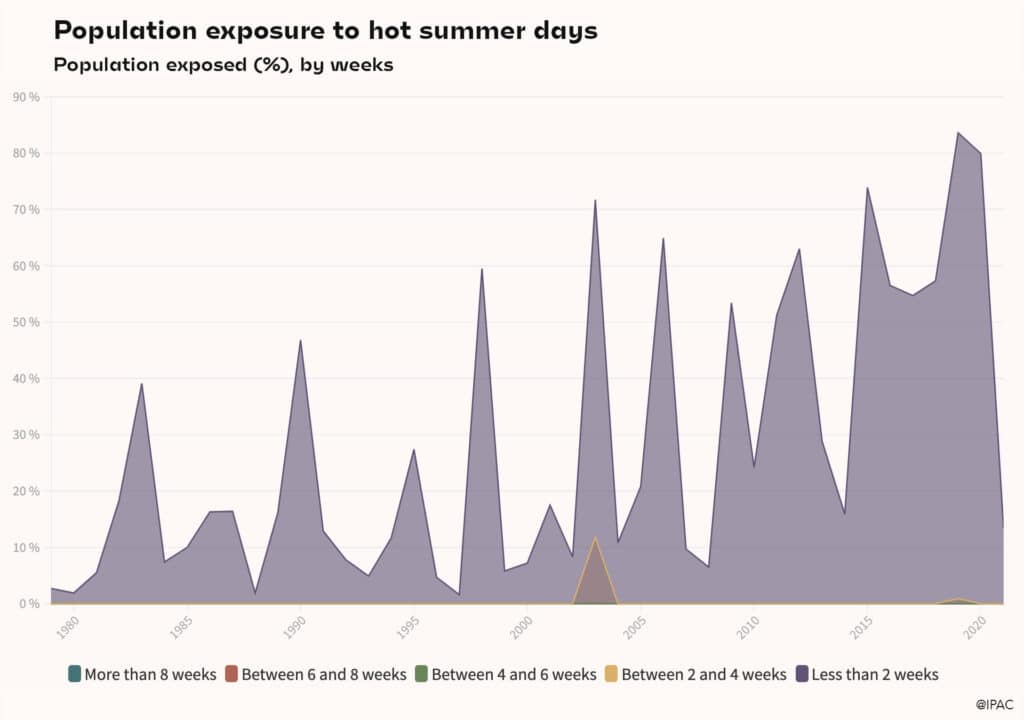
On the other hand, the percentage of the population exposed to summer days with temperatures above 35°C is increasing. According to the IPAC scoreboard, this indicator helps to understand the possible risks of extreme temperatures for the population. We should keep in mind that France cannot be satisfied with mitigating long-term chronic risks and must find solutions to deal with acute risks, such as heatwaves, to which it is increasingly vulnerable.
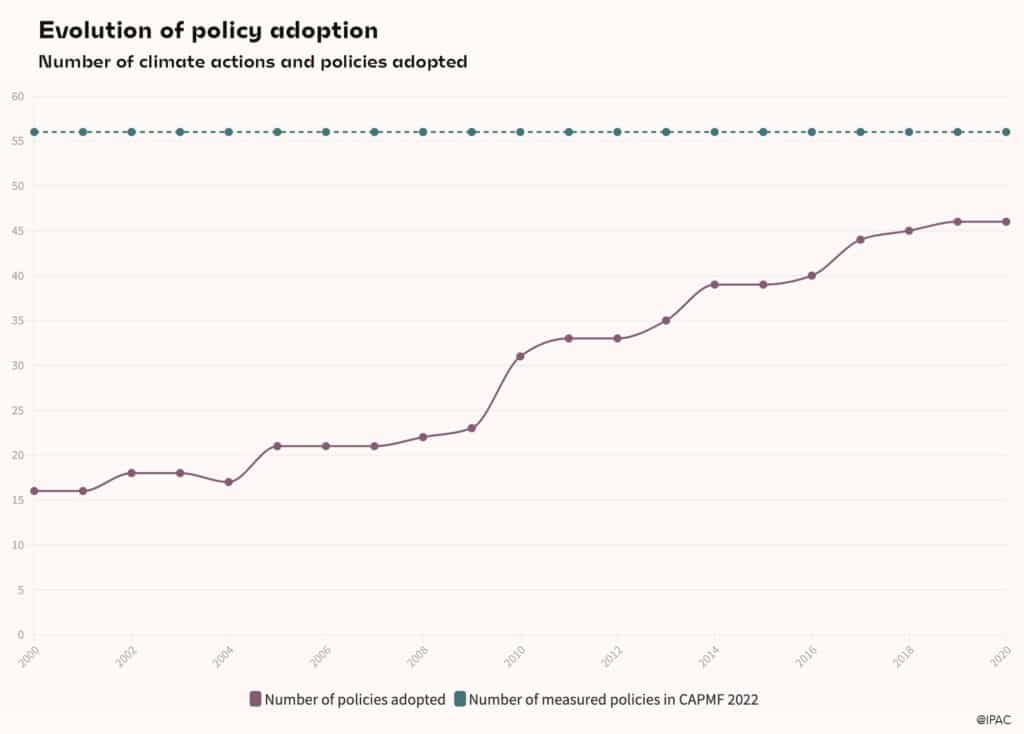
In terms of “actions and opportunities”, we find that France is increasingly adopting climate policies, but is not yet adopting the full range of available policy options as measured by the OECD, represented by the dotted line (OECD, 2022).
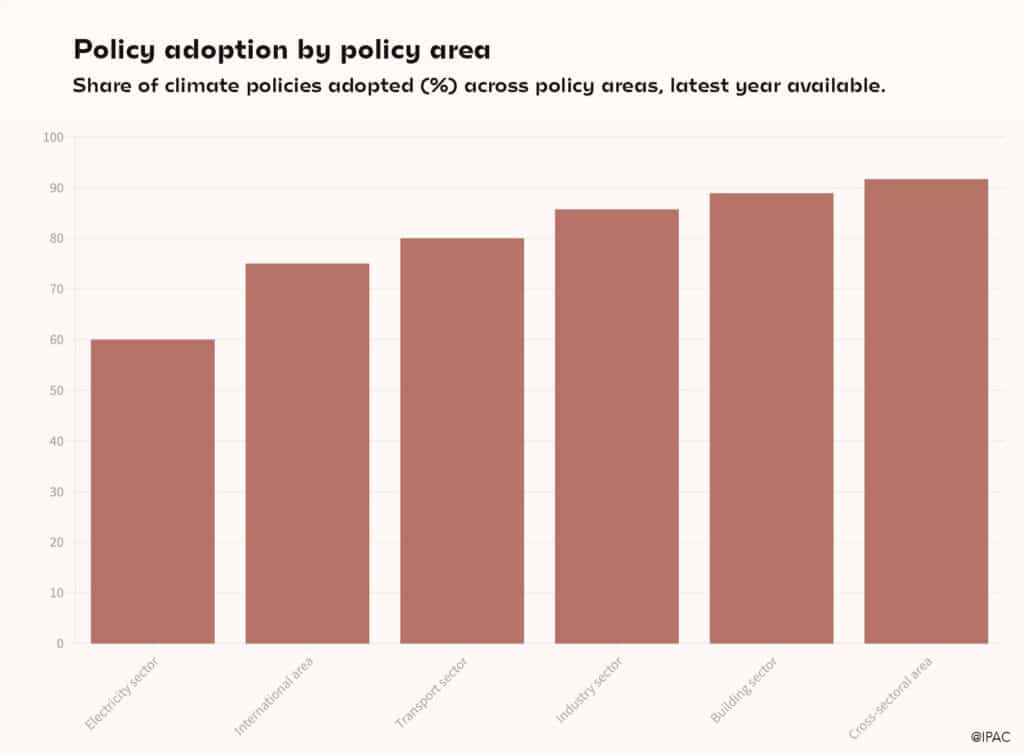
Furthermore, it appears that France has currently adopted the largest share of available policies targeting all sectors, followed by those targeting the building sector. Given that the French climate strategy prioritises energy efficiency in buildings, it appears that policy making here is aligned with national and municipal targets. Nevertheless, France has the opportunity to adopt a broader set of policies, especially those related to the electricity sector, where it is lagging behind.
In tackling climate change, every country goes through the inevitable process of determining the most effective policies in a constantly changing national and international context. The urgency to find solutions continues to grow, and while countries have certainly shown progress in their actions and ambitions, current national climate commitments are still not sufficient to meet the goals of the Paris Agreement. Moreover, while countries need to “scale up” their commitments, many are struggling to meet their current targets. This OECD initiative therefore provides much-needed support and encourages stakeholders not to shoot blind, but to rely on holistic and data-driven tools.
Additional data on emissions, impacts, risks, actions, and opportunities are available in the IPAC dashboard.
For more info
Nachtigall, D., Lutz, L., Cárdenas Rodríguez, M., Hašcic, I., and R. Pizarro (2022), “The climate actions and policies measurement framework: A structured and harmonised climate policy database to monitor countries’ mitigation action”, Environment Working paper No. 203, Publication OECD Paris