Radulanine A: discovery of a natural herbicide


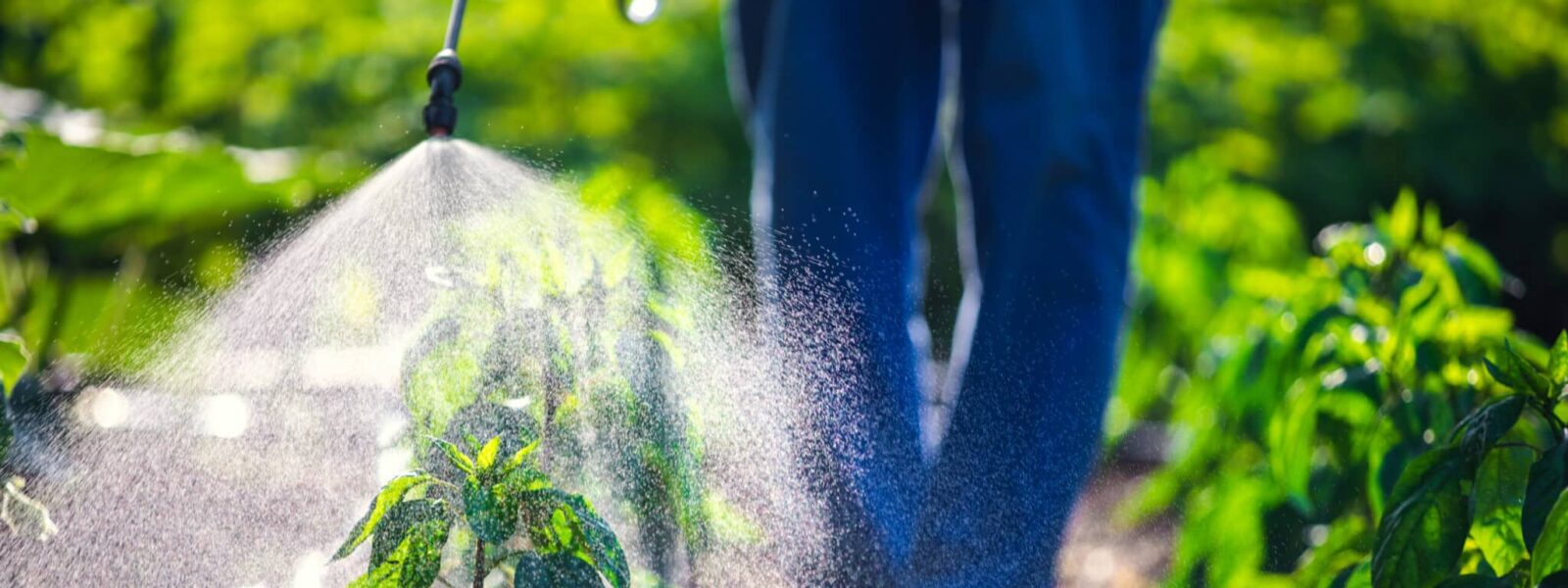
The use of synthetic pesticides and herbicides is a sensitive subject in terms of public opinion, who are often concerned about the safety of exposed populations and biodiversity. Without entering too much into this debate, it must nevertheless be stressed that the search for sustainable solutions and alternatives is an active field in chemistry, particularly focused on natural substances.
In organic chemistry, we sometimes play Lego with atoms to reproduce small natural molecules with interesting properties. This is what we call total synthesis. Once these molecules have been synthesised, we try to bring them to life through new applications.
Research in this field has already made it possible to bring molecules of natural origin onto the market. To give an idea of the extent of the phenomenon, it should be noted that about a third of the pesticides patented between 1997 and 2010 are “natural” 1. Alternatives therefore exist, but “natural” does not necessarily mean “safe”.
This figure is much lower in the category of herbicides: over the same period, only 8% of patented molecules are “natural”. It is in this context that we discovered a natural herbicide with potential applications. Notably in agriculture, but also in the treatment of railway tracks, which must remain perfectly free from weeds to run high-speed trains on them, for example. Our project is financed by the innovation clusters at the CNRS 2 and Institut Polytechnique de Paris 3.
Unexpected discovery
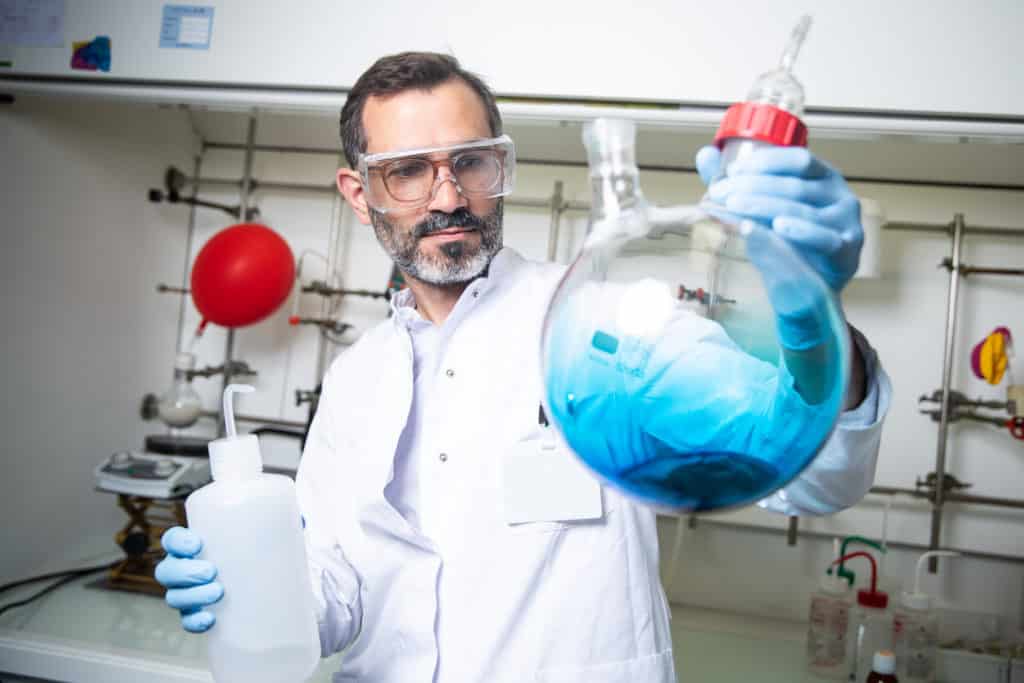
In May 2019 our team from the Organic Synthesis Laboratory of École polytechnique 4 announced that we had succeeded in synthesising a natural herbicide: Radulanin A. The story is an example of “serendipity” – the ability to make a scientific discovery by chance and grasp its usefulness. For it was not a new herbicide that we were working on at first, but rather a new method of synthesis, targeting complex molecules.
The molecules targeted in our research are often complex and require long-term work. Basically, what we were aiming for was a molecule produced by a fungus; a complex molecule with certain motifs that interested us. To reproduce these motifs (seven-chain oxygenated cycles) we developed a new method of synthesis, using a particular chemical reaction (for the specialists reading, this was by a rearrangement of the retro-Claisen type). To test the usefulness of this method, we therefore chose a simpler molecule: Radulanin A. And, low and behold, our method of synthesis worked. In the beginning, therefore, Radulanin A was not specifcally our target.
First reflex: find an application
Once synthesised, the question arose as to how this molecule is used in nature. In doing so, we discovered that it has similarities with molecules known to have plant hormone properties. A fellow researcher from Sorbonne University, Emmanuel Baudouin, then took over and showed that Radulanin A does indeed have the ability to interact with plants, through phytotoxic properties. Without knowing it, we had synthesised a natural herbicide!
At a time when we are looking for industrial alternatives to glyphosate, this was good news. The herbicidal property of Radulanin A has now been patented, and industry is interested in it. For the patent to be exploited, it will be necessary to understand how, over time, the molecule interacts with the environment, and whether it can have effects on the human body. These questions, central to industry, are a prerequisite for approval. The impact of a molecule also depends on how it is used, which must remain reasonable to limit its impact on the environment. The toxicity of a substance is almost always a matter of concentration.
Contributors
Bastien Nay
After 13 years at the Muséum National d'Histoire Naturelle, Bastien Nay joined the Organic Synthesis Laboratory (*LSO: a joint research unit of CNRS, École Polytechnique - Institut Polytechnique de Paris and ENSTA Paris) in 2017 to develop his research in organic chemistry, aiming to achieve the synthesis of natural substances of interest and not easily accessible by other means. In particular, he is interested in methods for the rapid generation of molecular complexity and diversity.