
Rising sea levels and subsiding towns: a double threat to the coastline




- 11% of the world's population living in coastal areas are at threat from rising sea levels and subsidence.
- Researchers have identified various causes including weight of residual sediments from the last great thaw or tectonic movements.
- Human activity is undeniably playing a major role in this phenomenon.
- Scientists are thus warning of threats to coastal populations, such as food security, flooding, and access to drinking water.
In 2020, almost 11% of the world’s population lived in coastal areas less than 10 metres above sea level1. This figure could rise from nearly 900 million to over a billion by 2050. These people’s future is particularly at risk. Of course, rising sea levels – due to global warming – affect them directly. But other human activities along the coastline, which are causing towns to subside, are also increasing risk – sometimes in a major way.
Subsidence: a threat to our coasts
Between 2006 and 2018, the average rise in global sea level is estimated at 3.7 mm per year2. “The thermal expansion of the oceans – linked to the rise in temperature – and the melting of glaciers and ice caps are major factors behind this increase,” explains Rémi Thieblemont, a researcher in climatology and coastal risks at BRGM. On a regional level, however, when we look at the rise in relative sea level, the sea seems to be gaining much more ground. Relative sea level corresponds to the height of the sea level in relation to a local land reference. A research team has published a study on this subject in the journal Nature Climate Change3. On a global scale, the rise in sea level relative to all coasts was 2.6 mm/year between 1993 and 2015. But when the researchers compare this with coastal population density, the figure is 4 times higher, illustrating the impact of human activities! The cause? The subsidence of the coastal land.
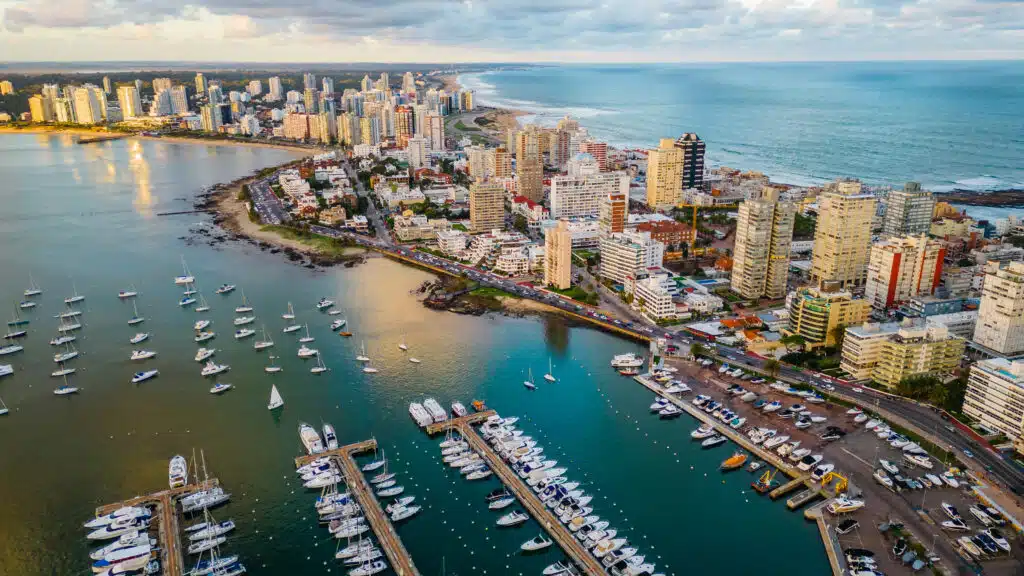
This is known as subsidence. This is a major phenomenon: “In some regions, the effect of subsidence can be 10 times greater than that of sea-level rise”, write the authors of an article in Nature Communications4. They estimate that the impact of subsidence equals that of sea-level rise almost everywhere along the east coast of the United States, and can be as much as 6 mm/year. In an assessment covering 99 coastal cities around the world5, another team found that in a third of the cities, neighbourhoods were sinking by at least 10 mm/year. For some, such as Tianjin, Semarang and Jakarta, the figure rises to over 30 mm/year! Istanbul, Lagos, Taipei, Mumbai, Auckland, Tampa Bay, Manila, Karachi… the authors underline the scale of the phenomenon for culturally and economically important cities. Coastal plains and deltaic regions are the areas most affected worldwide6.
The cause: human activities and natural phenomena
How can this subsidence be explained? It’s a complex phenomenon, which varies significantly from one place to another and over time7, but scientists always point first and foremost to natural processes. “These processes have been well documented, in particular the fallout from the last major deglaciation 12,000 years ago, which affected the whole planet,” explains Mélanie Becker, a CNRS researcher in geophysics at the University of La Rochelle. Large quantities of sediment – particles carried along by the waters – accumulated upstream of the former glacial valleys. “In large deltaic regions, the weight of these sediments still contributes to subsidence, at a rate of a few mm/year”, adds Mélanie Becker. Conversely, the melting of the great ice caps of the time still causes an uplift of the Earth, like a weight removed from a mattress. “This phenomenon is particularly marked in North America and Europe, where the rise in land level can be as much as 10 mm/year: this helps to limit the relative rise in sea level,” explains Mélanie Becker. Around the edges of this uplifitng land, other areas are subsiding to compensate: this is particularly the case for the east coast of the United States, where the rise is of the order of a few mm/year. There are other local natural processes: tectonic movements during earthquakes, for example. These can cause very strong vertical movements, of up to several tens of centimetres.
These natural phenomena partly explain why coastal towns are particularly affected by subsidence: many of them are located in deltaic or seismically active regions. But human activity also plays a major role. In New York, while the city is sinking by an average of 1 to 2 mm/year due to deglaciation, some districts are subsiding at least twice as fast8. In Brooklyn and Queens, the weight of the buildings could explain this subsidence: the authors of the study published in May 2023 point out that it could even last a hundred years.
An even more important anthropogenic factor is the pumping of groundwater and hydrocarbons. In the Long Beach region of California, oil and gas extraction since the 1940s has led to subsidence of up to 8.8 metres9. In Beijing, groundwater extraction caused a subsidence peak of 137 mm/year in 2009. Jakarta is an emblematic example of the effects of groundwater pumping: the capital has recorded rates of up to 280 mm/year. Worldwide, groundwater pumping is responsible for subsidence in almost 60% of cases, and human activities in general in 77% of cases10. “Human activities on coasts can accelerate subsidence, with rates up to 100 times greater than the absolute rise in sea level”, write the authors of an international study on coastal zones.
One of the challenges is to be able to make projections for the future
What are the consequences? Combined with rising sea levels, subsidence is accelerating the rise in relative sea levels. Salinisation of wetlands, changes to ecosystems, accelerated erosion and flood damage: the latest IPCC11 report lists the consequences. And in the future, these risks are likely to increase tenfold well before 2100: “Extreme events – which are occurring more frequently as a result of climate change – are going to affect coastal towns more often because of this relative rise,” points out Mélanie Becker. We are already seeing these effects in the major Asian deltas, such as Bangladesh. In the United States, the frequency of coastal flooding is set to double by 2050 if only the rise in sea level is taken into account. Scientists estimate that locally, due to subsidence, these levels will be reached even earlier. The effects on local populations are significant, with food security, water quality and infrastructure all under direct threat, “particularly in the large deltas where the population is high”, points out Mélanie Becker. Another consequence is an increase in the frequency of chronic flooding, which has already been observed on the east coast of the United States12. “These chronic floods are caused by tides and seasonal variations in sea level, and have major economic consequences,” explains Rémi Thieblemont.
The scientific community is now taking steps to better characterise the phenomenon. “One of the challenges is to be able to make projections for the future,” says Rémi Thieblemont. It is in fact possible to partially halt the process: in Jakarta and Shanghai, the reduction in groundwater pumping has significantly slowed subsidence. “The subsidence of coastal cities is a known phenomenon, but one that is very little integrated into adaptation strategies,” concludes Mélanie Becker. “It’s important to do something about it”.