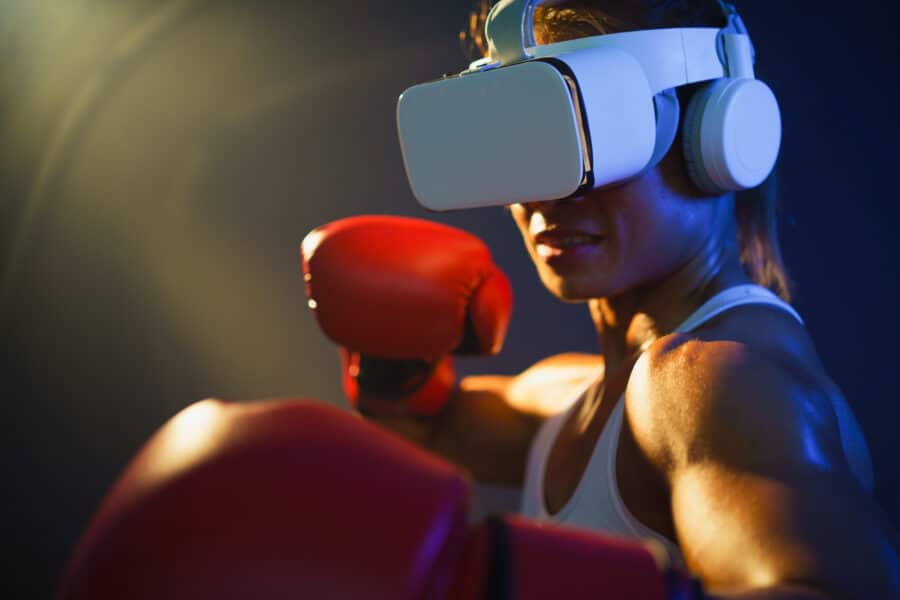



The 2024 Olympic Games are just around the corner and it’s not just the city of Paris that’s getting ready… science is getting involved too! At Inria Rennes, we are conducting research with the Olympic boxing team and its coach: as part of the REVEA project1, we are looking at how virtual reality can help the team work on certain “sub-skills” that need to be improved, such as speed, motor coordination and strength training, to name a few. Contrary to what one might expect, our virtual reality system does not aim to replicate a real match or competition, but rather to identify a specific sub-skill and improve it in a targeted combat situation. In the case of boxing, the sub-skill we are looking to train is the ability to anticipate opponents’ attacks.
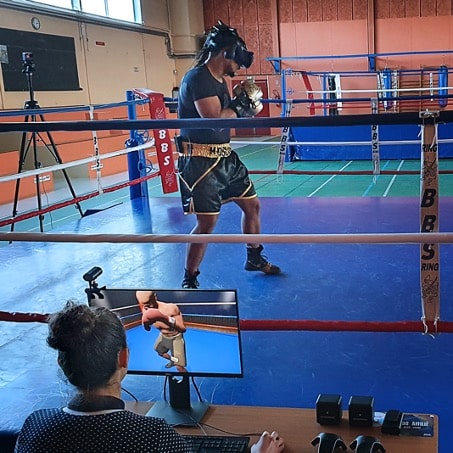
To analyse the opponent’s behaviour without virtual reality, two boxers must combat face to face, with one of them being asked to reproduce typical attacks. It is very difficult, however, to control and faithfully reproduce certain movements from one trial to the next. This approach inevitably limits training time since such an exercise is physically demanding when real punches are being exchanged. In virtual reality, this type of training can be done with our avatar and a virtual opponent without the risk of anyone being injured. It also offers a range of stimuli that go beyond what is possible in real life: we can experiment with various visual and auditory perceptions or practise with a highly-skilled opponent to push the limits of traditional training.
A boxer “behaviour map”
To this end, our team has developed a virtual reality simulator that uses three-dimensional measurements of the movements of professional boxers obtained with motion capture devices – via the Immermove platform installed in the M2S laboratory) The data obtained from this simulator, which includes, for example, anticipatory defensive movements, such as slight hip movements, is then transposed onto virtual humans with different morphologies. As such, the boxer can visualise his opponent, represented by an avatar and displayed in a virtual reality headset. In our experiments, we observe the boxer’s reactions to different types of blows, and whether he is sensitive to the slight anticipatory movements perceived by the opponent. These observations can be quantified, for example, by success rates or reaction times, to create a “map” of the boxer’s anticipatory performance.
As well as applying it to boxing, we used our approach to train goalkeepers at the Stade Rennais Football Club. Our virtual reality system trained them not to focus on the player with the ball, but to better manage peripheral vision information. Indeed, if the footballer about to attempt a goal makes a pass to someone on the other side of the goal at the very last second, the goalkeeper may not have time to react.
Applied research
Our research is very applied: our objective is to help the Olympic teams get ready for Paris 2024. Indeed, thinking about how to include these technologies in the daily life of athletes is one of the main goals. We asked ourselves the following questions: how much training should be done with this type of technology? At what time of the day and at what stage in the training programme? How long should a typical session last? Who should we train with – Olympic hopefuls or all athletes, for example? And how often? Our approach is part of a wider training programme set by the coach, which includes physical, mental and technical preparation…
The training programme includes physical, mental, and technical preparation… with added virtual reality sessions!
Our system is being used at the Olympic team’s training centre and by the scientists at INSEP working with the French Boxing Federation. We are continuing to develop it and make it more effective thanks to the feedback we receive from athletes and coaches. For example, in our first version, the opponent made too many repetitive movements, which made the combat unrealistic. We are also improving the equipment used for virtual reality training.
“Translating” the data
We have a software platform that is based on a commercial tool called Unity, routinely used for making video games. It loads a three-dimensional environment – in our case, a boxing ring – as well as virtual humans and their movements. We write a scenario in which the movements of the virtual humans are stored in “movement libraries”, which we play back. There are then algorithms linked to the motion control of the avatars. All these elements provide us with the metrics that allow us to measure the reaction times and the anticipatory behaviour of the boxers.
We have also started to work on artificial intelligence, neural networks and deep reinforcement learning to improve the behaviour of virtual opponents. This part of the technology is not yet mature, but initial results show that it is possible to reproduce the complex interactions between two boxers with very few observations of real combats. Taking this approach to its limits, we could consider simulating the movements and strategies of a particular boxer based on some video footage of his previous matches.