


How can we stay alert when faced with questionable information in a time of crisis? What attitude can we adopt to contend with unfounded conspiracy theories and paranoid rants?
Freedom of information, a distinctive feature of democracy, is also one of its greatest weaknesses because of the inherent psychological capacity for each of us to be naïve or gullible. Indeed, our brain is subject to mental shortcuts that we too often attribute to others rather than ourselves.
Cognitive biases, prejudice, stereotypes and false memories insidiously affect our perception and judgement. We delight in the sensational, rapid satisfaction, simple or even simplistic reasoning, but also consensus-based explanations and dichotomous thinking, as in the case of the famous false dilemma: “either you are with us, or against us”.
Intent on deciding and acting immediately in the present, these psychological mechanisms reveal what the economist and Nobel prize winner Richard Thaler calls the “doer” self 1. The opposite is the “planner” self, meaning the cognitive processes which require more effort; the require time, modesty, and perspective as well as the tools to observe and compare facts. Managing this “doer-planner” conflict is at the heart of our free will. Especially given that, in times of crisis, uncertainty about the future and an “infodemic” environment, strongly enhance pre-existing prejudice.
Beating conspiracy theories
The fight against conspiracy theories is a major subject of contemporary research, which is reflected in the work on inhibition led in France by Olivier Houdé 2. Inhibition is a process of attentive control and cognitive resistance that blocks heuristics, questionable intuitions and rigid prejudices, so that they can be challenged by the mind.
This process can be trained and enhanced. But it remains difficult because, for the “doer”, fake news and conspiracy theories are tasty morsels that carry convincing rhetoric supported by “persuasive lubricants” such as authority figures, illusions of correlation, generalisations…the list is long. Everyone tries to convince themselves that they are more or less aware of this underlying conflict and their ability to master it.
Some of these cognitive biases are even also there to give us the feeling that we are not at the mercy of these pitfalls! This is the case for the overconfidence effect – a bias which explains why more than half of the population believe they are smarter than average, that 93% of drivers consider themselves better than other motorists 3, and that 94% of university lecturers believe that they are more competent than their colleagues 4!
What about you? Don’t you throw the dice more gently when you want a small number and more energetically when you want a large one?! The illusion of control coaxes us into thinking that we possess a reassuring power, including in the face of uncertainty.
Cultural truisms
But another, less obvious, problem explains the power of fake news and conspiracy theories; “cultural truisms” and the deficit in democracy they are associated with. A cultural truism is a cultural representation, acquired through education, which serves as a common ground and is widely shared between the members of a community. As such, it is rarely debated or challenged – hence its weakness. Some examples include non-controversial values (honesty, equality, equity), or principles considered to be obvious in some societies (secularism or the universality of human rights).
Since truisms are self-evident, we are not aware of the reasons for which we adhere to these values, and we are not trained to defend them when they are challenged. Let us consider the teachers who had to explain and justify freedom of speech to their class in the wake of Samuel Paty’s murder in Conflans-Sainte-Honorine (France).
Contemporary truisms are often targeted by conspiracy theories. For example, they present science as a narrative very similar to others (Etienne Klein explains this problem perfectly in his latest short work, Le goût du vrai, 2020 5). Thus, the truism according to which “scientific knowledge seeks truth and works for the good of humankind” is completely undermined, as are the benefits of vaccination, or global warming linked to human activity.
Fake news: shortcuts
Since scepticism is born from a lack of herd immunity against conspiracy theories, how then can we stimulate the immune system of our social fabric? Firstly, through efficient popularisation of the ideas targeted by conspiracy theories. For example, by explaining how science works and the fundamental basis of free speech and secularism. But this can also be achieved by understanding our own individual and collective naivety in the face of fake news and conspiracy theories. A mechanism that can help us inhibit our “doer self”.
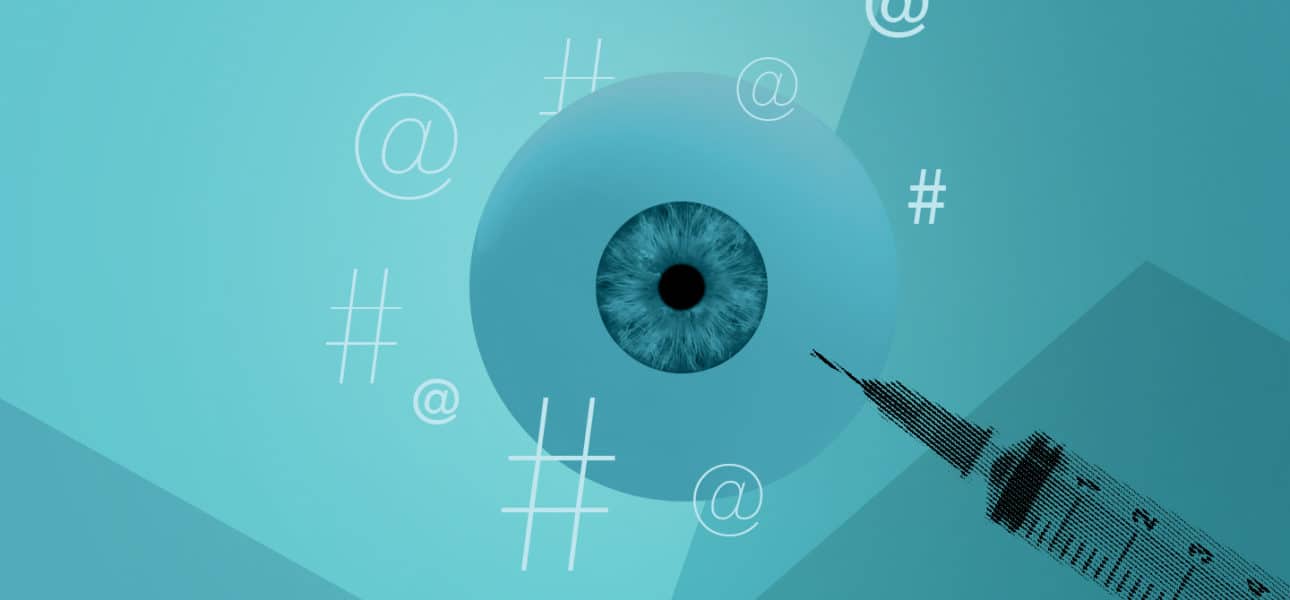
Being aware of these biases does not seem to be enough though, we must improve our skills and our ability to present effective counterarguments to confront fake news and conspiracy theories. This question of the defence of truisms is not new, but it resurfaces in the light of current events. It was formalised by the psychologist William McGuire in his “inoculation theory”, which has been making a comeback in scientific publications over the past three years. Analogous to biological inoculation, the purpose of psychological inoculation is to help individuals create their own defences, using “psychological antibodies” to resist persuasive external attacks.
As with medicine, the social fabric of democracy needs immunity to resist the infodemic – especially if it is weakened by a crisis.
The solution: a vaccine
The psychological inoculation process consists of a reverse training practice: to understand how to wield conspiracy theories and fallacious arguments, calling truisms into question in order to unravel their mechanisms and skilfully deconstruct them. Training to challenge evidence is not an easy task, because it must first pass by a respect for the very strategies that we are trying to overcome, so that we can master them later on. It is however a very promising approach in contemporary research.
An inoculation workshop is usually divided into three sessions: a defence phase, an attack phase, and finally a rebuttal phase. The defence phase consists of providing or producing arguments in favour of the idea we wish to defend (for example, freedom of speech). In the attack phase, participants will listen or honestly and sincerely develop opposing arguments to this idea, but also use common conspiracy theory tricks. In our example, freedom of speech is challenged. In other words, participants behave as conspiracy theorists or antagonists.
Finally, the rebuttal phase of the inoculation protocol consists in presenting counterarguments to train and stimulate psychological defences. Participating in these workshops in small groups leads to “social inoculation”, where participants also learn from one another.
Today, trials based on “democracy workshops” or “fake news games” allow members to carry out simulations and learn to play the roles of conspiracy theorists. Researchers like Jon Roozenbeek in Cambridge show how much this type of pedagogy helps to reduce the persuasive power of fake news articles, to put conspiracy theories into perspective and sharpen the defence of the values we hold dear 6. Democracy should not be taken for granted: our societies need to develop and train the skills of their citizens more than ever if they want to be the architects of their future.