Crisis management: how to ensure trust in these critical AI systems




- AI is becoming an increasingly important tool for transforming raw data into actionable insights.
- Algorithms designed to predict crowd movements provide professionals with tools to anticipate stampedes in panic situations.
- At present, AI is still rarely used in the tools and work processes of first responders, nor in the decision-making mechanisms of the authorities.
- Mistrust of AI contributes to the debate and to improvements in the quality of the solutions deployed.
Faced with global challenges marked by climate change, the interconnection of our systems, geopolitical shifts and the proliferation of systemic emergencies, AI is increasingly emerging as an essential tool for security and emergency response personnel, as well as for decision-making authorities. Whilst innovation cannot be the sole response to this new reality, it undeniably constitutes a significant part of it.
However, the rapid pace of this technological evolution contrasts with the level of trust that crisis management stakeholders place in these tools. How can crisis managers and field operators rely on systems they do not fully understand? How can we ensure the effectiveness of this new technology in crisis management processes aimed at saving lives? The issue of trust and the mechanisms for building it is one of the central challenges in the use of AI in crisis management.
The term “crisis” derives from the ancient Greek word “krisis”, meaning “choice” [editor’s note: or “judgement”]. Originally, this word had no negative connotations; it referred to a moment of decision. An increasing number of systemic emergencies are emerging, the scale, duration, scope and multifaceted nature of which are shaking the very foundations of our society. We have moved from isolated crises, with rapid dynamics, to catastrophic situations characterised by multiple problems with a domino effect, unclear causes and consequences, and a relatively long duration, impacting numerous sectors1.
In addition to this shift in nature, the response to crises is also different. The proliferation of sensors, surveillance systems, satellite data and information shared by citizens via social media generates a massive flow of information requiring real-time analysis. AI is thus becoming an indispensable tool for transforming this raw data into actionable insights.
The benefits of using AI in crisis management
However, the growing volume of data comes up against a reality on the ground: human resources alone are often insufficient to process this data and extract value from it. AI, in its various forms, offers opportunities to automate the collection, classification and reporting of anomalies, or to make predictions depending on the relevance of the use case. Progress is continuous and iterative.
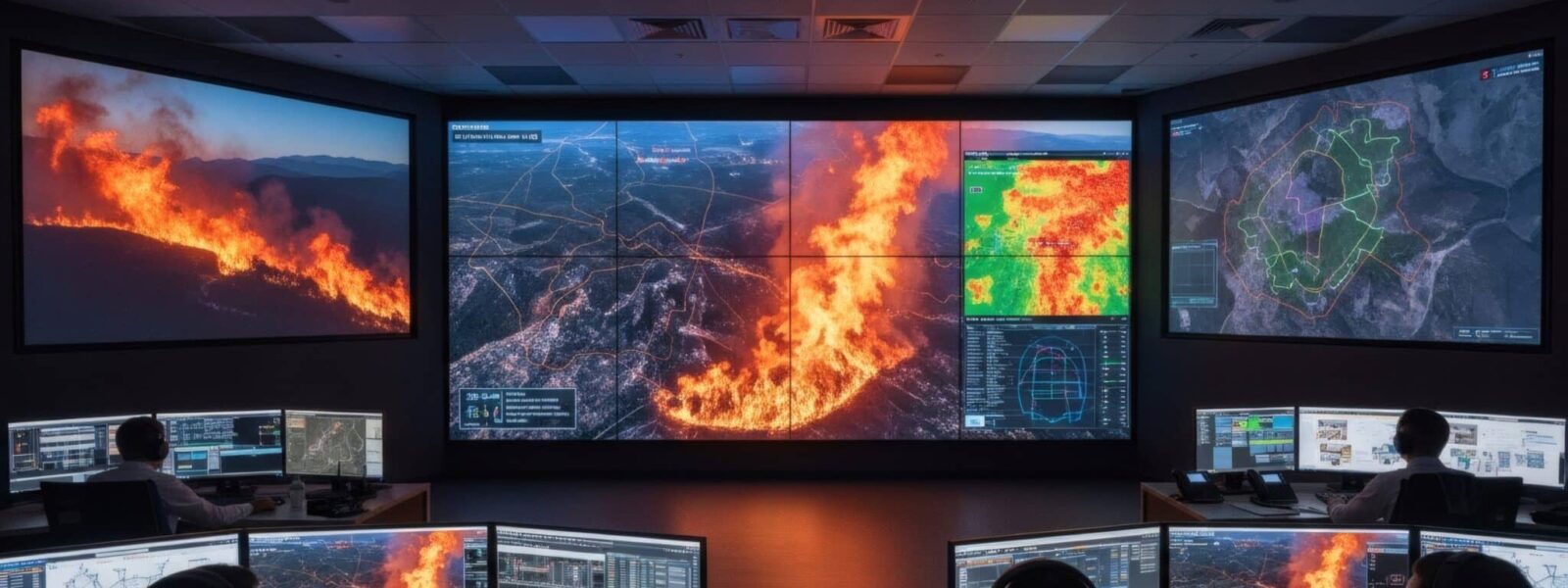
In the field of firefighting, AlertCalifornia2 monitors California’s forests using a network of high-definition cameras coupled with AI analysis, detecting between 50 and 300 incidents per day. Similar initiatives are emerging in Europe, such as Pyronear3 in France and FireTracking4 in Indre-et-Loire, with increasing reliability and a reduced false positive rate. In Indonesia, a chatbot (PetaBencana.id) maps floods reported by Jakarta residents in real time, supplementing citizen-generated data with official data5.
The convergence of these capabilities paves the way for applications designed to resolve complex, multi-factorial situations.
Spatial and satellite data, combined with algorithms such as Random Forest and Deep Neural Networks, also enable the precise mapping of landslide risks6. Algorithms designed to predict crowd movements provide professionals with tools to anticipate stampedes in panic situations. On a different scale, the ECMWF is developing prototypes of digital twins of the Earth in collaboration with the European Space Agency (ESA)7.
The convergence of these capabilities paves the way for applications designed to resolve complex, multi-factorial situations. Thus, safe.brussels8 and ESA brought together eight international teams in late 2025 for a hackathon focused on the use of space data and AI for managing the movement of people in emergency situations.
However, a collective challenge remains to be addressed: data collection and interoperability. Conditions on the ground during disasters, the diversity of formats used by different stakeholders, and the heterogeneity of legal frameworks and organisational cultures all present obstacles. Data cleansing is an essential prerequisite for reliable and responsive warning systems.
Building trust in AI: between transparency and accountability
At present, AI is still rarely found in the tools and work processes of operators or in the decision-making mechanisms of public authorities. Whilst technical and budgetary considerations may explain this situation, the issue of trust in this technology is also a key factor. Artificial intelligence solutions can be regarded as “socio-technical” systems, the performance of which relies on interactions. Consequently, building trust in this technology is a dynamic process. This process can be structured around several key elements: credibility (reliable data and validated results), explainability (stable and reproducible results), relational proximity (clear and understandable human interactions with AI), and alignment of interests (AI regarded as oriented towards the public interest, rather than towards external commercial or political objectives).
Whilst scepticism is intrinsic to any technology, it is particularly prevalent when it comes to AI. It is natural and healthy for a manager to be sceptical about a new technology on which vital decisions may depend. This scepticism contributes to the debate and to improvements in the quality of the solutions deployed. However, it must not slow down the experimentation necessary for the iterative improvement of these technical solutions.
No decision-maker decides based on a case that is not rigorously detailed, documented, quantified, and whose data is not fully traceable. Yet, the current state of the art in artificial intelligence rarely allows for a guaranteed level of reliability without human supervision. The answer therefore lies here: for the time being, there is no question of relying on fully autonomous solutions. Instead, the solutions aim to provide refined, aggregated, verifiable information, placing humans at the heart of the system. This concept is known as Human in the Loop (HITL) and is becoming central to high-stakes decisions. The EU’s AI Act9 also enshrines this human role in the supervision of AI systems classified as high-risk.
If the role of these technologies is to shift humans towards tasks with higher added value, then society at large seems willing to accept it. However, if they are perceived as posing a risk of competing with the role of experts, then tensions arise. This nuance is reflected in studies by LaborIA10 and APEC11: 37% see AI as an opportunity, 22% as a threat. Acceptability depends heavily on context and the level of information available.
As we have seen, trust also depends on the robustness and explainability of the tools, which are currently active fields of scientific research. Other elements are key to establishing this trust: data traceability, which presents a challenge and an area for investment, as well as so-called Zero-Knowledge Proof (ZKP)12,13, which offer the prospect of cryptographically guaranteeing the origin of data. Finally, the clarity of the information presented in a crisis situation is crucial: this is the challenge of “Decision Intelligence”, the set of methods enabling the consolidation of data useful for predictive purposes, in a context where the flow of information can overwhelm cognitive capacity.
Conditions for success
The implementation of AI in crisis management will ultimately depend on conditions that foster the development of a relationship of trust between crisis management stakeholders and AI systems. Co-design is fundamental. Prospective users must be involved from the earliest stages of development to ensure that the tool meets their actual needs. This collaborative approach increases acceptance, fosters a sense of ownership and builds closer relationships. Data sharing between institutions, emergency services, law enforcement, critical infrastructure operators and citizens will improve the relevance of AI recommendations, drawing on a consolidated data ecosystem.
Clear governance must establish ethical and transparency principles, impose mechanisms for traceability and the explanation of decisions, ensure accountability for assisted decisions, and define everyone’s responsibilities. Continuous evaluation is essential through feedback mechanisms and post-crisis debriefings. Finally, tailored training explaining the limits of AI, potential biases and the scope for action available to operators, supplemented by regular exercises simulating crisis scenarios incorporating AI, will enhance understanding, mastery and, consequently, trust.
The integration of artificial intelligence into crisis management is not merely a technological issue; it is essentially a challenge of trust. Without trust, technology is nothing more than an empty promise. The iterative progress of AI-based solutions demonstrates tangible potential for improving crisis management, making systems more responsive and effective in dealing with emergencies. However, challenges remain. These require human investment in governance and data collection, as well as the need to adopt iterative approaches and support research and open-source initiatives.
https://doi.org/10.3390/rs16162947↑