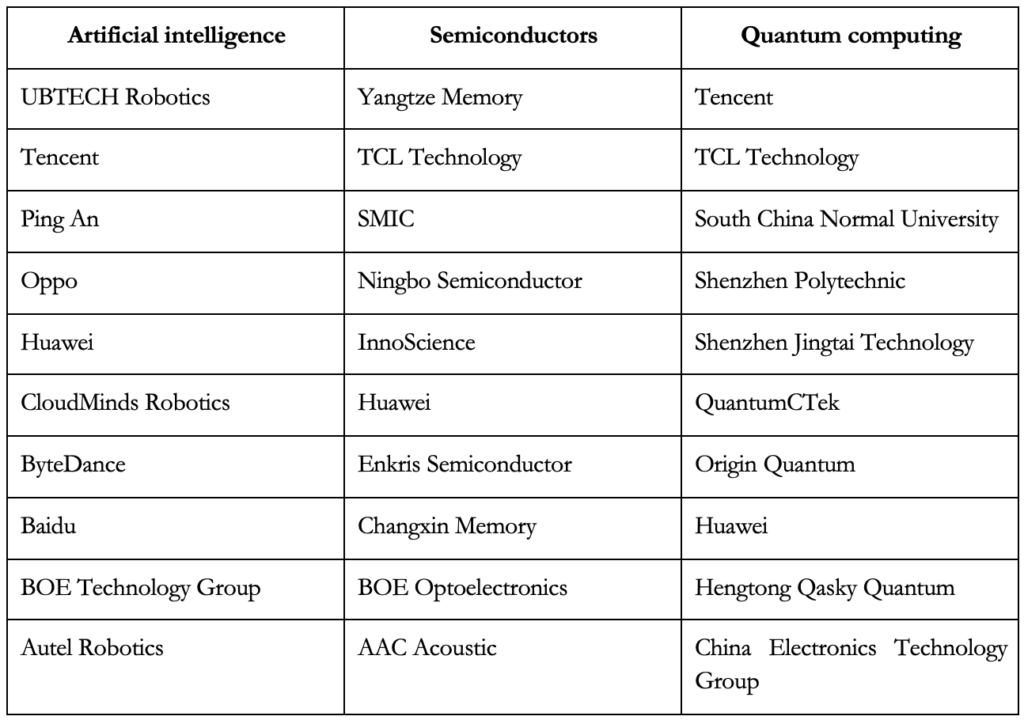



China can no longer be considered a second-tier competitor in technological innovation. Since the mid-2010s, it has demonstrated its ability to position itself as a leading player. With regards to high performance in the global race for AI, whilst not overtaking the United States, it has clearly distinguished itself. Looking at the number of Chinese patents filed in this field, the pace has clearly accelerated since 2019. According to the World Intellectual Property Organisation, Beijing filed nearly 30,000 patents related to generative AI between 2014 and 2024.
At the turn of the 2020s, the Chinese tech giant Huawei made a breakthrough that has American competitors fearing the launch of Chinese chips just as powerful as their own products. Today, according to observations by Pierre Sel, a PhD student at the University of Vienna, “it’s open-source AI models are of higher quality than those developed in the United States.”
DeepSeek‑R: an overrated tool?
In January 2025, the Chinese company DeepSeek surprised the world by unveiling DeepSeek-R1, a high-performing open-source AI model, trained at a fraction of the cost of OpenAI, thanks in particular to engineering work that enabled developers to maximise the use of the chips at their disposal. Liang Wenfeng, its founder with a background in quantitative finance, has outperformed US tech, whilst OpenAI had until then seemed unbeatable.
Even more surprising is that he achieves this performance at reduced costs and without access to the most efficient chips. Pierre Sel qualifies this success by noting that “access to advanced chips is not a cut off. The start-up has certainly been able to benefit from the Malaysian black market”1 and is said to have “trained” its model using American models. As for the actual cost, whilst DeepSeek puts it at $6 million, “this figure excludes costs related to the development cycle and the deployment of infrastructure2,” the researcher clarifies. The sudden emergence of this model was subsequently exploited extensively by both Beijing and Washington, against a backdrop of political and commercial objectives.
Generative AI according to Beijing: a key element in China’s future
The Chinese Communist Party (CCP) places AI at the heart of its economic framework and, more specifically, advocates for the widespread deployment of generative AI. The report by the China Internet Network Information Centre (2025) promotes the “growing adoption” of these technologies and notes that the use of “smart assistants” is already commonplace in many sectors, including industry, consumer goods, healthcare, disaster prediction and education. Official statements that should be treated with caution, as Pierre Sel points out, “serious doubts remain regarding the quality of this adoption”.
The gap between the two countries lies in computing power, which is determined by the chips used.
According to official data published by Beijing, the uptake of these technologies has already reached an advanced stage: “more than 78% of the companies surveyed use some form of AI, ranging from customer service to logistics.” On the user side, figures released in February 2026 indicate 600 million users of generative AI, out of a total of 1.125 billion internet users. The platforms are also reported to have processed over 600 billion queries per day3.
This massive uptake, combined with widespread use, requires considerable computing power, a digital architecture and infrastructure commensurate with the Party’s stated ambitions. “In terms of development capabilities, there is no doubt that China possesses technical and human resources (and, to a lesser extent, financial resources) comparable to those of the United States. The gap between the two countries lies in computing power, which is determined by the chips used,” explains Pierre Sel.
Semiconductors: a national priority
There is no doubt that the United States dominates the semiconductor market, with their tech giants such as NVIDIA, Qualcomm and AMD. In 2024–2025, over 50% of global semiconductor revenue was generated in the United States. On the other side of the Pacific, almost a quarter of the chips sold worldwide in 2024 were purchased by Chinese electronics manufacturers, according to estimates by the Semiconductor Industry Association.
In January 2025, shortly before leaving the White House, Joe Biden introduced new regulations: the Framework for Artificial Intelligence Diffusion. This legislation aimed to restrict access to chips for Chinese buyers. A year and a president later, a policy shift took place. Donald Trump relaxed export controls by authorising NVIDIA to sell the H200 chips, one of the most powerful available to Beijing. In return, a 25% tax must be levied by the United States.
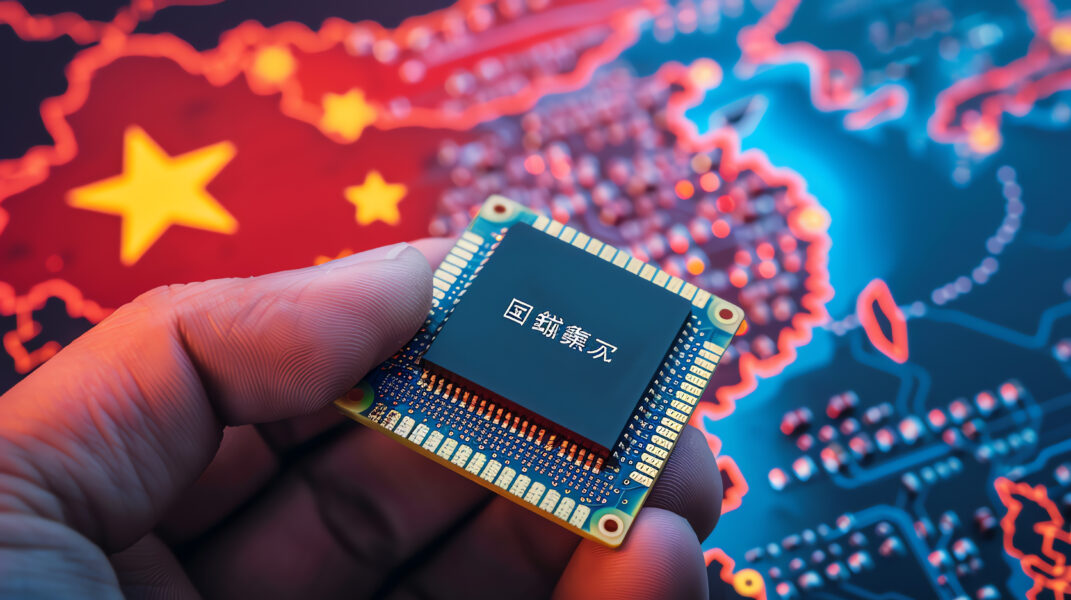
Aware of this strategic weakness, the Chinese government is seeking to regain its sovereignty, notably by strongly encouraging manufacturers to develop local alternatives. Moreover, according to Pierre Sel, “companies can choose to use a data centre located abroad (often in Malaysia or Singapore) to train AI models. These data centres are not subject to US restrictions and can procure NVIDIA chips freely”4.
Adverse forecasts for Chinese chip production?
According to Chris McGuire, a member of the Council on Foreign Relations think tank and advocate of export controls, the gap between the two powers is widening. Based on the highest estimates, Huawei would account for only 5% of NVIDIA’s global computing power in 2025, 4% in 2026 and 2% in 20275. Others point to some progress: 20 to 30% of the equipment used in Chinese chip manufacturing is expected to be produced in China by 2025, compared with 10% in 20226.
Despite China’s overall lag in this race, Pierre Sel warns against jumping to conclusions. He particularly highlights the ambiguity of the players involved, who have multiple interests in exaggerating the lead of some or downplaying their own. Furthermore, the criteria used to give one country an “advantage” over another are vague. Thus, “while China may not possess the most powerful chips or models, it is its open-source models that are the most downloaded7.” Downloading does not necessarily imply usage; nevertheless, this data continues to cause concern among US stakeholders.