The construction sector’s hidden role in deepening global inequalities



- Over the past two decades, global CO₂ emissions from buildings have risen by 50%.
- Emissions from the (residential) building sector exceed 1 tonne per person in several regions: Europe and Eurasia, North America, East Asia, the Middle East, and Australia, Japan and New Zealand.
- Around half of new buildings constructed in emerging and developing economies are not covered by energy performance regulations.
- The mitigation potential of decarbonisation measures in the sector amounts to 8.2 billion tonnes of CO2 by 2050.
The construction and operation of buildings constitute one of the main sectors emitting CO2, the primary anthropogenic greenhouse gas. In 2023, the sector accounts for around 34% of energy-related CO2 emissions (up to 37% when including emissions from building materials), and 32% of global energy demand1. “Its share of global greenhouse gas emissions is considerable and cannot be ignored,” says José Lopez. Indeed, if we are to limit global warming to 1.5°C, the sector accounts for 11% of the global mitigation potential by 2035.
Decarbonisation targets
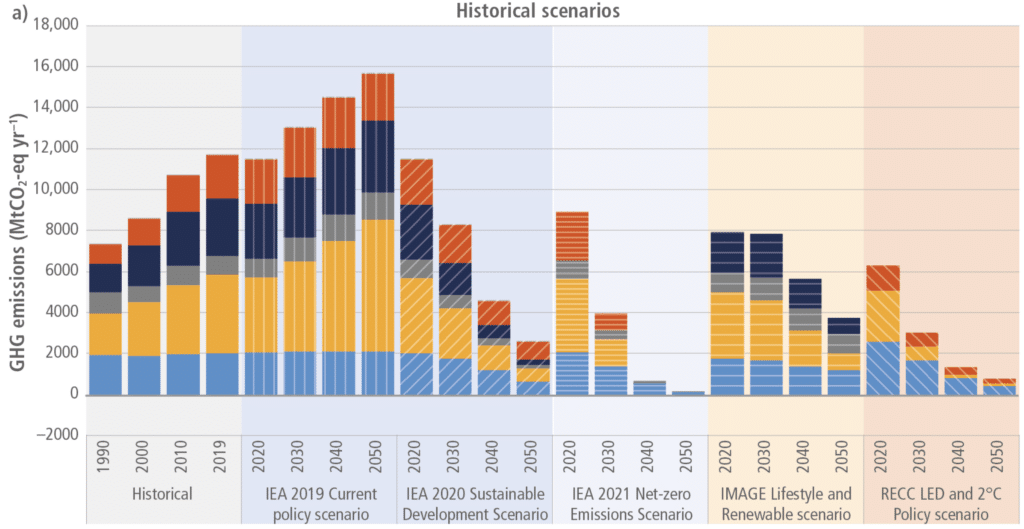
And yet, this sector is still a long way from achieving its decarbonisation targets. Over the past two decades, global CO2 emissions from buildings have risen by 50%2. Whilst emissions linked to building use should have fallen by 28.1% between 2015 and 2023 to meet the sector’s decarbonisation targets, they have risen by 5.4%. None of the indicators, including energy intensity, the share of renewables, environmental certifications, investment or policy progress, is meeting its targets. The reason? “The trend is driven by emerging and developing economies, particularly in Asia,” notes José Lopez. Growing energy demand is driven by Africa, Asia and the Pacific, and studies show that this growth is set to continue. As for developed economies, they have reduced emissions from residential buildings and have managed to stabilise those from the non-residential sector, according to the IPCC. Australia, Japan and New Zealand are exceptions, and the trajectories of these countries as a whole vary significantly.

But caution is needed: we must avoid simplistic arguments that point the finger at emerging and developing economies whilst praising developed economies. “Climate change is an indicator of inequality, and the building sector actually illustrates a double inequality,” adds José Lopez. “The countries that have historically emitted the most are not the ones building the most today, and the populations most in need of improved thermal comfort are often those with the least means to access it sustainably.”
Increase in emissions
The IPCC’s 6th Synthesis Report details the factors explaining why emissions from the sector continue to rise, focusing on the residential sector, which is the primary component: population growth (28%), the increase in living space per capita (and thus the lack of energy-saving measures, 52 per cent) and the rise in the carbon intensity of the global energy mix (16 per cent). However, these factors vary greatly by region: for example, many people lack access to housing, and the lack of energy-saving measures and the increase in living space per capita therefore affect only a portion of the global population. Whilst population growth has a moderate impact on developed regions, it accounts for a large proportion of the rise in emissions in developing regions. The other factors, such as rising living standards, a lack of energy-saving measures, and low uptake of renewables and energy efficiency, are also marked by significant regional disparities.
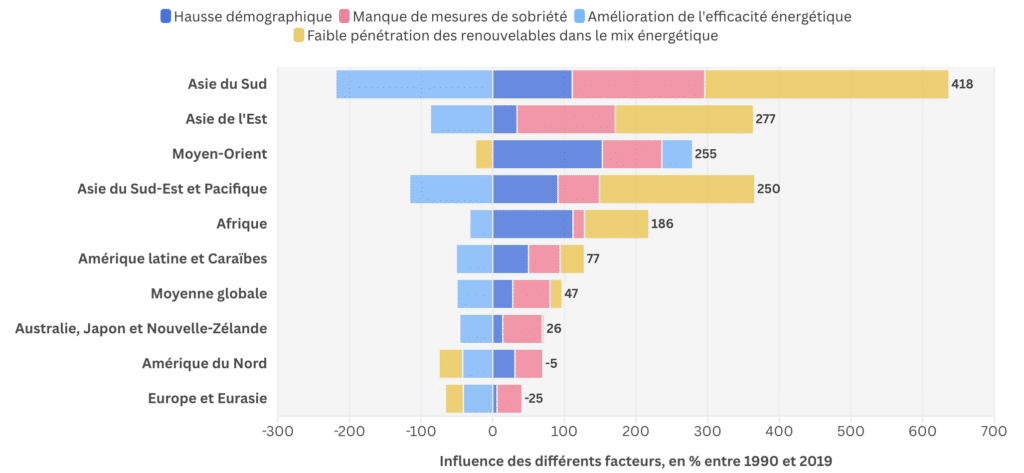
And how can we talk about the building sector without considering the people involved? “Housing is a right; there are colossal challenges of social and geographical equity in the face of disparities in access to housing, healthcare and education,” agrees José Lopez. Whilst the growing demand for energy is driven by Africa, Asia and the Pacific, their per capita emissions remain well below those of developed regions. In 2019, global average emissions from the residential sector stood at 0.85 tonnes of CO2 per person per year. Emissions from the (residential) building sector exceed 1 tonne per person in several regions (Europe and Eurasia, North America, East Asia, the Middle East and Australia, Japan and New Zealand). Conversely, all other regions are below 0.3 tCO2 per person (Africa, Latin America and the Caribbean, South-East and South Asia, and the Pacific)5.
These disparities highlight a central issue of climate justice: the regions that contribute least to emissions are often those where construction and adaptation needs are greatest. “Today, emerging and developing economies want to build in the same way as Europe,” continues José Lopez. “We need to strike a balance and not simply converge towards the Western model. This applies to developing economies, but also to developed ones, which must make a significant effort to reduce their energy consumption.” The aim is to achieve decent living standards for the entire population, whilst adjusting standards. In the sole carbon-neutral scenario reported by the IPCC, where standards are the same across developed and emerging economies, the optimal living space amounts to 20–40m2 per person. “This also raises the question of the sector’s development model: should we replicate energy- and material-intensive, high-carbon models, or develop models adapted to local contexts that are more frugal and resilient?” points out José Lopez.
Building and renovation codes and standards
However, progress on building and renovation codes and standards has been slow, with around 20 new codes adopted in 2023, compared with just 3 in 2024. “Overall, their level of implementation remains limited,” adds José Lopez. According to the International Energy Agency, around half of new buildings constructed in emerging and developing economies are not covered by energy performance regulations (compared with less than 30% for residential buildings in developed countries). However, demographic forecasts point to global population growth and a significant rural exodus, with Africa and Asia accounting for 90% of the latter. “A doubling of built-up area is forecast by 2060, driven mainly by Africa,” says José Lopez. “Yet it is very difficult to counter the standardisation of construction materials, such as concrete, steel and glass, which marginalises other sectors, such as earthen brick, which is particularly relevant in Africa.”
Finally, whilst inequalities are glaringly obvious in terms of responsibility and demographic challenges, a further one is added: the effects of climate change. In Europe, for example, direct CO2 emissions from the building sector fell in 2022 thanks to mild winter temperatures6. Conversely, the rise in extreme weather events such as heatwaves poses a particular challenge in the Asia-Pacific region. “These events, combined with poor-quality construction and rising living standards, are causing a surge in the use of air conditioning,” comments José Lopez. Two-thirds of the world’s population lives in hot climates, so access to cooling solutions is becoming a public health issue. But its expansion can increase emissions and strain on electricity grids, and we expect energy consumption in the building sector for air conditioning to triple by 2050!
The levers for decarbonising the sector are well known, as the IPCC explains: moderation (occupying all existing buildings, sharing housing, adjusting size to changing needs, etc.), energy efficiency and reducing the carbon intensity of energy. Implementing these measures would be effective: the mitigation potential amounts to 8.2 billion tonnes of CO2 by 2050. It is highest in emerging and developing economies (5.4 billion tCO2) despite these countries currently emitting less CO2 in this sector and stands at 2.7 billion tCO2 for developed economies. “Realising this mitigation potential poses a major social challenge: the poorest households often live in the least energy-efficient homes. Without appropriate supporting measures, the building sector transition therefore risks exacerbating inequalities,” concludes José Lopez.
Anaïs Marechal
https://wedocs.unep.org/20.500.11822/47214↑