Post-mortem ecology: the rise of “green funerals”


- In France, only three methods of inhumation are legal: burial, cremation and donation of the body to science.
- However, these methods have a significant ecological impact, since according to one study, a single burial generates 833 kg of CO2.
- Today, more ecological alternatives are emerging: promession, aquamation and terramation.
- These “green funerals” illustrate society’s ecological aspirations, with burial methods that are synonymous with a spiritual return to the earth.
- At the same time, cemeteries are evolving into greener spaces that welcome biodiversity.
Funeral rites have not escaped the glare of the ecological transition. While alternative methods of burial are slowly emerging, traditional means of burial and cremation are evolving to reduce ecological impact, in particular with the advent of greener cemeteries.
In the words of André Malraux, “the most beautiful tomb is the memory of man”. The most ecological, however, has yet to be determined. We are increasingly concerned about the environmental impact of our death, but we are still faced with a limited choice. “Only two types of burial are legal in France,” says Martin Julier Costes, a sociologist specialising in end-of-life and bereavement issues. “These are burial and cremation. There is a third option, which is to donate one’s body to science,” he adds, “but very few people make this choice.” The majority (6 out of 10) of funerals are burials. Cremation, on the other hand, has become increasingly popular since “the end of the 19th century and the authorisation of cremation”. According to the Association Française d’Information Funéraire (Afif), cremation will account for 41% of funerals by 2022, and more than 50% in many towns and cities.
These funeral rites have a significant ecological footprint. They generate greenhouse gas emissions, consume natural resources and pollute the soil. One of the only French studies on the subject1, commissioned in 2017 by the funeral services of the City of Paris, estimated the carbon emissions produced by a single committal at 833 kg of CO2. That’s the equivalent of driving a private car 4,000 km or producing 741 litres of beer.
Alternatives are still in their infancy
While more environmentally-friendly solutions are emerging for paying tribute to the deceased, none has yet been legalised in France. There is “promession”, a Swedish initiative that is still in its infancy and as yet untested, which involves using extreme cold (a liquid nitrogen bath) to freeze and then reduce the body to powder. Conversley, “aquamation” is a reverse technique that dissolves the body in an alkaline solution at 93°C, before transforming the bones into powder. “This method is legal in North America,” explains the sociologist, “but its technical effectiveness has yet to be demonstrated.”
From one element to another, “terramation” does not involve liquid processes, but consists of “returning the human body to a state of humus”. In other words, human composting, which can take place on three different levels. Firstly, on the ground, with a humusation process in which the corpse is placed on a bed of shredded material, then covered with organic matter. Then above ground, as proposed by the American company Recompose, which decomposes the body in capsules (“recomposition containers”) and creates compost in a few weeks, which is given to the family to “return to nature”, with the aim of revitalising the soil. Lastly, there is a ground technique, i.e. burial without a coffin, in a shroud and with shredding to activate and regenerate the soil. In this case, “we make something new out of something old”, explains Martin Julier Costes, “because coffins were not compulsory in France until the time of Napoleon”.
Back to the Earth
For the researcher, who shares his thoughts and work on his personal page2, all these initiatives mobilise the imagination of “gentleness, (…) natural elements and a return to the earth”. But their growth in popularity is not only explained by the rise of ecological aspirations in society. “Some people are taking an interest in the destiny of their bodies by drawing inspiration from new spiritualities, particularly those stemming from Eastern currents such as Hinduism or Buddhism”. Their approach is motivated by a certain coherence between life, body, nature, and spirit. The idea of returning to the earth is particularly present in the terramation process, with the idea of “creating a virtuous cycle between life and death, by regenerating nature” after having lived in it for a while. “Other mental frameworks are associated with this dynamic,” he continues, “such as animalism, shamanism, or the new philosophy of living beings espoused by intellectuals such as Philippe Descola or Baptiste Morizot”.
At the same time, the sociologist observes a growing individualisation of social behaviour, which would explain a “growing trend towards personalised funerals”. This is a new way of standing out from the crowd, by organising “funerals in one’s own image, outside the traditional methods of burial” that are too closely associated with dominant religious or cultural dogmas.
From fields of gravestones to gardens of rest
While we await the legalisation of some of these environmentally-friendly funeral rites, the first steps to be taken to reduce the environmental impact of our funerals should be sought in cemeteries. French burial grounds are essentially gravel and minerals. “Burial with the construction of a vault and the installation of a monument, often imported from South-East Asia, is equivalent to the greenhouse gas emissions of more than 5 cremations” warns the City of Paris funeral services in their study.
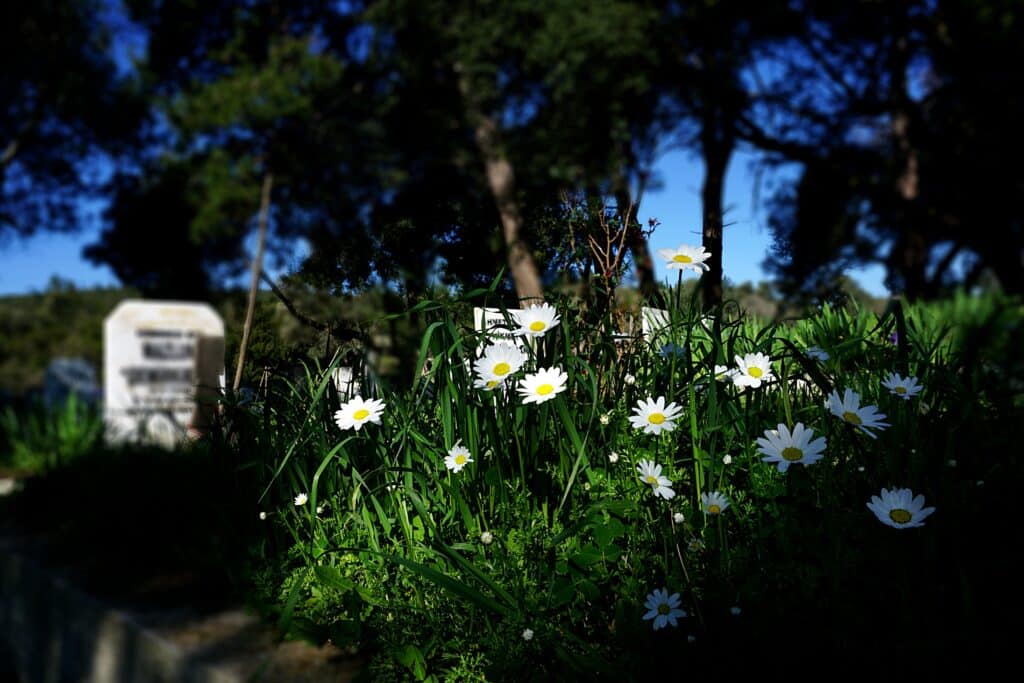
Against this backdrop, we need to make the transition from a field of tombstones to a garden of rest. “Our cemeteries are gradually becoming greener, landscaped spaces,” observes Martin Julier Costes, following the example of Père Lachaise in Paris and others in Niort, Versailles, Lyon and Grenoble. Weasels, foxes and tawny owls roam freely alongside 140 other animal species and “more than 220 wild plant species (…) observed between 2010 and 2020”, according to the Paris City Council.
The recent “Living Cemeteries” study conducted by the Île-de-France Biodiversity Agency shows that these areas have “an interesting capacity to host biodiversity”. Nevertheless, they remain “heavily mineralised”, suggesting the need for a real greening policy? This would benefit both wildlife and residents (the urban green lung effect), as well as those who live there or aspire to do so in terms of ecological acceptability. What remains to be done is to “get this transformation adopted by staff and citizens alike”, points out Martin Julier Costes, who points out that more and more local authorities are “taking a political approach to the greening of the funeral industry”, as is the case in Lyon.
Taking political ownership of green funerals
This is not the full picture, and there are still gaps in the analysis of the ecological footprint of funerals. “There is, for example, no solid study combining biology, hydrology and chemistry to examine the environmental impact of burial and cremation on the soil, the air or the water cycle, or on thanatopraxy and the associated care”, notes the sociologist. The study commissioned by the Paris funeral services “is interesting, from his point of view, but still insufficient”.
He therefore calls on the public authorities to take up the issue, to objectivise this environmental impact, and take the necessary measures to make the funeral industry greener, and tomorrow – perhaps – we could curl up in a plant cocoon and let the soil take care of our burial. Naturally?