


The facts are clear: we need to drastically reduce our greenhouse gas emissions. With today’s technologies, this means abandoning fossil fuels if we hope to limit the extent of climate change. This transition to decarbonised energy sources (wind, photovoltaic, hydro, nuclear, geothermal, biogas, etc.) will not be easy. It will be a first for mankind, as historian Jean-Baptiste Fressoz1 has shown. Until now, energy systems have been cumulative, rather than one source substituting for another.
To get from production sites to installation sites, the components of a nuclear power plant or photovoltaic panels are still being shipped around the world on container ships powered by fossil fuels. Hence, renewable energies are developing in synergy with fossil fuels. For example, copper is a crucial element in power grids and thus in the energy transition. With some 5.5 million tonnes extracted every year, Chile is the world’s leading producer. To meet nearly 25% of the world market’s needs, Chilean mines use thousands of tonnes of refined petroleum, which is essential for bulldozers, as well as electricity, 40% of which is produced from coal2. Coal is imported by ship from Colombia, Australia, and the United States, via a supply chain that also relies on oil and gas.
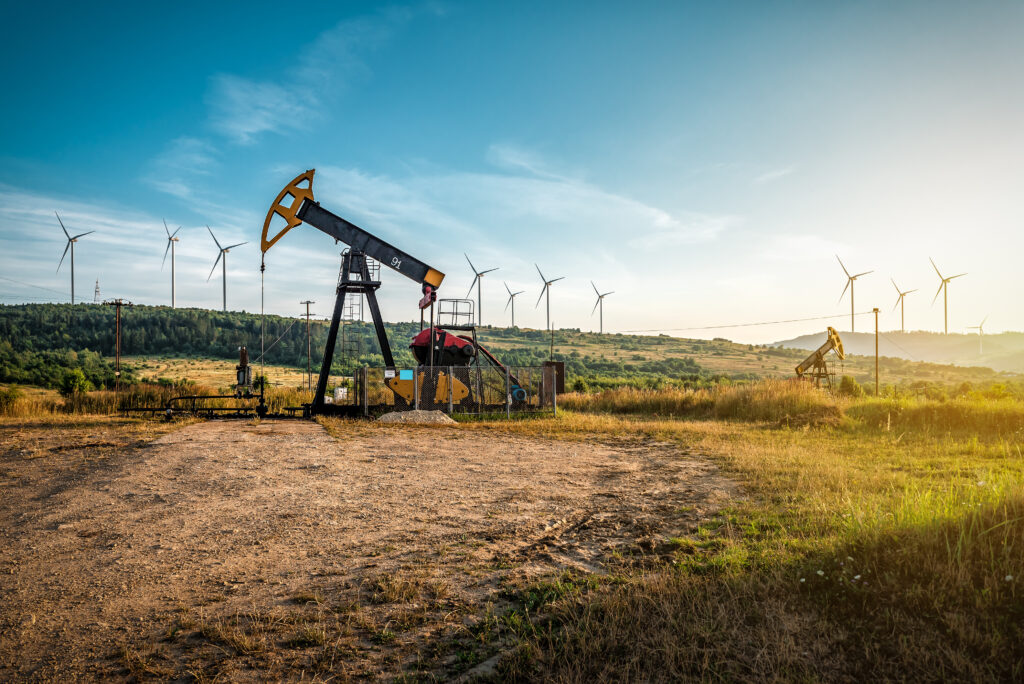
Global consumption of primary energy, i.e. the sum total of unprocessed energy products, is rising steadily. And the synergy works both ways: more and more fossil fuel extraction sites are running on renewable energies, as illustrated by the wind turbines powering South Africa’s Mpumalanga coal mines, or the photovoltaic panels deployed around Texas oil wells.
A bottleneck
The transition we must make will need to be absolute, not relative like those of the past. And, as an added difficulty, to compensate for the immense energy density of fossil fuels, many infrastructures based on renewables will need to be operational rapidly.
In order to achieve a carbon-neutral world economy by 2050, i.e. a transition capable of keeping climate drift to 1.5°C, the International Energy Agency (IEA)3 has identified hydrogen as playing a central role. The properties of this energy “carrier” make it particularly well suited to decarbonising industrial processes (steel and fertiliser production in particular) and air and sea transport. Today, some 115 million tonnes of hydrogen are produced worldwide every year, mainly through industrial processes based on gas and coal. These techniques therefore emit greenhouse gases. The IEA estimates that by 2050, 500 million tonnes of hydrogen per year will be needed, this time from low carbon sources.
How can we achieve this quantum leap? White hydrogen, of natural origin, a large deposit of which has just been discovered in the Lorraine region of France, does not appear to be a viable option on this scale within the timeframe imposed for the transition. Although more advanced industrially, the same is true of blue hydrogen, which is based on the combustion of fossil fuels combined with carbon capture and sequestration. Instead, we’d have to rely on “green” hydrogen, produced by the electrolysis of water using decarbonised electricity. But the electricity requirements would then be gigantic. Producing 500 million tonnes of carbon-free hydrogen per year would mean building some 4,000 new nuclear reactors worldwide, in addition to the current 437. If political choices lead to a preference for wind power, 6.2 million wind turbines would have to be installed by 2050, compared with the current global total of some 500,000.
Will we have the industrial and material resources for these developments? Recent research shows that, in a rapid transition scenario, the construction of the low-carbon energy system risks producing a bottleneck on available energy. For a few decades, the low-carbon energy system would cannibalize so much energy that it would constrain other productive systems, leaving much less energy available for air transport, steel or cement production for other purposes4.
Heading towards a war economy?
A rapid energy transition, compatible with national commitments, risks imposing extremely severe constraints on our societies, which we need to anticipate. According to certain models, we can expect a massive redirection of the production apparatus, comparable to that experienced by the United States when it entered the Second World War5. The material and energy requirements to produce wind turbines, photovoltaic panels and electrolysers would be such that they could lead to a shortage of everyday goods. This could even restrict household consumption. Against this backdrop, unemployment is likely to fall, as the need for manpower will be considerable. But the combination of industrial effort, tension on the labour market and, consequently, rising wages, would lead to high inflation – around 10% a year – for several decades to come.
But it’s not all over yet. Many political decisions could influence this “war economy” scenario. In fact, the term is already being called into question. Not least because, historically, a war economy is temporary; it’s an effort demanded of citizens with a view to a return to normality6. However, if the ecological bifurcation is successfully completed, there is no question of returning to the world of the past, with its waste and abysmal inequalities.
In this new world, neither the technical progress essential to the sustainability of the transition, nor the various political options, will enable us to free ourselves from the material constraints imposed by the physical world. Without the illusions created by the easy energy of fossil fuels, our relationship with energy will revert to that which humanity knew before the twentieth century. Is this catastrophic? No, we just need to accept this return of restrictions and adapt to them as soon as possible. Otherwise, we run the risk of becoming the victims of this new energy order.