


For decades, the field of space developed thanks to large infrastructures such as space agencies (NASA, ESA, Russian Roscosmos) and large aeronautics industry groups (Boeing, Lockheed Martin, Airbus, Dassault). But times are changing. Today, new economic models are emerging, based on agility, innovation and greater risk-taking – both technological and economic. This shift has given rise to budding private companies trying to make their mark in the highly competitive field of space.
What changes have enabled their appearance? What is this new dynamic? For what applications and markets? Let’s take a closer look at what is known today as the “New Space”.
Space, more accessible than ever
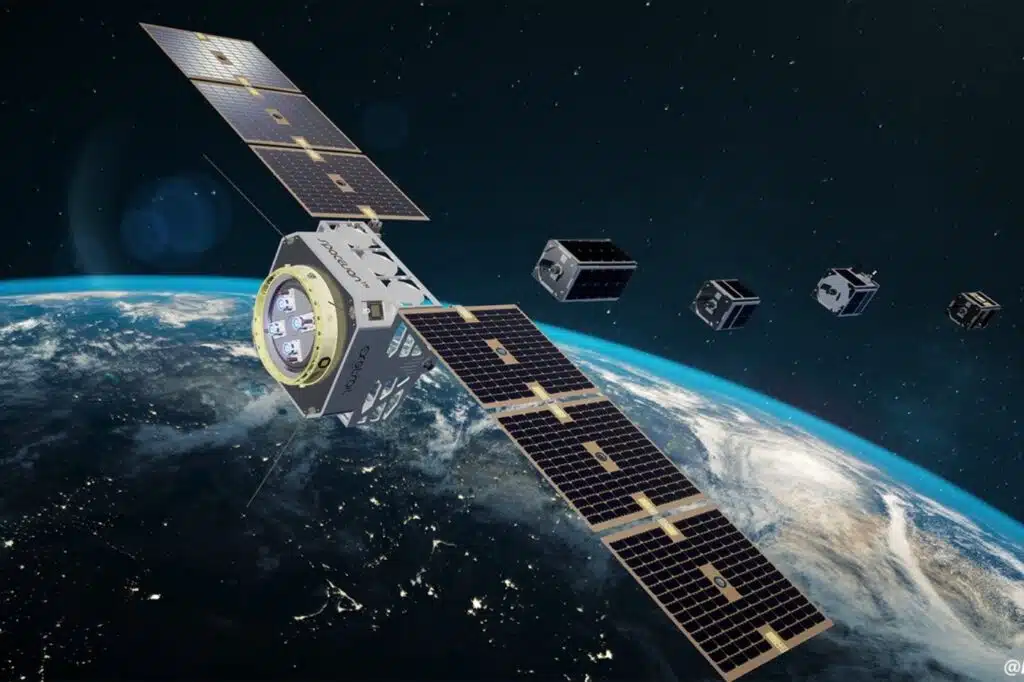
The last two decades have seen several changes that have made it easier (and cheaper) to access and use space. First, technologies have seen considerable evolutions making is possible, today, to compress equipment into a volume equivalent to a few shoeboxes. Such technology would previously have required a satellite the size of a car. Hence, thanks to the miniaturisation of electronic components, new materials and on-board artificial intelligence algorithms, new satellites are small, flexible and much cheaper than their predecessors.
From ‘microsatellites’ weighing barely more than 100 kg, we have now moved on to nanosatellites (about 10 kg). These nanosatellites are now mainly used by universities for educational and pedagogical projects or by research organisations to carry out space experiments at low cost (around €100 000 per unit). The DART probe that recently crashed into the Dimorphos asteroid to test the possibility of deflecting an asteroid by “kinetic impact” carried a nanosatellite called LICIA (Light Italian Cubesat for Imaging of Asteroids) that allowed real-time filming of the impact and immediate return of the data to Earth.
But the savings are not just in payload mass. A company that needs to send a few nanosatellites into orbit for its operations now has a much wider choice of launchers that will put their equipment into orbit. Alongside the traditional pillars of space (European Ariane, Russian Soyuz, Chinese Long March), new rockets are being developed with this central idea of economic efficiency.
One example is SpaceX’s famous Falcon9 with its reusable primary stage, which can automatically return to land at its starting base. Then, after a thorough technical inspection, they can take off again. Some of the launchers are already on their 15th flight in a row without failure. For a price of around $65m, it is thus possible to afford the services of this orbiting tool. This launcher is used for a wide variety of purposes: sending cargo supplies (Dragon Missions) or astronauts (Crew Dragon capsule) to the International Space Station, telecommunication satellites (Asiasat, ABS-2A, etc.), scientific study satellites (DSCOVR, TESS) or tens of thousands of Starlink micro-satellites, produced by SpaceX, and intended to provide global Internet coverage.
Another concept comes from New Zealand. Designed by the Rocket Lab company, the Electron launcher, after successfully placing 34 satellites in orbit, was recently recovered by a helicopter as it descended to earth by parachute. This is another way of putting the notion of reusability into practice. This launcher, which is less powerful than the Falcon9, specialises in launching nanosatellites for Earth imaging (DOVE from Planet Labs) or maritime surveillance (Bro-One from French start-up Unseenlabs). One example is the recent launch of the CAPSTONE satellite around our natural satellite to test the stability of the orbit where the future Gateway lunar station will be built.
There is no need to build a rocket capable of going to the Moon if you just want to place your payloads in low orbit.
There is no need to build a rocket capable of going all the way to the Moon if you just want to place your payloads in low orbit, a few hundred kilometres above the Earth’s surface. Because it is at this altitude that the bulk of the market is to be found.
This is why several start-ups are working on the idea of ‘micro-launchers’, miniature rockets with just the capacity to reach low orbit. One example is the French company Venture Orbital System and its Zephyr microlancer (17 metres long), part of whose propulsion system is built by industrial 3D printing for reasons of economy. Its maiden flight is scheduled for 2024.
New ideas to exploit the full potential of space
One of the great novelties of New Space is also its disruptive character, allowing new uses to be found for space technologies. And in this field, even in France, ideas abound.
The field of space tourism, for example, suffers from a mixed image because of the environmental consequences of space flights. While some launchers, such as the New Shepard from Blue Origin, owned by billionaire Jeff Bezos, can boast of using fuels (oxygen and liquid hydrogen) that produce only water after combustion, others, such as the SpaceShip (from Richard Branson’s VirginGalactic) or the famous Russian Soyuz launcher (which has already sent wealthy tourists to the International Space Station), use fuels that emit other carbon compounds.
One of the great novelties of New Space is also its disruptive character, allowing new uses to be found for space technologies.
The proposal of the French start-up Zephalto is therefore to develop a stratospheric balloon capable of offering six passengers and two pilots a “low-carbon” journey into space. The first flight is planned for 2024.
Sometimes, the innovative aspect does not consist in building new satellites but in making better use of the immense amount of data generated by all the satellites already in place. The startup Kayrros, for example, uses data from the Earth observation satellites of the European COPERNICUS programme to automatically detect large industrial methane leaks, monitor deforestation, or accurately assess the carbon content sequestered in vegetation.
Back on Earth, in the field of agriculture, the start-up Agreenculture offers a solution for autonomous agricultural machines guided by satellites with a precision on the ground of less than a centimetre, which enables the robots to carry out programmed weeding and maintenance tasks.

And if, finally, you need to put your satellites into orbit to measure space radiation, provide targeted telecommunication coverage or synchronise terrestrial power grids, U‑Space is offering to help its customers design and build the nanosatellite(s) for their needs. Once these are built, customers will be able to choose the startup Exotrail and its “space van” to carry several of these nanosatellites and, once SpaceX’s Falcon9 launch vehicle has released it into space, let it drop each payload into its own operational orbit.
New Eden or unchecked Wild West?
New Space developed in the United States with the emergence of innovative start-ups supported by digital millionaires willing to invest massively in this new access to space at reduced prices.
Moreover, digital technology is nowadays about space. Geopositioning, network synchronisation, telecommunications, global internet, these new markets are opening up to anyone who wants to take them, and the competition is fierce. Today, Europe is trying to regain this ground. It is true that American companies find it easier to raise huge sums of money, but they also spend a lot in the process, with an efficiency that is not, in the end, drastically superior to the European approach, which focuses more on sobriety and efficiency.
One thing is certain, the sector of young companies positioned on space (whether in terms of innovative technologies or services using space data) is booming in France. Today, several start-ups are being created every month, and the pace is accelerating every year.
Today, several start-ups are being created every month, and the pace is accelerating every year.
Of course, this growing trend is not without its legitimate concerns. What about the legislative framework in which this new economy is developing? In low orbit, a satellite never stays over a single territory but circulates freely around the world. This overflight of an increasing number of private eyes and sensors over foreign territories is not without its own strategic and geopolitical problems.
And, last but not least, is the exponential increase in the number of satellites in low earth orbit and the risk of collision in space, threatening to send thousands of pieces of debris around the earth at tens of thousands of kilometres per hour (which could in turn damage other satellites orbiting at the same altitude). The problem is not so much the individual satellites as the satellite constellations, sets of thousands, sometimes tens of thousands of microsatellites covering almost the entire surface of the Earth, such as SpaceX’s Starlink global internet project, currently being deployed, whose total number of satellites is estimated, if it is completed, at 42,000.
It is true that some New Space companies specialise in the detection and/or real-time tracking of these hundreds of thousands of objects and debris in orbit, such as the French start-up Spaceable, but will this be enough to guarantee their safety? Only time will tell.