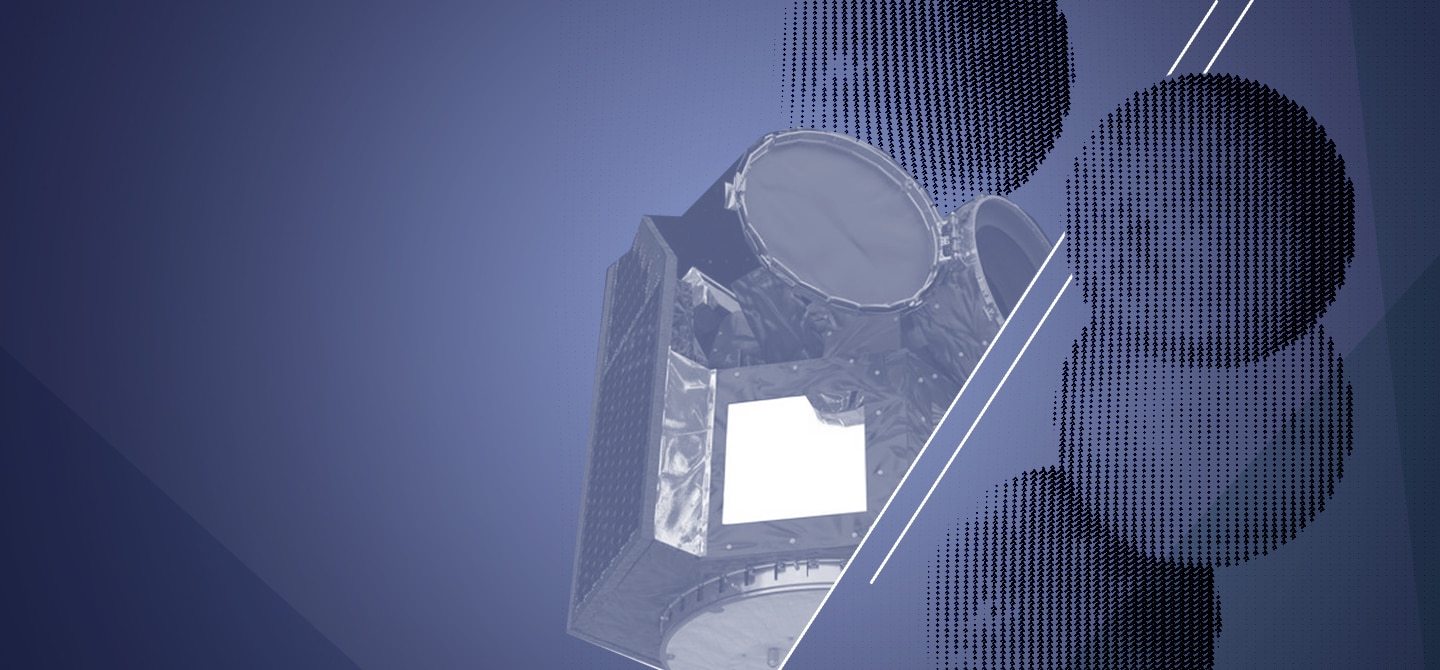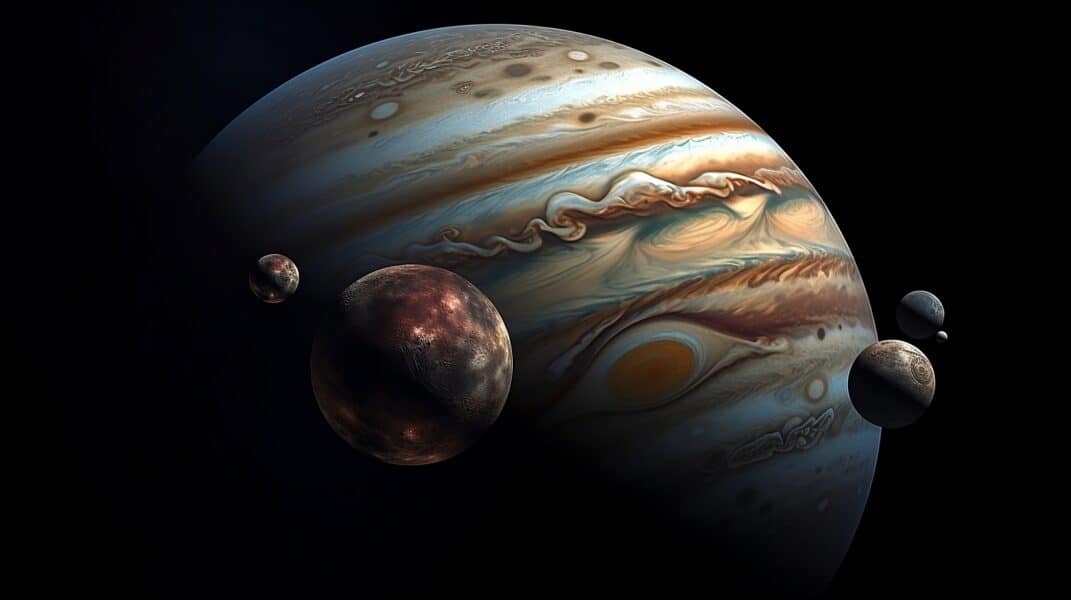


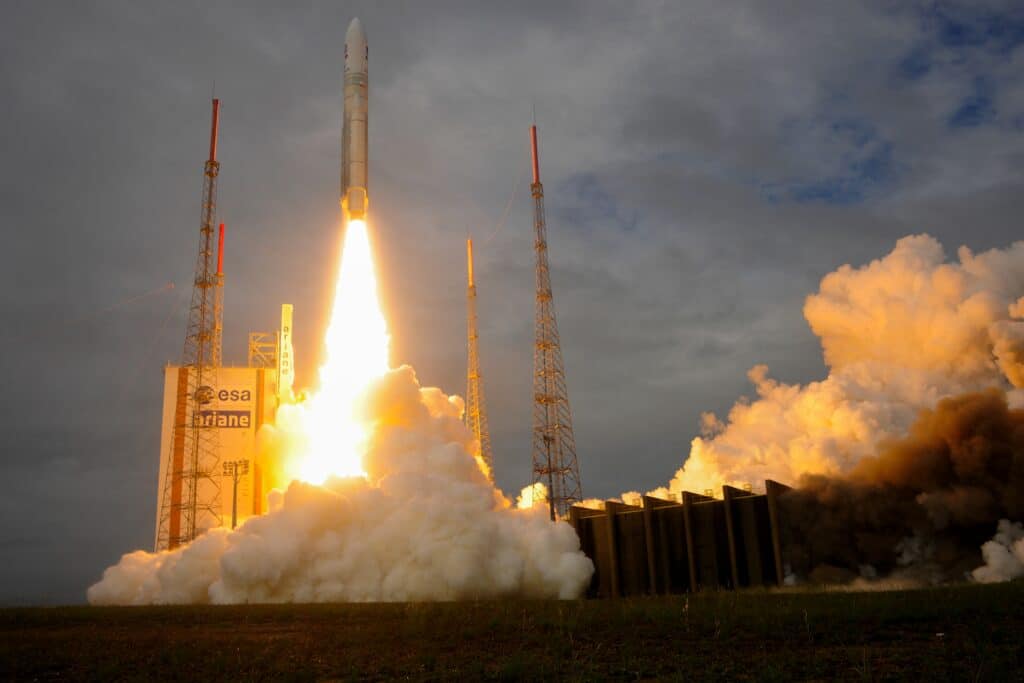
The European Space Agency’s JUICE (Jupiter Icy Moons Explorer) mission was launched on 14th April aboard an Ariane 5 rocket from Kourou in French Guiana. The purpose of the mission is to test the conditions that could have led to the emergence of habitable environments on three of Jupiter’s four icy moons (Europa, Ganymede and Callisto, all of which have oceans). It is scheduled to reach the gas giant in July 2031. JUICE will be the first spacecraft to orbit a moon in the outer Solar System, arriving in December 2034 in the orbit of Ganymede, the only moon in the Solar System with a magnetic field. Olivier La Marle, Head of Universal Science Programmes at CNES, tells us the story of the mission’s development and the role of CNES in the project.
At CNES, we are not involved in scientific research as such, but we are responsible for ensuring France’s participation in international space missions. In return, French scientists have access to the data obtained during these missions and can then publish articles in scientific journals. These researchers do not come from CNES, but from CNRS, CEA and university laboratories, for example. They are motivated by their own research priorities – priorities that are communicated and refined during regular foresight exercises coordinated by their research organisations and CNES. The aim of these exercises is to identify projects that merit future funding, and then to help them to be selected by the major agencies.
As the scientific community is international by nature, we collaborate with other major space agencies – such as ESA, NASA, the Chinese Space Agency (CNSA), the Japan Aerospace Exploration Agency (JAXA), and of course the other European national agencies. We decide together which country will be responsible for what. These collaborations are necessary because large-scale missions like JUICE cannot be funded by the CNES budget alone, nor by the French space community in general. The most traditional way of organising such missions is to entrust each country with the task of developing and building part of the scientific instrumentation that will be carried on board. CNES’s role in this phase is to position France’s contribution to the instruments in line with our national areas of expertise.
Highly complex missions
The development of these major scientific missions involves a whole series of tests, modelling, and simulations to help define and develop a realistic mission that can be launched. Scientists play an essential role in this exercise, as they alone can advise the agencies and their industrial partners to work towards a mission that is both achievable and of sufficient scientific interest. Clinging to unattainable objectives can only lead to a dead end and the mission being abandoned.
Our role here extends from financial and technical support for our national laboratories, to coordination with partner space agencies and, ultimately, to preparing for the exploitation of the huge quantities of data that will be obtained. This involves developing extremely reliable models, simulations, and software to interpret the huge quantity of images and spectra that will be obtained. For example, for Euclid1, another ESA mission, images of one billion pixels will be obtained every ten minutes. These data will also have to be combined with those from existing telescopes, such as the James Webb telescope.
There is a lot of preparatory work to be done, and a certain amount of scientific competition, the researchers who publish their results first will be the most visible. If a mission from another agency is not on the list of top priorities for French scientists, we will work on a more modest instrumental contribution. On the other hand, on space missions such as JUICE, we are heavily involved, being entirely responsible for one of the 10 instruments on board. This is the infrared spectrometer, a large, complicated, and expensive instrument. We have also contributed to the development of half a dozen other instruments. This is by far the largest contribution of any European country. The components of the other instruments were supplied by other European agencies, in addition to NASA and JAXA. These include an optical camera, various spectrometers, an altimeter, a radar, particle detectors and a magnetometer.
As head of the astrophysics theme at CNES at the time, my role included defining and setting up the French contributions to Euclid and to SVOM (a joint Franco-Chinese mission dedicated to the detection and detailed study of phenomena known as gamma-ray bursts, to be launched in 2024). For Euclid, this involved numerous meetings with the CNRS, the CEA and the main agencies involved (ESA, the Italian Space Agency, and the UK Space Agency in particular). For SVOM, we collaborated with the CNSA, which required numerous trips to Shanghai and Beijing to reach agreement on a text incorporating everyone’s contributions. This goes as far as knowing how many French or Chinese scientists authors of the resulting scientific publications will be. The question of the budget is of course essential: how much will the French contribution cost, and will we have the necessary resources?
A national space agency and a technical centre
France is unique in having a national space agency that also has a technical centre. We can boast experienced engineers who know how to successfully carry out space missions and who have built satellites from A to Z. When we decide to contribute to a mission, we know that we have a pool of CNES engineers who will take charge of the technical aspects or entrust them to CNRS or CEA laboratories interested in the mission, providing them with financial and technical support. Unlike other European countries, France does not necessarily need to sign a contract with industry to carry out a preliminary study.
The infrared spectrometer we have developed for JUICE is the result of more than 15 years of technical development.
We are working on a relatively long-time horizon when we draw up our strategies, because the missions we are currently preparing and participating in will be launched in the 2030s. One of the areas we are working on is miniaturisation: when we send probes into space, one of the main problems is the mass of the payload. On a probe like JUICE, for example, over 90% of the mass comes from the body of the satellite itself and the fuel used to propel it. The on-board instruments must therefore weigh no more than a few tens of kilograms. Compared with standard laboratory equipment, this is very light: it is difficult to manufacture a spectrum analyser or an infrared spectrometer that can withstand the extreme conditions of space, that fits into a small space and is limited in mass.
The infrared spectrometer we developed for JUICE weighs around 40 kg and is the result of more than 15 years of technical development in collaboration with researchers at the Institut d’Astrophysique Spatiale d’Orsay, experts in this field.
A mission of the utmost importance
The JUICE mission has been recognised by the authorities and researchers as being of the utmost importance. Some of Jupiter’s moons have ice crusts under which there may be liquid oceans that could benefit from temperate conditions. Although we won’t be able to see what lies beneath the ice, the onboard instruments will enable us to probe this environment and analyse its composition. The scientific community was very enthusiastic about this prospect and the project was identified very early on as a top priority. In fact, it was selected by ESA in 2012, ahead of two other candidates: the Advanced Telescope for High Energy Astrophysics (ATHENA) and the New Gravitational Wave Observatory (NGO, later renamed LISA), which were also subsequently selected. It is also the first L‑class probe in ESA’s Cosmic Vision 2015–2025 programme.
Ultimately, JUICE will help us understand whether the conditions on Jupiter’s moons are, or were, potentially favourable for life. The internal structure, magnetism, the presence of a rocky soil at the bottom of liquid oceans, its contribution of mineral salts, the thickness and topology of icy crusts, the presence of pockets of water, the seismic effects caused by Jupiter’s enormous mass, not forgetting the study of the giant itself and its atmosphere, are just some of the results expected from the mission.
Why do the moons of Jupiter have an icy crust when the moons of the other planets in our solar system do not? Why do some have CO2 atmospheres and others nitrogen or methane, even though they all formed in the same initial soup? Why did they evolve in completely different ways, and what fuelled this evolution? Was it the effect of magnetic fields or the tidal effect of Jupiter? JUICE will answer all these questions, which currently remain unanswered.
The possibility of finding forms of life elsewhere is of course fascinating. More generally, every time we visit objects in the Solar System, we discover that each of them is unique. JUICE’s discoveries will not disappoint us in this respect.
Interview by Isabelle Dumé
References
https://www.esa.int/Science_Exploration/Space_Science/Juice