



Can we tell if global warming is good or bad news for the wine business?
Éric Giraud-Héraud. Not really, no. But in order to answer correctly we need to put things into context. If we look at the current market, global consumption is stable – even on the rise. Yet this tendency does not benefit everyone. Bordeaux wines are an example of an economic crisis, partly explained by a change in what consumers want and the choice of products on the market.
Indeed, we have noted a structural change in red wines for several years. We see an increase in alcohol content, decrease in acidity and degradation of aromatic complexity. In addition, wines are often more concentrated and dominated by aromas of stewed fruits.
We showed that this does not meet the expectations of consumers of Bordeaux wines. Yet over the past decade, pressure from wine-specialised consultants and other short-sighted advisors, many winemakers opted to concentrate their wines and artificially increase the degree of alcohol when they didn’t need to, yet. This movement was further amplified by what we call wine “parkerisation”– named after the American wine critic Robert Parker.
In the end, though, the demand is different. As it turns out, wines which prematurely mimic the effects global warming are no longer in demand and the economic risk of such decisions is already kicking in.
What is the impact of these developments?
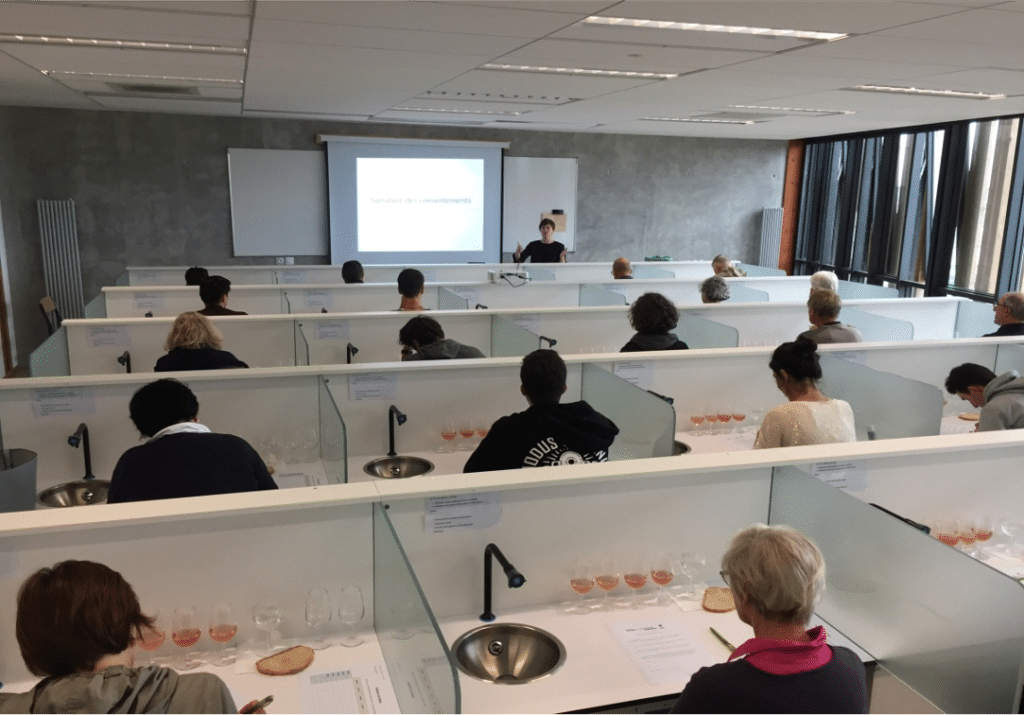
In 2015, we conducted an experimental study with 250 consumers to try to understand what was happening. By using the methodology of experimental markets, we measured consumer willingness to pay for a wine in different, controlled situations (related to wines and their labels). Put simply, we invited a large number of consumers representative of a population. They were asked to “reveal” their willingness to pay for each pre-selected wine. To avoid bias, the wine was randomly drawn in a ballot box and if its cost was lower than the price the consumer was willing to pay, then he or she agreed to buy the wine in question. We performed this experiment with a well-known wine from Bordeaux. The main grape variety of this AOC is Merlot, which is variety strongly affected by global warming.
What were the results of this study?
The study was carried out in two stages. First, with experts in sensory analysis of the ISVV, we selected 30 wines before keeping only three of them (I am not at liberty to reveal their names). Then, 250 consumers were recruited to test the selected wines (colour, odour, taste) before revealing their final willingness-to-pay.
- Wine A: a traditional wine of the AOC. Even though it had the lowest market price, it had a good complexity, and low alcohol content of 13.5%.
- Wine B: a wine regarded as a “global warming wine”, which is concentrated, produced with low yield, and contains 15% alcohol.
- Wine C: an intermediary between A and B on the range of all the characteristics.
Results: consumers were willing to pay significantly higher prices for wine B than wine A. Wine C came out somewhere in the middle (which was not clear at first). Therefore, the only possible interpretation was that the consumers preferred concentrated wines with higher alcohol content, and thus that consumers prefer “global warming wines”!
Were you sure of your conclusions?
No. We thought that there might be a “flattering” effect to this wine B and that we needed to test what we call “preference stability”. This would mean that the consumers took pleasure in drinking this type of wine at the time of the experiment, but that over time this demand might change. We therefore moved on to the second stage of the experiment. We gave wines A and B to the consumers and asked them to taste these on four different occasions during one weekend, i.e., twice per day. Then, without giving further information, we told them to come back and see us to reveal again their willingness-to-pay for wines A, B and C. The result is as follows: the willingness-to-pay for wine B collapsed while the price for wine A stayed the same. Wine C kept its intermediary position, with a slight decline in willingness-to-pay. We thus observed that consumers grew weary of wine B, which more or less gives some idea of the consequences of global warming on Bordeaux wines if we are not careful.
What commercial conclusions can we draw from this experiment?
In 2015, therefore, we managed to measure and characterise the economic risk that global warming can represent: consumers grew weary of characteristics and no longer sought them. This effect is systematically neglected by professionals in the wine sector because they make snap judgements, or even naïve decisions. We would need to perform this experiment again with other wines and populations to support our conclusions; but by using only one experimental market we did nevertheless show that (for this type of wine, at least), consumers do not necessarily demand a high degree in alcohol, concentration and consistency. The past decade has confirmed this through the market crisis for some red wines, the rise of rosé wines, and the development of completely new markets such as organic wine, or alcohol-free alternatives.
Winemakers must therefore develop the taste of their wines by drawing inspiration from research studies and innovations in the field of oenology if they want to win back their markets.