


Why do we talk about space debris so much?
Christophe Bonnal. Because it is a very important issue today. The number of space debris – meaning non-functional orbital objects, such as derelict rocket stages or satellites –, has increased exponentially since the launch of Sputnik 1 in 1957.
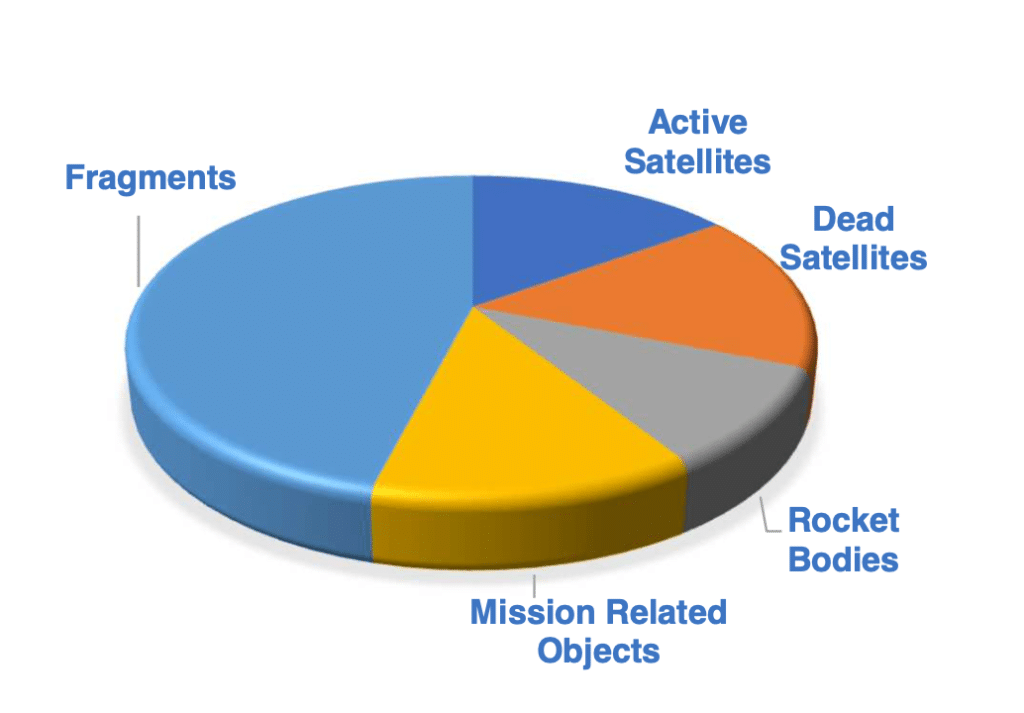
Today, more than 24,000 objects are found in space. They measure more than 10 cm in low orbit, and more than 1 m in geostationary orbit. To these are added more than 900,000 objects measuring more than 1 cm and some 130 million objects measuring more than 1 mm. All these objects are liable to neutralise a satellite, depending on the position of their impact. As a matter of fact, we have reached a critical density of objects at the altitude ranging between 700 and 1,100 km: the number of new objects is higher than the atmosphere’s natural ability to burn them off.
However, even if we were to stop launching objects in space today, the number of debris would continue to rise, because each collision generates new space junk: it is called the Kessler syndrome. The most famous example is the collision in 2009 of two satellites weighing more than 750 kg: the Russian satellite Kosmos-2251 and the active American telecommunications satellite Iridium-33. This collision generated 4,000 new debris.
Don’t these debris fall into the atmosphere at some point?
Indeed, everything eventually falls into the residual atmosphere, but it will take 200 years for an object to descend 800 km…and 1,000 years for it to descend 1,000 km. Meanwhile, they are very likely to collide with other objects, especially in low orbit. The Toulouse space centre thus received no less than 3 million conjunction warnings in only one year! We can avoid collisions between objects that can be manoeuvred, but not between inert objects.
That being said, the situation has been evolving since the end of the ‘90s. The big space agencies have adopted regulations to reduce the number of debris, especially by striving not to create new ones, or by avoiding collisions as much as possible. The problem is that these rules, which have become European and international standards, are still seldom respected: there are still a dozen of explosions of space objects per year. Only France has transformed international standards into law, with its Law on Space Operations (Loi sur les Operations Spatiales – LOS).
What solutions could deal with these collision risks and reduce their consequences?
There are two types of solutions. Up to now, the main approach was to clean space of its biggest debris. It is called Active Debris Removal (ADR). It applies to debris as big as a stage of the Zenit Russian launcher. It measured 9 m and weighed 9 tons and 45 of these units are floating around in space. The European Space Agency thus assigned the ClearSpace Swiss start-up with the production of a clean-up demonstrator to retrieve a stage of the Vega launcher located in low orbit since 2013. These strategic solutions are efficient in the long run. If we could manage to remove a dozen of these big debris per year, the growth would no longer be exponential, and in 20 years, we could stabilise the general situation.
However today, we have another problem: how can we avoid collision between non-functional space objects? Nowadays, radars can anticipate collisions, but not avoid them. In this case, we need a tactical solution. It is named Just-in-time Collision Avoidance (JCA). It consists in modifying the orbit of one of the two objects to avoid collision. The speed of a debris being 8 km per second, you only need to modify the trajectory by a hundredth of a second only 24h before the collision to get a 1 km margin.
How can you reduce the speed of an orbiting non-functional debris?
There are currently three methods. The first consists in sending a swarm of little miniaturised satellites, like the CubeSat modules, in the middle of a big debris cloud. They will cling to them before becoming dormant. In the case of a collision risk, they can be “awakened” in order to move the debris. But there are several aspects to develop, like the clinging to the debris, communications with Earth, or the cost.
The second solution, a very elegant one at that, consists in modifying the orbit using lasers. Very small pulses deposit a very high energy at the surface of the debris to vaporize the surface. The laser causes a very slight ablation which generates a small gas plume when it is ejected, and thus acts like a rocket engine. More than the trajectory of the debris, the aim is to modify its time period. A variation of one second on an orbit of 90 minutes means that the debris will lose 14 seconds in 24 hours. This is enough to avoid collision.
The third solution, named Space Blower, consists in creating an artificial atmosphere before the debris by spraying a cloud of microparticles to slow it down.
Do all these solutions require an intervention from space?
Not necessarily, but it certainly makes these interventions easier. There already are several projects of “in-orbit services”, service stations orbiting in space. Much like utility trucks, these stations could perform different missions like, for example, to deorbit or refuel a satellite. It could also lower the cost of interventions and help to fund the different solutions to avoid collisions.
For further reading
- C. Bonnal, La pollution de l’espace: L’état d’urgence (2016), Belin
- Video of Space Blower: https://www.youtube.com/watch?v=7GZ3eQVjnH4