Finance: no more middlemen?


Can you explain the concept of decentralised finance, or “DeFi” as it is now called?
Decentralised finance provides access to financial services such as credit or asset exchanges (mainly crypto-currencies). Unlike traditional finance, there are no banking or legal intermediaries. Exchanges are managed between private computers thanks to the blockchain, which makes it possible to generate contracts that are self-executing under certain conditions (e.g. repaying a loan at regular intervals or committing to sell an asset at a given price). This is what we call “smart contracts”. They replace banks for transactions and the legal arsenal (regulators, lawyers, courts) that was previously called upon in case of breach of contract. The blockchain is neutral, unalterable and allows to trace in all transparency all the steps of a contract. It is an open book shared by all.
A platform like Uniswap records an average of more than $1bn-worth of transactions per day1. Does this mean decentralised finance is taking off?
Compared to traditional finance, it’s tiny, but these volumes are massive and continue to grow. So, we can indeed talk about a take-off, especially for lending protocols (Compound, Aave), decentralised exchanges (Uniswap, Curve) and “stablecoins” (Maker). This success is partly driven by the explosion in capitalisation of crypto-currencies, which is still close to $2tn2.
But isn’t decentralised finance only for crypto-currency holders?
Yes, only crypto-currencies can be traded. Exchanges of regulated assets, such as stocks, are not possible for reasons of non-compliance with the legislative framework. It is important to understand that the classic market works in reverse to the crypto-currency market. In market finance, we know the identity of the players (thanks to “know your customer” procedures for identifying customers), yet their operations sometimes remain opaque. In decentralised finance, identities can be pseudonymised, but all operations are transparent.
What does “DeFi” promise to achieve?
To take an extreme case, the initial version of Uniswap was only 300 lines of code. Hence, decentralised finance is accessible to the masses as opposed to the costs of entering traditional finance, which are very high (licensing, initial capital, lawyers). If these costs come down, it will stimulate competition and access to complex financial products that are today reserved for the richest. This democratisation is the strong promise of DeFi. That being said, it is not without danger. Most regulators believe that one should not give too easy access to finance because small holders could risk losing out if they lack full understanding; this is what we sometimes see with hyper-simplified stock trading mobile apps like Robinhood.
What are the obstacles to large-scale adoption of “DeFi”?
In addition to the regulatory hurdle mentioned above, the industry also has to overcome technological barriers. The main one is scaling up to a much larger scale. Despite the relatively moderate number of exchanges, there is already some congestion on the Ethereum blockchain. There are often too many transaction requests compared to the validation capacity of Ethereum. Furthermore, mining is structurally slow compared to the thousandths of a second required for an exchange in centralised finance. An interoperable network of multiple blockchains and sidechains will likely be required to develop DeFi. This is a significant technological challenge, but many developers are working on it and given the dynamism of the sector their ingenuity should not be underestimated.
Doesn’t decentralised finance encourage risky speculation?
As finance does in general, I would say! That being said, there is a speculative frenzy around crypto-currencies. If we look further ahead, we can hope that this speculation will fall back to make way for solid markets based on blockchain technology, with an intermediation cost limited to the remuneration of the network infrastructure.
What is the risk of a cryptocurrency market reversal?
It should not be overlooked. In a context of high valuation of financial assets, we can indeed fear a violent reversal of the crypto-currency market. What’s more, there are doubts about the resilience of stablecoins3 to such a scenario. It is easy to imagine a banking panic similar to the one suffered by money market funds during the 2008 crisis; except this time central banks will probably refuse to save stablecoins by exercising their power of lender of last resort. Hence, it is becoming urgent to build tools to anticipate systemic risks in DeFi, a task we are actively working on in our research chair.
Can the high energy consumption of blockchain slow down – if not prevent – its development?
As we face the acceleration of global warming, we cannot imagine DeFi relying on Bitcoin’s proof of work and its excessive carbon footprint – which currently accounts for 0.3%-0.5% of the world’s electricity consumption. The future will probably be found in proof-of-stake, which uses much less energy. In proof-of-work, the miners in charge of updating the blockchain must solve an energy-intensive cryptographic problem. Whereas proof-of-stake, instead of selecting miners based on their amount of work, the protocol uses the amount of crypto-currency they hold. The idea is that miners who hold crypto-currencies native to the Blockchain also have an interest in it working properly.
Proof of stake has already been tested, in particular by Tezos, a blockchain co-founded by a polytechnician, Arthur Breitman, and whose research center Nomadic Labs is one of the sponsors of our chair. We are conducting work to formally establish and, as far as possible, improve the robustness of the proof of stake.
Interview by Clément Boulle
Contributors
Julien Prat
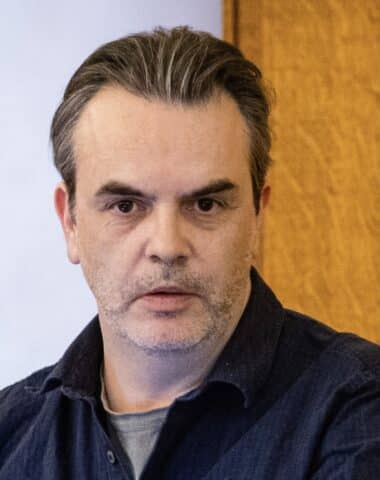
Julien Prat holds a PhD in economics from the European University Institute. He works as a CNRS researcher attached to CREST and as a lecturer at the Ecole Polytechnique (IP Paris). Before joining CREST in 2012, he worked as a lecturer at the University of Vienna from 2004 to 2008 and as a researcher at the Barcelona Institute for Economic Analysis from 2009 to 2012.