Agrivoltaics: the hidden airflow beneath the panels



- La protection des cultures est un enjeu majeur face au changement climatique, à l’intensification des sécheresses et face à la demande alimentaire mondiale, qui devrait augmenter de 45 % d’ici 2050.
- L’agrivoltaïsme permet un ombrage pour les cultures, ce qui atténue l’intensité d’ensoleillement, tout en optimisant cette surface agricole pour produire de l’énergie électrique.
- La présence de la structure modifie les vents sous les panneaux, parfois jusqu’à 70 % de moins que dans une zone témoin, ce qui peut participer à la création d’un microclimat, favorable selon la culture, et limiter l’évapotranspiration.
- Les simulations numériques montrent que les conditions environnementales provoquées (vents, humidité du sol, température de l’air, etc.) varient selon qu’on se trouve pile sous un panneau, entre deux rangées ou près du bord d’une installation.
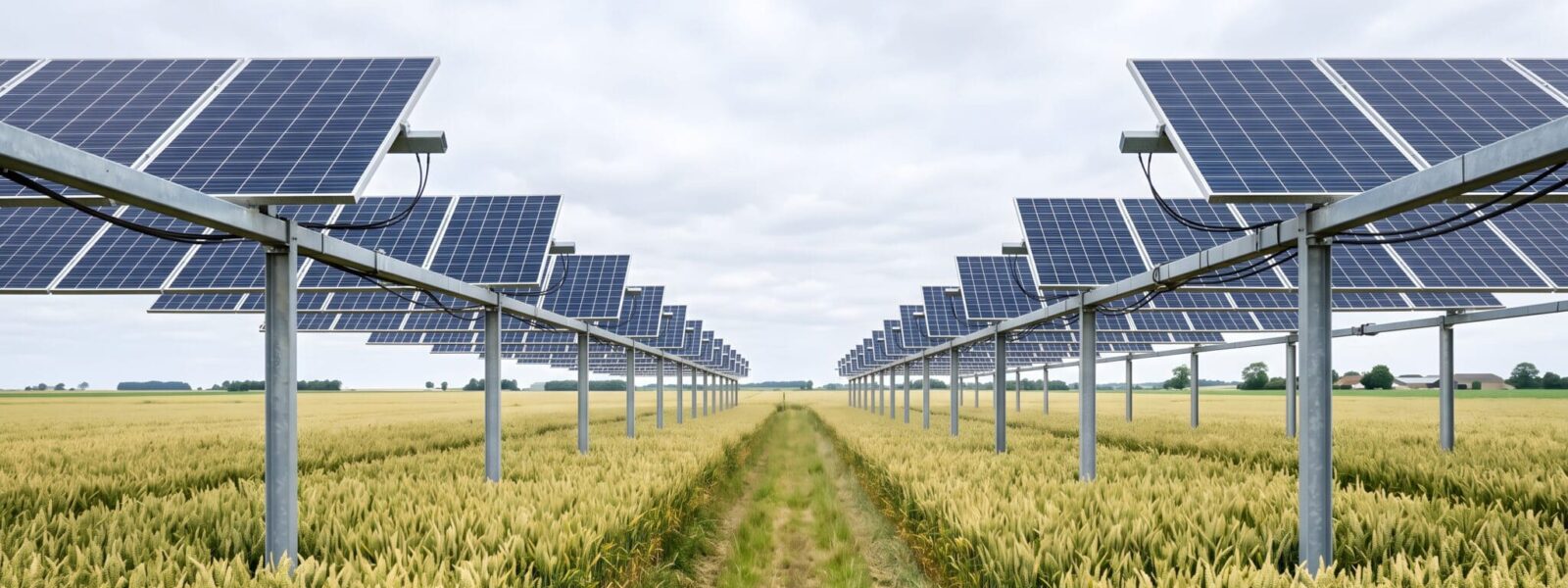
Agrivoltaics, which involves installing photovoltaic panels above agricultural land, is increasingly emerging as a promising solution for combining renewable electricity generation with agriculture. This technique provides clean energy without the need for new land and helps protect crops from what can sometimes be excessive sunlight. Published in early 2026 in the journal Energy Nexus1, our study expands on this understanding of agrivoltaics by examining a previously under-explored aspect: the way in which the panels alter air circulation, and consequently the exchange of water and energy between plants, the soil and the atmosphere. Far from calling into question the value of agrivoltaics, this research provides valuable tools for further refining the design of such installations and maximising their benefits.
Protecting crops: a major challenge
Too much sun can damage plants. During the 2003 drought in Italy, maize yields plummeted by 36 %. In 2012, a similar drought in the United States resulted in the loss of around 26 % of the projected maize harvest. With global warming intensifying droughts, and global food demand set to rise by 45 % by 2050, protecting crops is becoming a major challenge. And this is precisely where agrivoltaics has a key role to play.
By partially shading crops, solar panels reduce evapotranspiration, i.e. the water that plants release through their leaves. This water is thus used more efficiently, as it remains available in the soil for longer. As such, the risk of soil drying out during dry periods is reduced, as is water stress in plants. These combined effects enable crops to be grown with minimal losses but reducing solar radiation in this way to lower evapotranspiration can only be achieved through a localised and temporary reduction in plant photosynthesis, and a reduction in evapotranspiration caused by reduced wind does not necessarily achieve this. What’s more, limiting evapotranspiration too severely can be harmful if the plant needs these processes to cool itself during very hot periods.
The real expertise lies in finding the right balance of shade depending on the climate and the crop.
Nevertheless, when conditions are optimised according to the specific crop being grown, some studies have shown that, under drought conditions, beans or tomatoes grown under panels capture more CO₂ and yield better results than those grown in open fields. The real expertise therefore lies in finding the right balance of shade depending on the climate and the crop. This is a balance that the most successful agrivoltaic projects have already mastered, and which this study helps to further refine.
To estimate evapotranspiration, agronomists have been using well-established formulas for decades, the best known being the so-called “PM-FAO56” equation, popularised by the Food and Agriculture Organisation (FAO) of the United Nations. These formulas are based on simple measurements: solar radiation, air temperature, humidity and wind speed. They have proven their worth in open fields. When applied directly to innovative applications such as agrivoltaics, they need to be verified and, if necessary, adjusted. The formulas are based on three assumptions: consistent ground conditions, a direct correlation between wind speed and turbulence, and wind measurements taken at a reference height that are representative of conditions at plant level. Until this study, no one had directly measured the turbulence of the airflow beneath agrivoltaic panels.
Sensors and a digital twin
To get a clearer picture, we installed sonic anemometers (sensors capable of measuring the three wind components ten times per second, and therefore turbulence) on SIRTA’s agrivoltaic experimental platform, a research site near Paris. Three sensors were deployed: one in a control area without panels, and two at the heart of the agrivoltaic installation: one beneath the panels and the other above them. These measurements, combined with soil moisture and radiation sensors, were collected over several months between November 2024 and June 2025. In addition, we utilised state-of-the-art numerical simulation software (code_saturne, developed by EDF) to reconstruct the three-dimensional airflow around the panels and estimate energy and water exchanges at various points within the installation, to assess their spatial variations. This combined experimental and numerical approach clearly illustrates the level of technical sophistication now being applied to agrivoltaics, a sector benefiting from considerable research investment to optimise each individual design parameter.
The wind speeds under the panels are generally lower than in the control area, sometimes by as much as 70 %. This is actually good news for crops sensitive to drought, as a lower wind speeds mechanically limit water losses through evapotranspiration. Furthermore, air turbulence is, in some places, significantly stronger beneath the panels, with differences exceeding 300 % compared with the control area under certain conditions, a phenomenon that demonstrates the extent to which the panels create a distinct and rich microclimate, which can now be precisely characterised thanks to this study. This finding challenges one of the assumptions underlying conventional evapotranspiration equations, namely that turbulence always follows wind speed.
This study shows that the relationship is more nuanced in agrivoltaic environments, requiring even more precise models, tailor-made for these installations. We have also observed that wind speed, depending on the direction and tilt of the panels (which, in some installations, can pivot throughout the day to track the sun’s path), can be reduced by between 10 % and 60 % locally. This therefore provides an additional lever that designers can utilise to fine-tune crop exposure according to their specific needs. The vertical wind profile, which is more complex beneath the panels than in open fields, reaches a local maximum just below the panels, then decreases in the wake zone they create, before rising again above them. This is excellent news, as it indicates precisely where and how to take measurements to obtain data that is truly representative of what is happening at crop level, rather than relying on measurements taken higher up, which do not always reflect the reality on the ground.
A wealth of microclimates at plot level
Numerical simulations confirm and refine these field observations. They show that conditions vary between locations: directly beneath a panel, between two rows, or near the edge of a photovoltaic installation. Far from being a drawback, this diversity of microclimates within a single plot can become an asset: it makes it possible, in the long term, to devise planting strategies tailored to specific zones, taking advantage of the most favourable conditions at each location within the installation. This same diversity is reflected in soil moisture levels. In spring, the soil located directly beneath a row of panels retains significantly more water (around 30 %) than that situated between two rows (which drops to 18 % under the same conditions), further confirmation that the panels effectively fulfil their role in conserving soil moisture, with the added benefit of naturally collecting rainwater that runs off their surface.
By combining advanced numerical simulations with artificial intelligence, the researchers envisage even more effective design tools.
These new findings have practical implications. Depending on the calculation method used and the exact location of the measuring sensor, estimates of evapotranspiration under the panels can vary significantly, whereas in open fields, the different methods tend to yield similar results. It is precisely by identifying this margin of uncertainty that the study greatly benefits the sector. It enables project developers to fine-tune their forecasts right from the design stage, thereby ensuring that installations are set up in a way that allows for even better control of their agronomic and energy potential.
In the longer term, the study opens up an exciting prospect: the development of evapotranspiration models specifically designed for agrivoltaic systems. By combining advanced numerical simulations with artificial intelligence, the researchers envisage the possibility of developing even more effective design tools, capable of incorporating the geometry of the panels, their tilt and local weather conditions. This will enable future agrivoltaic installations to simultaneously optimise both electricity generation and agricultural yields. This breakthrough confirms, once again, the enormous potential of this sector, which lies at the crossroads of the energy transition and agricultural resilience.