China: are air conditioners at odds with climate ambitions?



- Global sales of air conditioners continue to rise despite their particularly high energy and carbon footprint.
- According to a 2023 IPCC report, energy savings and improved energy efficiency have great potential to reduce GHG emissions.
- A study on the use of air conditioners in China shows that Chinese consumers place too much importance on the price of air conditioners when making purchases, to the detriment of their long-term energy costs.
- Households may therefore not appreciate energy-efficient air conditioners, which reduce their energy consumption.
- The purchasing behaviour of Chinese households with regard to air conditioners varies according to geographical and sociological criteria.
Global warming is changing even our simplest habits. The widespread increase in the use of air conditioners in remote regions around the world is proof of this. Ensuring the well-being of populations, particularly in hot regions, is a goal that largely explains the increase in the purchase and use of these cooling electrical appliances. However, these devices, which are so beneficial in summer, have a darker side: their particularly high energy and carbon footprint. Of all white goods12 [Editor’s note: kitchen and bathroom appliances], air conditioners are said to consume the most energy, creating a vicious cycle – they help us cope with the heat, but also contribute significantly to global warming. Yet, ccording to the 2023 IPCC report3, one of the greatest potentials for reducing GHG emissions lies in energy savings and improving energy efficiency [Editor’s note: methods of reducing a system’s energy consumption while maintaining the same end service or improving its quality]. Are air conditioners at odds with our climate ambitions?
China’s air conditioner stock will represent nearly 37% of the global stock.
To mitigate global warming, developed and developing countries are implementing strategies to improve the energy efficiency of their appliances. The European Union, for example, has set itself an ambitious target: to achieve at least a 32.5% improvement in energy efficiency by 20304. But are all countries following suit?
In China, demand for air conditioners has exploded over the past decade, doubling the average number per household. Between 2010 and 2020, sales of air conditioners rose from 51.5 million units per year to nearly 100 million5. The scale of the phenomenon is such that by 2025, China’s air conditioner stock will represent nearly 37% of the global stock6. However, the purchase of numerous air conditioners by Chinese households and the high energy consumption of these appliances could have a significant negative impact on Chinese households’ energy savings and carbon emissions reduction. But is China implementing measures to improve the energy efficiency of its air conditioners? Are Chinese households buying energy-efficient air conditioners? What are their air conditioning habits?
Understanding the choices made by Chinese households
To answer this question, a study entitled Implicit Discount Rates and Energy Efficiency Gap in Air Conditioning: Evidence from the Chinese Market was published in May 2025 in the journal Resource and Energy Economics. We know, for example, that adopting energy-efficient air conditioners would reduce household energy consumption, lowering electricity bills and reducing climate impact. However, these units usually come with higher upfront purchase costs. Do Chinese consumers take these criteria into account in their economic behaviour?
To conduct this research, scientists used detailed data on air conditioner sales and prices in 274 Chinese cities between 2013 and 2018. The results of the study indicate that Chinese consumers place too much importance on the price of air conditioners when making purchases, to the detriment of their long-term energy costs, which is not beneficial for them.
Chinese consumers may not fully appreciate the energy savings offered by energy-efficient air conditioners.
Specifically, Chinese consumers only take 41% of operating costs [Editor’s note: i.e., the costs of use and maintenance incurred after purchasing a product] into account in their purchasing decisions. This means that they achieve an implicit discount rate of around 24% when choosing air conditioners. However, a high implicit discount rate reflects how an individual favours short-term purchases over future savings. In this case, the high discount rate suggests that Chinese households purchasing air conditioners generally place much less importance on future energy savings than they should rationally.
These results therefore imply that Chinese consumers may not fully appreciate the energy savings offered by energy-efficient air conditioners. In other words, there is a gap between what is financially optimal for households—the increased adoption of energy-efficient air conditioners—and their actual choices, which are less expensive but more energy-intensive air conditioners.
Costly choices for households and the climate
What are the concrete consequences of Chinese households underestimating future energy savings when purchasing air conditioners? The air conditioning habits of Chinese consumers could primarily affect their well-being and overall energy consumption. According to the study, high discount rates in the Chinese air conditioning market would lead to an increase in annual energy consumption of around 7.5% and a loss of well-being of 30.3 yuan per consumer. According to counterfactual estimates, if consumers did not underestimate future energy costs in the Chinese market, the market share of energy-efficient air conditioners would increase from 35.1% to 39.3%, which is all the more reason to draw consumers’ attention to the long-term energy costs of these appliances.
This study on Chinese air conditioning habits is also important because it addresses differences in purchasing behaviour based on city and social group (fig. 1). Chinese consumer purchasing behaviour is not homogeneous but varies according to geographical and sociological criteria.
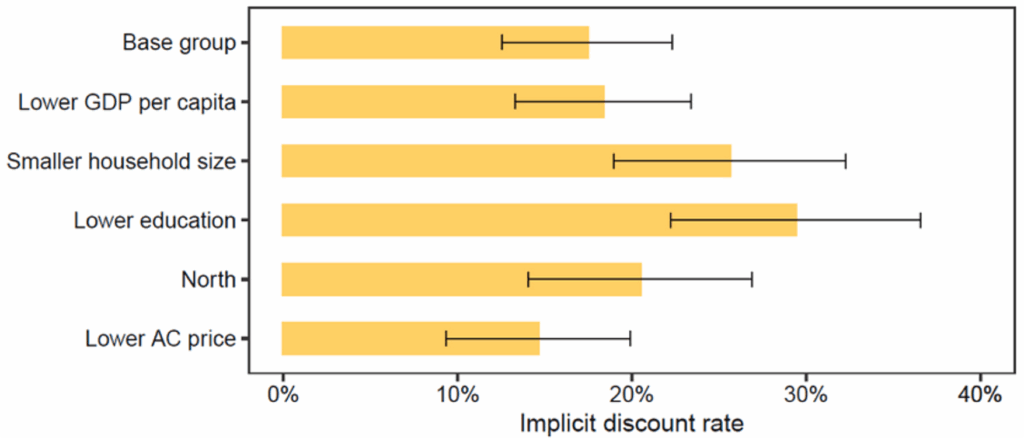
In Chinese cities with higher GDP per capita, consumers place less emphasis on the long-term costs of air conditioning than those in cities with lower GDP per capita. The same is true for larger households, those that invest more in their children’s education, and residents of southern China, where air conditioners are more widely used than in the north due to higher temperatures.
Limitations of the study and future avenues for research
In conclusion, this study provides insight into the purchasing behaviour of Chinese consumers with regard to air conditioners. However, it has limitations that warrant further investigation through additional research. First, data on air conditioner usage in different regions of the country is obtained from household surveys and may therefore be less accurate than data derived from electricity load data. One avenue for future research would therefore be to use electricity grid load data to estimate future energy costs more accurately for each model of air conditioner on the market.
Furthermore, the study does not explore the reasons why some consumers place less emphasis on the short-term energy costs of air conditioners than on the long-term costs. A study on this issue would, however, offer new directions for this research. It would allow for the exploration of various hypotheses, such as credit constraints7, myopia891011, inattentive behaviour121314, and lack of salience1516. Finally, the adoption of new energy-efficient air conditioners could lead to a rebound effect [Editor’s note: increased use of air conditioners by consumers due to improved energy efficiency], which could push households to consume more energy than initially planned17181920.
This study therefore provides new data on the behaviour of Chinese households when purchasing air conditioners. It shows that they tend not to take sufficient account of energy costs over the long term. That is why it is time to act: this behavioural bias is leading to an increase in electricity consumption in China and could have consequences for global warming. Nevertheless, countermeasures can be implemented. These include setting minimum energy efficiency21222324 standards, providing information, and offering incentives for energy efficiency. Addressing the issue of high energy consumption by air conditioners in China could improve people’s well-being and mitigate climate change.