4 technologies to enhance sporting performance







- A number of technologies are being developed around the world to enhance sporting performance.
- Research has shown that a good sports bra is important for supporting the breasts and demonstrated how it affects the knee joint during running.
- The work proves that sports bras, which have changed little over the last 50 years, should be considered as sports equipment in their own right.
- Insoles fitted with sensors could be used to measure the progress and performance of athletes during various sporting activities.
- Korean researchers have developed a conductive hydrogel capable of regenerating and reconnecting injured muscle to the nervous system.
- These and other technologies being developed could help athletes progress and improve their performance.
#1 A good sports bra can increase running performance by 7%
As well as a good pair of running shoes, a well-fitting sports bra that efficiently supports the breasts is important for female runners. It can help reduce breast pain and improve performance. When the breasts are not properly supported, the body compensates by protecting them in other ways. This compensation can reduce running performance, increase the risk of injury and even lead to back and chest pain.
To better understand the role of a good sports bra on the biomechanics of running, a team of researchers led by Douglas Powell and Hailey Fong from the Breast Biomechanics Research Center at the University of Memphis (USA) studied how wearing a bra impacts knee joint stiffness during exercise. This biomechanical measurement provides information on the resistance of the knee joint to an applied force. To do this, the researchers recruited 12 non-professional female runners aged 18–35 and had them wear two different sports bras: one with high support and the other with low support. A control group did not wear a bra at all.
Each participant ran on a treadmill equipped with force detectors for three minutes. The researchers filmed the runners using a 10-camera motion capture system. Retroreflective markers placed on the runners’ bodies also tracked their movements. The researchers then used software that they had specially developed in this work to calculate the excursions of the knee joint (flexions, extensions and rotations) on the basis of the images they obtained. They also monitored chest movement during the exercise.
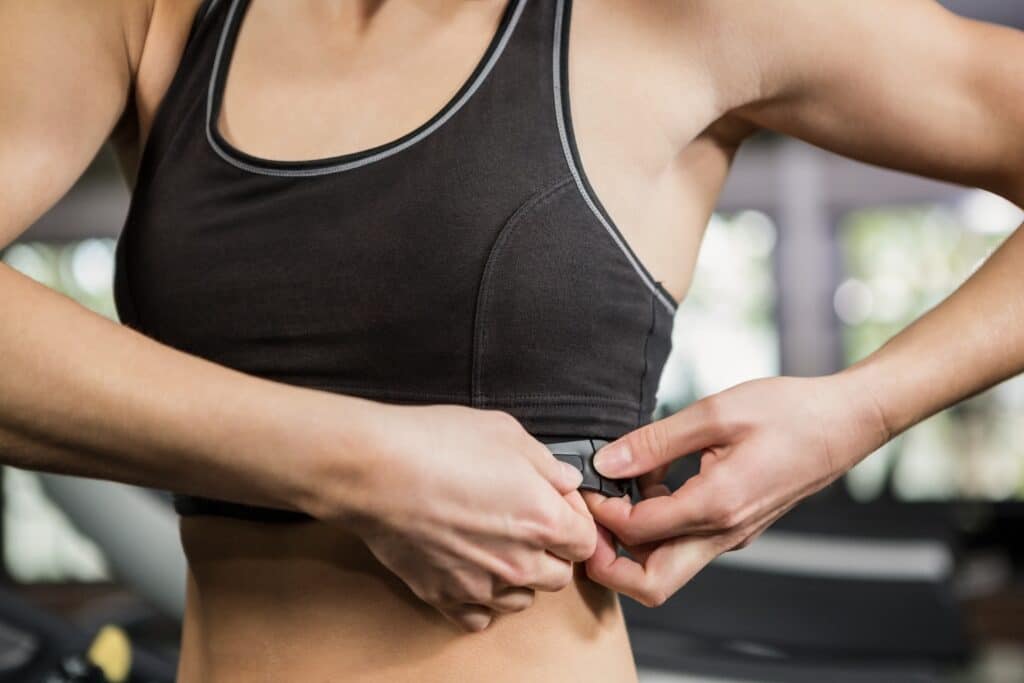
The experiments revealed that when breast support was higher, the knee joint was more rigid, thanks to smaller joint excursions. Compared with the control group, the low- and high-containment bras increased knee joint stiffness by 2% and 5% respectively. Overall, a high support sports bra appeared to improve running performance by 7%. The research also revealed that improvements in running performance with high support sports bras was strongly correlated with breast size: women with larger breasts benefited more in terms of running performance.
Over the last 50 years, bra design has changed little, explains Douglas Powell: “our results, combined with those of previous studies, show that sports bras should be considered not just as apparel, but as sports equipment in their own right.”12.
#2 3D-printed insoles to assess athletes’ performance
In top-level sport, a fraction of a second can make all the difference. Made-to-measure insoles can improve sporting performance and researchers at Empa, ETH Zurich and EPFL, all in Switzerland, have developed a device that is much more sophisticated than a simple insert. The new insole comprises pressure and shear sensors that can measure these parameters directly on the sole of the foot during any type of physical activity.
“The pressures recorded can be used to determine whether a person is walking, running, or climbing stairs. It’s even possible to determine whether they’re carrying a heavy load on their back, in which case the pressure shifts more towards the heel,” explains Gilberto Siqueira, project leader and researcher at Empa and ETH’s Complex Materials Laboratory.
The soles were fabricated using a 3D printer, known as an extruder. The base of the sole is made from a mixture of silicone and cellulose nanoparticles. A conductive ink containing silver is then printed atop this first layer. The sensors, which are piezoelectric, convert mechanical pressure into electrical signals. These are printed on the conducting part of the sole, where the pressure exerted by the foot is greatest. The ensemble is protected by a final layer of silicone. An interface for reading the signals generated, inserted into the sole, completes the device.
As well as Empa, ETH Zurich and EPFL, the Centre Hospitalier Universitaire Vaudois (CHUV) and the orthopedics company Numo were also involved in this work. Such insoles could be used by athletes to measure their progress during training and their performance in general3.
#3 An electrically conductive hydrogel could help regenerate muscle
Researchers at the Institute of Basic Science (IBS) in South Korea have developed a new tissue prosthesis made from a conductive hydrogel that can be injected directly into an injured muscle to regenerate it and reconnect it to the nervous system. This prosthesis has enabled rats with torn hind limbs to walk again.
Muscle injuries such as strains or tears are common sports injuries. When a muscle is torn, its electrical communication with the nervous system is disrupted and it no longer functions properly. Today, these injuries can be treated using portable or implantable electronic devices. However, these devices are rigid and inflexible, which makes them incompatible with soft biological tissue. Not only are these devices uncomfortable for the patient, they can even cause inflammation, which slows the healing process.
The researchers’ flexible prosthesis comprises a hydrogel containing hyaluronic acid – a natural polysaccharide with mechanical properties similar to those of soft tissue and known for its regenerative properties. To make the prosthesis electrically conducting, they added, via covalent bonds, chemical compounds to it containing hexagonal rings that can accommodate gold nanoparticles. Gold is also biocompatible and intrinsically chemically inert.
When the gel is injected into the muscle tissue of a rat, the chemical bonds it contains are broken. They quickly re-form once the hydrogel is fixed in the muscle, however. It is this innovative chemistry that enables it to regenerate damaged tissue. What is more, the gel does not overactivate the animal’s immune system. It therefore does not produce fibrous scar tissue, as can be the case with conventional implantable prostheses.
The researchers found that the hydrogel adheres to the peripheral nerves of the injured muscles in the rat’s hind leg. This means that the device can be connected to electrical wires and the scientists are able to activate the muscle by sending electrical stimulation through the gel. Repeated stimulation enabled the rodents to walk shortly after an injury.
Ultimately, the researchers would like to apply their technique to human muscle. However, before they can do this, they will need to carry out studies on animals larger than rodents to determine whether the hydrogel can conduct electricity over longer distances4.
#4 Analysing how a table tennis ball bounces off a racket
Researchers in France have measured the speed of progression, rotation and rebound angle of a table tennis ball off a glass surface. Led by Jean-Christophe Géminard, CNRS research director at the physics laboratory of the ENS in Lyon, the scientists fired the ball onto a glass plate while varying the angle and impact speed of the ball. They then measured the above parameters by analysing videos of how the ball interacted with the plate.
The result: at angles of incidence typically less than 45 degrees, the ball rolled (without sliding along the surface of the plate) completing a fraction of a full turn, that is, less than one turn, before rebounding. At higher angles of incidence, the ball still slid as it left the surface, reducing its rotation after the bounce. The researchers explain that when bouncing off a solid surface, such as a glass plate, the final rotation, speed and bounce angle of the ball are governed solely by the friction between the ball and the surface. This result, they say, would be the same for a ball bouncing off a real ping-pong table.
To make their experiments more realistic, Jean-Christophe Géminard and his colleagues then repeated them using a racket covered with a stack of foam and elastomer. To a certain extent, this scenario prevented the ball from sliding over the surface of the glass plate. Players capable of reproducing the techniques described in this study will undoubtedly have a significant advantage, say the researchers.
Finally, the scientists reproduced their experiments on surfaces commonly used by table-tennis players in the real world, but to date the results of this part of their work have not yet been made public56.