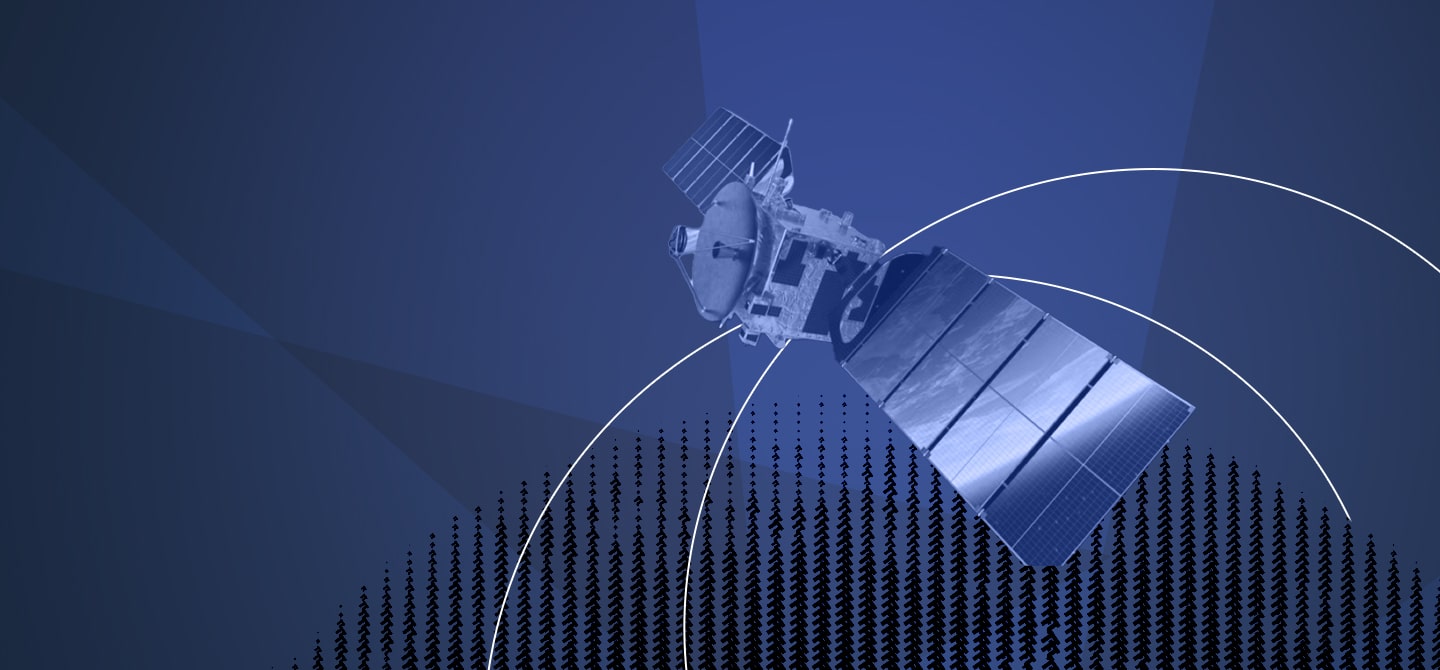


In 2018, Florence Parly, then Minister of the Armed Forces, made public the clandestine manoeuvre, which took place in 2017, of the Russian satellite Louch-Olymp1 near the Franco-Italian military telecommunications satellite Athena-Fidus. The emergence of conflict ‘towards, in and from space’ prompted France, soon followed by several other European countries, to set up a Space Command (CDE) within the Air and Space Force. To discuss the threats facing the country and Europe, and the missions of the CDE, Lieutenant General Philippe Adam, Commander of Space from July 2022 to August 2025 explains.
In 2019, France officially incorporated space as a domain of military action into its doctrine. What are the threats?
Philippe Adam. The threats are very real. The arrival of private entities, the explosion in usage and the exponential increase in the number of satellites in orbit have rapidly transformed the space environment. At the heart of this new landscape, we are seeing behaviour that we consider problematic. With space services having become crucial to both civil society and the military, we also know that an adversary wishing to harm us would have every interest in attacking our space capabilities, either on the ground or in orbit, as this would hinder our ability to continue operations. This happened during the invasion of Ukraine. The first Russian attack targeted ground terminals of the American KA-SAT satellite, used by the armed forces for communications – impacting other users in Europe who were neither Ukrainian nor military.
The Louch-Olymp episode was a clandestine manoeuvre. What types of attacks could be carried out in orbit?
Attacks against satellites can consist of blinding, jamming, capturing or neutralising them with directed energy weapons, or even deorbiting or destroying them through collisions or missiles. Russia and China have demonstrated their ability to carry out these actions in a wide variety of ways2.
We were surprised to find that Iranian satellites were capable of performing maneuvers relative to each other, a technique that few countries have mastered to date
We are also paying close attention to the behaviour of certain nations, such as North Korea and Iran, whose intentions we do not know. Their level of technological expertise is not yet on a par with that of the major space powers, but they are advancing rapidly, aided by Russia and perhaps China. For example, we were surprised to find that Iranian satellites were capable of performing relative manoeuvres with each other, a technique that few countries have mastered to date.
What hostile behaviour towards French and European satellites are we seeing today?
Every day, we observe attempts at jamming around real conflict zones: the Middle East, the Black Sea and Ukraine, the Kaliningrad enclave and the Baltic Sea. The Louch-Olymp episode is not an isolated case: we regularly observe suspicious, undeclared manoeuvres in the vicinity of our satellites, which we find difficult to consider purely peaceful, and this in all orbits. It should be noted that the 1967 Outer Space Treaty is currently the only international legislation on space. However, it does not prohibit anything except the deployment of weapons of mass destruction – namely, nuclear weapons in orbit. This lack of rules is an obstacle to the clear characterisation of situations that have security and safety implications.
What are the risks of war affecting a European Union country in the coming years?
The probability of a major conflict in Europe, which would inevitably involve NATO, has never been higher, and we believe that certain behaviours we are seeing in space could be preparatory to a state of war. In fact, if Russia’s aggression in Ukraine stops where we are today, I don’t see what will prevent Russia from starting again in three or four years’ time, once it has rebuilt its forces. We are very concerned, but the role of the armed forces, like that of diplomats, is precisely to do what is necessary to prevent this from happening.

In the civilian sector, we know that collaboration at the European level can sometimes be difficult. What about in the military?
Given the urgency of the situation, discussions between military personnel are relatively healthy. Wanting to launch joint programmes at all costs is not enough – defence remains the prerogative of nations, and we cannot blame those who have the means to develop their own capabilities. But we are sharing ideas and the discussion must continue so that we can keep each other informed of what we are doing and ensure the interoperability of the capabilities we are developing. I am convinced that this will also lead to industrial collaborations that have so far been difficult to establish.
What does France’s space defence strategy consist of?
French doctrine aims for what is known as “space mastery”, which is a proportionate and, above all, defensive stance. The CDE’s mission is therefore, on the one hand, to maintain and improve military space services (observation, telecommunications, navigation) and, on the other hand, to protect French capabilities in the event of aggression, including by fighting in space if necessary. This strategy is based on strong collaboration with our friends and partners. Together, we are much more effective at identifying what is happening in orbit and responding to it, and more credible in denouncing any aggression. In our action plans, it is therefore extremely important to describe how our partners will be involved, because if we use force against an aggressor satellite, we will create consequences for everyone.
What actions are being taken to maintain and improve military space services?
The actions taken will involve changes in architecture and usage concepts: favouring large constellations over isolated satellites to avoid losing everything in the event of an attack and accepting that we can no longer rely solely on 100% military means. The war in Ukraine has shown that civilian resources can be invaluable, both for the Ukrainian army’s telecommunications and for helping its partners understand what is happening on the theatre of operations.
And how can we protect our space resources?
We have launched two experimental programmes, each comprising two patrol-surveillance satellites: YODA, in the vicinity of geostationary orbit, and TOUTATIS, in low orbit. These will be quickly followed by the deployment of operational capabilities, both for observing space from space and for taking action. We will also strengthen our low-orbit surveillance capabilities, which currently consist almost exclusively of the GRAVES radar, with the arrival of the more powerful AURORE by 2030.
The destruction of a satellite is a very aggressive course of action, and one that creates a lot of debris. We are therefore not really pursuing this option
But to have an impact on the battlefield, doctrine and resources are not enough: trained personnel are also needed. In Europe, it is very clear that it is the armed forces, not civilian agencies, that are responsible for using force: in space, this is the mission of the CDE. The military must therefore learn to operate their own satellites, something they have not done until now. The National Centre for Space Studies (CNES) will of course remain the specialist in space manoeuvres, including in a military context, but the CDE must become the specialist in military manoeuvres in space. The challenges are not the same, and we will need each other.
In 2022, France committed to not conducting destructive direct-ascent anti-satellite missile tests. Does this mean that the country is considering using weapons designed to destroy hostile satellites?
The destruction of a satellite is a very aggressive course of action, and one that creates a lot of debris. We are therefore not really pursuing this avenue. Instead, we will focus on developing non-kinetic means of action, such as lasers or jammers, which have the advantage of being reversible to a certain extent. The US Chief of Space Operations, General Saltzman, defines space deterrence as the set of measures that make an attack or hostile action against space capabilities so costly, difficult or pointless that adversaries give up. That is what we are aiming for.
Emmanuel Macron inaugurated the new Space Command facilities on 12th November 2025 in Toulouse. How would you assess the CDE’s six years of existence?
The inauguration on 12th November marked a real achievement. When it was created, the CDE had some 200 people from two units within the Air and Space Force and specialised units of the Armed Forces Staff. We had to recruit and train personnel to enable them to carry out the CDE’s new missions: the workforce now includes 400 people and will reach around 500 by 2030. The CDE has already taken on several missions: space surveillance is the area in which it is most advanced, but it is also starting to operate satellites.
In 2024, then in 2025, the CDE carried out joint manoeuvres in orbit with the United States. This was a first, and we are quite proud to be the first to do so. I am also very satisfied with the cultural and operational ties we have managed to forge with all the French armed forces. This was necessary for a small command like ours, based at a single location, with an inter-army dimension. As for regrets, we need to move faster. Seven years after the Louch-Olymp episode, we still have no means of responding to it.
How can we move faster? Is it a question of budget?
I am convinced that with the budget we have, we could do better, both within the armed forces and among manufacturers. We have always prioritised performance over schedule and cost. We waste a lot of time wondering whether the solution we have chosen is really the best one… Today, we need to focus on speed, even if it means taking more risks. We need to keep pace with the technological world around us. France has everything it needs to do this, and it has virtually all the technology required to develop capabilities in space. Now we need to demonstrate this in orbit.