


One of the main applications of plasmas – which are ionised gases – is in semiconductor etching for microelectronics. Through their experimental, theoretical and simulation work, Pascal Chabert and his team have discovered that this state of matter, and in particular cold plasmas (which have a low degree of ionisation), can be used for satellite propulsion.
More speed, less fuel
“We realised that there are strong similarities between what we are trying to do when we want to propel a satellite – that is, create ions and accelerate them – and the etching of semiconductors for microelectronics,” explains Pascal Chabert. “Instead of accelerating the ions against a surface, as is the case for etching, we can accelerate them into free space for satellite propulsion.”
The more you accelerate ions at high speed, the better, because this allows for lower fuel consumption.
“The more you accelerate the ions to a higher speed, the better, because this allows for lower fuel consumption,” he adds. For propulsion applications, a gas must first be ionised to produce positive ions that are then accelerated. However, you also need an electron cathode to neutralise the positive flux exiting the satellite, to avoid an excess of positive charge. “In microelectronics, we are faced with the same problem: a charge to neutralise,” explains Pascal Chabert. “It is the electrons that charge the surface when the ions are accelerated. This charge generates defects in the definition of the etching patterns because the trajectory of the ions is disturbed.”
The PEGASES project
To overcome this neutralisation problem in thrusters, the LPP researchers, inspired by techniques used in etching, decided to try and create a plasma that would contain both positive and negative ions, and to alternately accelerate these two types of ions into free space. This approach eliminates the need for an electron-emitting cathode to neutralise the flow of positive ions.
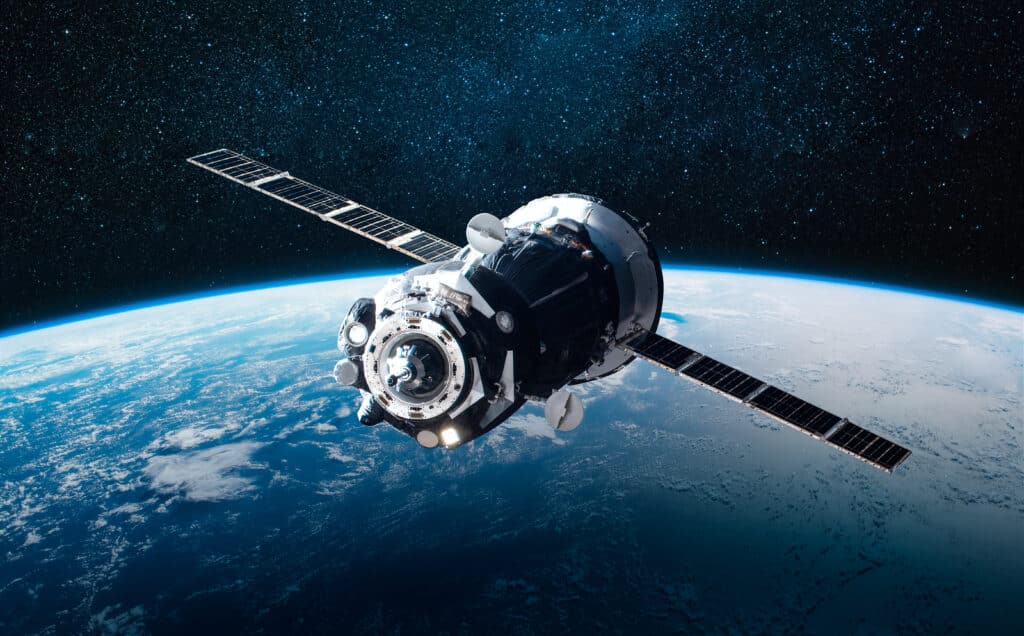
This project is called PEGASES (Plasma Propulsion with Electronegative GASES), the first prototype of which saw the light of day at LPP end 2007. “This concept led us to think about the best possible fuels for PEGASES,” explains Pascal Chabert. “We needed a fuel capable of producing both positive and negative ions and it turns out that iodine (I2) is the best candidate. This molecule can be cleaved to generate the plus (+) and minus (-) ions.”
A pioneer in the study of plasmas
“The PEGASES concept did not attract much attention from the scientific community at the time, but the project was not completely in vain since it allowed us to, among other things, identify iodine as the ideal gas from which to create the propulsion plasma (instead of the usual employed xenon),” adds the professor. “Moreover, a post-doctoral student, Ane Aanesland, who came to work in our laboratory, founded the start-up ThrustMe in 2017, which commercialises iodine propulsion systems to power small satellites.”
Pascal Chabert’s laboratory has become a pioneer in the study of iodine plasmas for propulsion, through the concept of alternative ion acceleration. The team’s reputation has been further strengthened thanks to research carried out as part of an ANR industrial chair held by team member Anne Bourdon with Safran Énergie on the simulation tools and Hall effect plasma thrusters that the company is developing.
Electric propulsion consists of ionising a gas and accelerating it within an electric field, in a machine the size of a teapot.
“The basic idea of electric propulsion is to ionise a gas and then accelerate it within an electric field, in a machine the size of a teapot,” explains Pascal Chabert. “The electrical power varies from 1 to 10 kW to produce thrusts that are very low – of the order of mN, which is less than when I blow out a candle. It’s very low, but for a satellite in a frictionless orbit, it’s enough to correct or change its orbit.”
The main advantage of ionic propulsion over chemical propulsion (which is used to propel rockets and, until recently, was also used on board satellites) is that the speed of fuel ejection is much higher. Fuel consumption is therefore much lower.
Chemical propulsion vs. electric propulsion
The propulsion of any spacecraft relies on obtaining a force by accelerating and ejecting a mass. In the case of chemical rockets, this thrust is achieved by rapidly ejecting large masses of material, allowing them to escape the gravitational pull of the Earth and reach space. However, chemical rockets are very expensive because of the literally astronomical amounts of energy they consume. They are therefore not ideal for long interplanetary missions or for keeping a satellite in orbit.
The ejection speed of the electric propulsion is about 30–50 km/s with an on-board fuel load 10 times lower than that required in the chemical method. The thrust is relatively low, however, and it therefore cannot be used to escape the Earth’s gravitation. The acceleration produced is sufficient for interplanetary missions though.