


Strategic planning consists of determining the set of decisions that will enable us to access the activities considered to be the most significant. In the immediate post-war period, planning was based on business forecasting methods that made it possible to evaluate the future on the basis of simple, reasoned extrapolations of past trends1. Essentially projective, planning began with an inventory of initial resources and means and ended, a posteriori, with the determination of short- and medium-term objectives. In the 50s and 60s, the emergence of foresight led to a renewal of planning approaches, particularly in terms of devising long-term objectives while the future remained undecided and uncertain. Unlike traditional planning, foresight planning focuses on long-term objectives and goals, and then progressively looks at goals, strategies, and resources in relation to an increasingly distant time horizon. Forward planning is based on a range of heterogeneous tools and practices2, the best known of which is the scenario method.
Scenario-based forward planning
Scenario-based forward planning involves projecting into the future changes in issues, rules of the game, strategies and capacities, as well as distortions in the behaviour of stakeholders and in the political, economic and societal context3. This method of planning keeps stakeholders in a state of permanent discomfort, as it constantly requires them to rethink objectives, strategies, organisations and resources in an ever-changing environment where the future remains unpredictable4. The aim is not to predict the future to better anticipate it. Rather, the aim is to imagine a possible future, or to use Herman Kahn’s phrase, to “think the unthinkable”5. For Herman Kahn6, scenarios are an “aid to the imagination” and consist of a list of hypothetical events designed to encourage reflection on their causes and the conditions for their realisation.
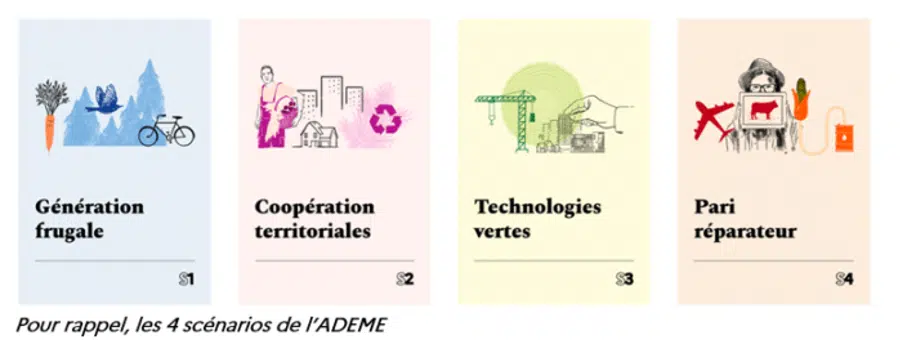
More generally, scenarios can be defined as specific representations of the future that stimulate reflection on the possible consequences of different events and facilitate the design of action plans. However, this image of the future may be more or less probable, plausible, possible or even desirable. For example, the Intergovernmental Panel on Climate Change (IPCC) has defined a scenario as “a plausible and often simplified description of how the future might evolve, based on a coherent and internally consistent set of assumptions about key driving forces and relationships”7. In contrast, ADEME’s scenarios8 of a carbon-neutral France in 20509 are speculative descriptions of several possible futures, which may be more or less desirable depending on the individual (Figure 1).
Different categories of scenario
Because the possibilities for representing the future are so varied, foresight planning can be based on a wide range of different types of scenarios. Depending on the complexity and uncertainty of the subject to be explored, the time horizon chosen and the resources available, the production of scenarios can be based to a greater or lesser extent on factual information, weak signals, major trends or speculative fictions. These choices will have a direct impact on the nature of the futures produced, which may be more or less probable, plausible or possible (Figure 2).
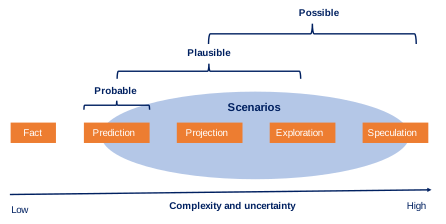
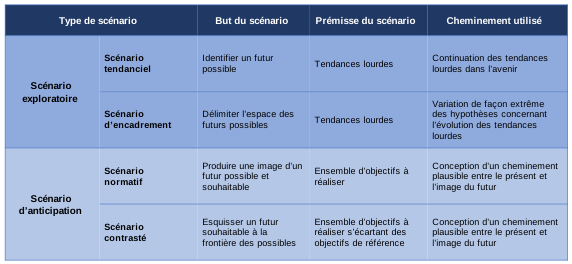
There are generally three main categories of scenarios, which differ according to the planning objectives11:
- predictive scenarios, which use past and present knowledge to estimate probable future situations;
- exploratory scenarios, which use the realities, knowledge, and major trends of the present to estimate the plausible continuation of these trends in the future;
- normative scenarios, which sketch out a particular vision of the future, generally desirable, and then go back in time to identify the paths to follow to reach that future.
This classification is not universal, however, and it is possible to specify and refine certain typologies12. For example, two types of exploratory scenario can be distinguished: trend scenarios, which favour the continuation of major trends, and framing scenarios, which aim to delimit the space of possible futures by radically varying the hypotheses on the evolution of present trends. Finally, the normative scenarios can be situated more or less at the frontier of the space of possibilities.
Scenario design
The academic literature14 generally distinguishes three main classes of scenario methods in foresight: the “Intuitive Logics” method15, initially developed at the Rand Corporation in the 1970s, then perfected by the Hudson Institute, Royal Dutch/Shell, the Stanford Research Institute and the Global Business Network; the “Probalilistic Modified Trends” method16 also developed at the Rand Corporation in the 1970s; and finally, “La Prospective”17 developed by the French foresight school. Although different in terms of objectives and techniques used, these three methods essentially share four main stages in scenario design.
If the present can be considered as the starting point (exploratory scenarios) or the end point (normative scenarios), structuring it always forms the basis of the scenario method. The first step is to describe the current situation, i.e. to construct the basis18 by highlighting the variables which characterise the phenomenon under study in its environment, and by identifying the players involved, their relationships and their motivations. This description can be based on a wide range of tools and techniques. For example, the classic tools of strategic analysis (PESTEL, SWOT, Porter’s 5 forces, etc.), the DELPHI method, or structural analysis, which involves organising a collective discussion to describe a system using a matrix of relationships.
The second stage consists of developing scenarios. Based on the image of the present, the identification of trends, “weak signals”19, “facts about the future” and the strategies of the players, the objective is to design sets of hypotheses in order to construct images of the future, i.e. scenarios. Depending on the variables selected and the set of hypotheses, it is possible to obtain a wide range of scenarios. A selection will then have to be made in order to propose a reasonable number of scenarios, generally a reference scenario and a few scenarios presenting contrasting images of the future. Depending on the objectives, these images may be more or less plausible or possible, exploratory or normative. This stage can also draw on a wide range of tools and techniques, for example, morphological analysis20 (for “foresight”), the 2x2 matrix technique21 (for “Intuitive Logics”), cross-impact analysis22 or trend-impact analysis23 (for “Probabilistic Modified Trends”).
The third step is to check the quality of the scenarios produced. The quality of a scenario is measured by its level of coherence24.This means assessing the sequence of elements linking the present situation to images of the future, and vice versa. This sequence must contain a certain degree of logical and empirical correspondence. In addition, all the elements and hypotheses of a scenario must remain compatible with each other. However, such a quest for justification may tend to privilege the issues of plausibility and perception of complexity to the detriment of the originality and variety of the paths envisaged25.
The final step is to study the consequences of these scenarios for the problem under study. This is a vitally important stage, as it involves determining the development strategies, clarifying the action plan, and defining and justifying the decisions to be taken. For this stage to be effective, however, the scenario method must not be confined to an episodic activity26. On the contrary, it must be integrated into organisational processes and routines such as strategy development, risk management, innovation, and public affairs27.