
- Planet
- Energy
- Health and biotech
- Digital
- Space
- Economics
- Industry
- Science and technology
- Society
- Geopolitics
- Neuroscience
- Videos
- Magazine

 Subscribe to our weekly newsletter
Subscribe to our weekly newsletter
Subscribe to our weekly newsletter
Despite the declining role of the car in major urban centres, mobility in less densely populated areas does not appear to be changing.
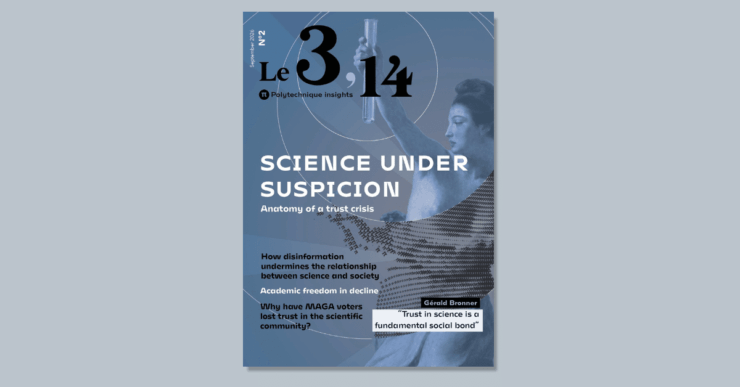
Is trust in science in crisis? Find out in the latest issue of the 3.14 magazine.
The Trump administration’s crackdown on science and universities is further eroding academic freedom. What is the situation in France?
For decades, disinformation has been rife, right up to the highest levels of government.
The United States and China dominate the global technology race, making tech security a major geopolitical issue.
Inspired by the way the brain works, frugal AI could enable image recognition whilst reducing the resources required by current models.
To what extent can, or should, a scientist engage in the public arena?
Putting public assets on digital ledgers offers a new way to modernise sovereign debt management.

A video game is a live laboratory built on players, rules, feedback, and the traces they generate.

The arrival of artificial general intelligence (AGI), an AI that would match human intelligence, is said to be imminent, between 2029 and 2032.
Between 2015 and 2025, as many as 50 countries recorded a substantial, statistically significant decline in their academic freedom index.
China has established itself as a true ‘engineering state’, making construction and infrastructure the driving forces behind its development.
To mark the 140th anniversary of the unveiling of the Statue of Liberty, the Musée des Arts et Métiers is organising an immersive exhibition.
The limitations of LLMs pave the way for “world models,” which are designed to understand the dynamics of the physical world.
The impact of global warming is exacerbating strains on the French power grid.
 More columns here
Daniel Racek, Head of the Department for Data Science in Crisis and Conflict Research at University of the Bundesw...
Marielle Saunois, Lecturer and Researcher at Université Versailles Saint Quentin and Member of Climate and Environment...
Jean-Pierre Diris , Interministerial Coordinator for France on IRIS² and GOVSATCOM
Ahmad Al Bitar, CNRS Research Engineer at Centre d'Études Spatiales de la Biosphère , Veronika Antonenko, Research Engineer at Centre d'Études Spatiales de la Biosphère
Étienne Berthier, Glaciologist at CNRS , Fabien Maussion, Associate Professor at Bristol Glaciology Centre at University of Bristol
Claire Huber, Engineer and Project Manager in Remote Sensing and GIS (Geographic Information System) at SERTIT , Cécile Lasserre, CNRS Research Director at the LGLTPE laboratory
Tai Ming Cheung, Professor at the University of California San Diego and Co-Director of the Institute on Global Confl...
Cornelia Woll, Professor of International Political Economy at the Hertie School
Arnaud Orain, Research Director at École des hautes études en sciences sociales (EHESS)
Christophe Bonnal, Space debris expert at the CNES launchers department
Jürgen Knödlseder, CNRS Research Director in Astronomy and Astrophysics , Loïs Miraux, Engineer and Researcher at Institut d’économie de l’énergie (CEA)
William Parker, Graduate Researcher at Massachusetts Institute of Technology
Xiang Zhang, CNRS Researcher at Laboratoire d'études spatiales et d'instrumentation en astrophysique , Philippe Zarka, CNRS Research Director at Laboratoire d'instrumentation et de recherche en astrophysique

Florian Naudet, Psychiatrist, Professor of Clinical Medicine at Université de Rennes, and Senior Member of the Insti... , Thomas Rhys Evans, Psychologist and Lecturer in Occupational Psychology and Open Research at the University of Greenwic... , Larry Vernon Hedges, Professor of Statistics and Data Science, Education and Social Policy, Psychology, and Medical Socia...
Alice Dreger, PhD in Philosophy and Former Professor at Northwestern University
Cyril Labbé, Professor at Université Grenoble-Alpes
Hélène Masson, Senior Research Fellow at Fondation pour la Recherche Stratégique
Samuel Faure, Lecturer in Political Science at Sciences Po Saint-Germain-en-Laye
Léo Péria-Peigné, Researcher at the Ifri Centre for Security Studies
Louise Souverbie, Researcher at IRIS in the Defense, Strategy, and Armaments Program
Dan Wang, Researcher at the Hoover History Lab at Stanford University
Pauline Rossi, Professor of Economics at Ecole Polytechnique (IP Paris) and Researcher at CREST
Jean-Paul Maréchal, Associate Professor in Economics at Université Paris-Saclay and Deputy Director of IDEST
Mathieu Xémard, Project Leader at Centre Interdisciplinaire d'Études pour la Défense et la Sécurité (IP Paris)
Pierre Sel, Associate Expert with the Asia Program at Institut Montaigne, PhD candidate at the University of Vie...
Alain Karsenty, Economist and Researcher at Centre de coopération internationale en recherche agronomique pour le dé...
Denis Couvet, President of the Foundation for Research on Biodiversity and Professor at Muséum National d'Histoire...
Tania Louis, PhD in biology and Columnist at Polytechnique Insights
Benoit Pisanu, Ecology Researcher at MNHN
Clémentine Mutillod, PhD Student at the Mediterranean Institute of Biodiversity and Ecology at Avignon Université , Simon Chollet, Lecturer at Université de Rennes
Kevin Darras, INRAE Researcher in Forest Ecosystems (EFNO)
Virginie Courtier-Orgogozo, CNRS Research Director and Associate Professor of Biology at Ecole Polytechnique (IP Paris)
Emiliano Grossman, Professor of Political Science at Sciences Po Paris and Director of the Center for Socio-Political D...
Olivier Nay, Professor of Political Science at Paris 1 University – Panthéon Sorbonne and associate professor at ...
Hugo Mercier, CNRS Research Director specialising in Cognitive Science at the Jean Nicod Institute , Ben Seyd, Senior Lecturer in Politics at the University of Kent
Dominique Wolton, Sociologist specialised in Communication Science, CNRS Research Director and Editor-in-Chief of the ...
Matthieu Vandamme, Professor at École Nationale des Ponts et Chaussées (IP Paris)
Valérie Desauziers, Professor at IMT Mines Alès at Institut des Sciences Analytiques et de Physico-chimie pour l’Environ... , Adélaïde Feraille, Professor specialising in life cycle assessments (LCA) at École Nationale des Ponts et Chaussées (IP...
Louis-Gaëtan Giraudet, Research Director at École nationale des ponts et chaussées (IP Paris)
Christophe Gaie, Deputy Director of the Digital Operations Division at the AP-HP , Jean Langlois-Berthelot, Doctor in Applied Mathematics and Former Researcher at Ecole Polytechnique (IP Paris)
Gilles Brassard, Professor of Computer Science at the University of Montreal
Filippo Vicentini, Assistant Professor of AI and Quantum Physics at Ecole Polytechnique (IP Paris)
Lionel Martellini, Founding Director of the EDHEC Quantum Institute and Director of Research at the CFA Institute Resea...
Sophie Hermans, AWS Quantum Postdoctoral Scholar at IQIM (Caltech)
Guillaume Chillet, Cognitive Scientist, Head of Humanities and Social Sciences at the Defense Innovation Agency (AID)
Thierry Warin, Professor of Data Science for Global Transformations at HEC Montreal
Célia Zolynski, Associate Professor of Private Law at Université Paris 1 Panthéon-Sorbonne
Gérald Bronner, Professor of Sociology at Sorbonne université
Martin Collet, Professor at Université Paris Panthéon-Assas
Philippe Huneman, CNRS Research Director at Université Paris 1 Panthéon-Sorbonne , Oana Goga, Research Director at Inria and a member of the Inria CEDAR team and the Laboratoire d’Informatique d...
Joëlle Toledano, Emeritus Professor of Economics at Université Paris Dauphine , Charles Thibout, Associate Doctor at CESSP and Associate Researcher at IRIS
Jérôme Benveniste, Chair of the COSPAR Scientific Committee on Space Studies of the Earth's Surface, Meteorology and Cl... , Audrey Hasson, Doctor of Physical Oceanography and Executive Director of the GEO Blue Planet Initiative , François Galgani, Senior Scientist at Ifremer, Specialist in the Marine Environment and Pollution
Bethanie Carney Almroth, Professor of Environmental Science at University of Gothenburg , Baptiste Monsaingeon, Lecturer at University of Reims Champagne-Ardennes , Florian Pohl, Leader of Emmy Noether Research Group at University of Bayreuth
Tania Louis, PhD in biology and Columnist at Polytechnique Insights
Thierry Pouch, Doctor of Economics and Chief Economist at Chambers of Agriculture France
Jérémy Denieulle, Doctor of Geopolitics and Director of Studies at the Agriculture Stratégies Think Tank
Olivier Antoine, Doctor of Geopolitics and Director of ORAE Geopolitics
Lionel Suchet, Chairman and Chief Executive Officer of CNES
Fiona Wood, Science, Technology and Innovation Policy Strategy Analyst , Mostafa Hassanalian, Associate Professor in the Department of Mechanical Engineering at New Mexico Tech
Daniel Lincot, Emeritus CNRS Research Director at IPVF , Loris Ibarrart, Specialist in onboard energy at CNES
Thomas Le Goff, Senior Lecturer in Digital Law at Télécom Paris (IP Paris)
Christophe Gaie, Deputy Director of the Digital Operations Division at the AP-HP , Jean Langlois-Berthelot, Doctor in Applied Mathematics and Former Researcher at Ecole Polytechnique (IP Paris)
Jean-Luc Gibernon, cybersecurity director at Sopra Steria and administrator of the Cyber Campus , Guillaume Poupard, former director of Anssi, the French national agency for information systems security
Badis Hammi, Associate Professor at Télécom SudParis (IP Paris) , Roni Carta , Ethical Hacker and Founder of Lupin & Holmes
Christophe Gaie, Deputy Director of the Digital Operations Division at the AP-HP , Jean Langlois-Berthelot, Doctor in Applied Mathematics and Former Researcher at Ecole Polytechnique (IP Paris)
Farah Doumit, Research Associate at the Center for Management Research (I³-CRG) at Ecole Polytechnique (IP Paris) , Benjamin Lehiany, Research Associate at Centre de Recherche en Gestion (I³-CRG) and Lecturer at Ecole Polytechnique (I...
Daniel Bajolet, Member of SAGSI (China) and Co-founder of ROSI
Amandine Volard, Wind and Marine Energy Engineer at ADEME
Anne de Bortoli, Associate Professor at Université du Québec and Associate Researcher at Ecole des Ponts ParisTech (I...
Thomas Grandin, In charge of the tyre and ELV sector at ADEME , Jean-Philippe Faure, Head of Research & Development and Director of Research and Innovation at Aliapur , Ludovic Moulin, PhD in Process and Environmental Engineering, R&D Manager at Alpha Carbone, and guest researcher...


